
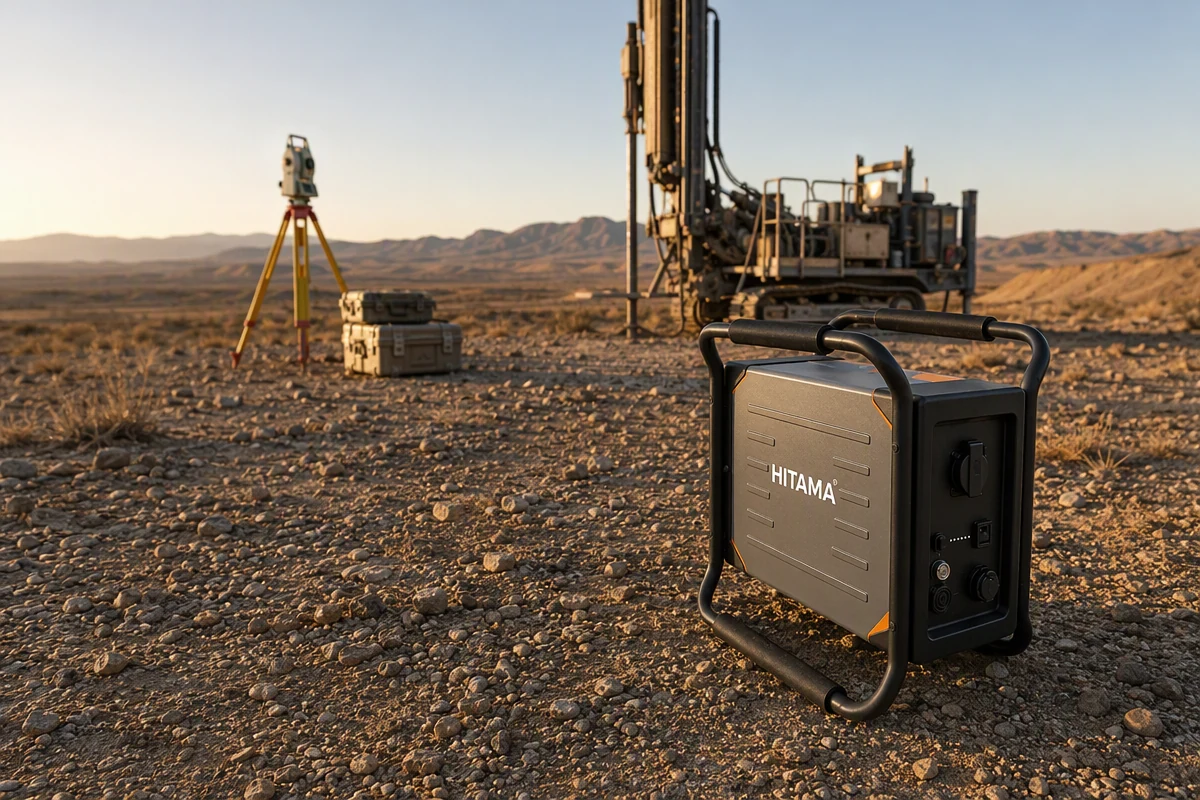
A UAV survey is limited by how many packs can be refilled between sorties, not by how long the aircraft can stay up. One 2.7 kWh unit holds enough to refill about four 500 Wh packs, which is roughly half a flying day for a mapping crew working from a vehicle. It stops being the right answer the moment the programme needs a full day of flying.
The day is a queue, not a duration
A sortie is 25 to 35 minutes of flight and a five-minute pack swap. The rest of the day the aircraft sits on the tailgate while the charger works, and that is where the energy goes.
A charger that pulls 1,000 W for an hour moves one kilowatt-hour. Four packs is a four-kilowatt-hour question in a unit that holds 2.7, and no amount of planning changes that division.
1. What caps the day, the aircraft or the charger?
The charger, on any site without a socket. The aircraft draws in bursts and rests between them; the charger draws continuously while a pack is on it. Covering charge hours takes a different supply from covering flight minutes.
What 2.7 kWh refills, in packs
Convert capacity into packs before comparing anything. Capacity times charging efficiency, divided by the pack: 2,700 Wh at 85 percent is 2,295 Wh, which at 500 Wh per pack is four and a half full packs.
Full packs are the wrong assumption in the field. Crews land with a fifth to a quarter left, so a refill is three-quarters of one, and the same 2.7 kWh buys five or six top-ups — a slightly longer day with less energy in each sortie.
2. How many sorties is that?
About half a mapping day on a normal cadence. Five or six packs at 25 to 35 minutes is two and a half to three and a half hours of flying plus turnaround. Then the unit is empty and the flying stops.
The charger sets the count, not the pack rack
More packs do not buy more flying. Ten packs on the tailgate and one 2.7 kWh unit still deliver around 2.3 kWh into packs; the crew spends the afternoon waiting instead of swapping.
3. Does the charge rate matter more than the pack count?
It matters for the packs, not for the day. A pack charged flat out runs warmer and ages faster, and that shows on the packs before it shows on the supply. The unit's job is steady output for hours without an engine inside the survey grid, which is why the HITAMA P25 is built around 2,500 W continuous from 2.7 kWh rather than a short peak.
Where the launch point has a vehicle socket, the arithmetic changes. A 230 V socket on site makes the battery optional, and pretending otherwise is how a crew carries 29 kg it did not need.
Where the unit does not belong
It is not a base supply. A receiver and a laptop at 100 W drain 2.7 kWh in 27 hours, so a week-long installation is mains or generator work.
It does not fix cold packs. Below freezing many packs refuse charge until warmed, and running a warming box costs energy the unit does not have to spare.
IP54 is spray, not weather. A launch point in driving rain needs a shelter over the charger whatever the unit is rated for.
The aircraft is still loud. A battery removes the generator at the launch point — engine note, exhaust, fuel can — not the aircraft, and anyone selling a quiet survey should say so.
What to put in the survey plan
Five numbers decide the configuration. Packs per flying day, the pack's watt-hours, the charger's input rating, planned flying hours, and whether the launch point has a socket.
| Figure | Value |
|---|---|
| Continuous output | 2,500 W |
| Capacity | 2.7 kWh |
| Recharge from a 230 V socket | 500–1,500 W |
| Unit weight | 29 kg |
| Ingress protection | IP54 |
The arithmetic is the whole of it. Capacity, losses and pack size give the number of sorties, and the programme either fits that number or needs another arrangement. The geological survey and exploration overview carries the wider load picture, including survey camp load lists and who handles the unit at each station; the P25 portable power station page carries the figures above.
How many drone packs will one 2.7 kWh unit refill?
About four full 500 Wh packs, or five to six practical top-ups once you allow for the reserve a crew lands with. The sum is 2,700 Wh times 85 percent, divided by 500 Wh, which is 4.5 packs.
Can one unit cover a full UAV survey day?
Only when the day is short. Five or six sorties is two and a half to three and a half hours of flying, so an eight-hour programme needs a second unit or a socket at the launch point. Plan from packs per flying hour.
Is a battery faster than a generator for charging packs?
No, and speed is the wrong comparison; a generator sized for the charger does the same job with more noise. What a 2,500 W unit changes is the launch point: no exhaust where the crew works, no fuel to carry in, nothing to refuel between sorties.
Send us the pack size, the charger's input rating and the planned flying hours, and we will work out whether one unit covers the day.