
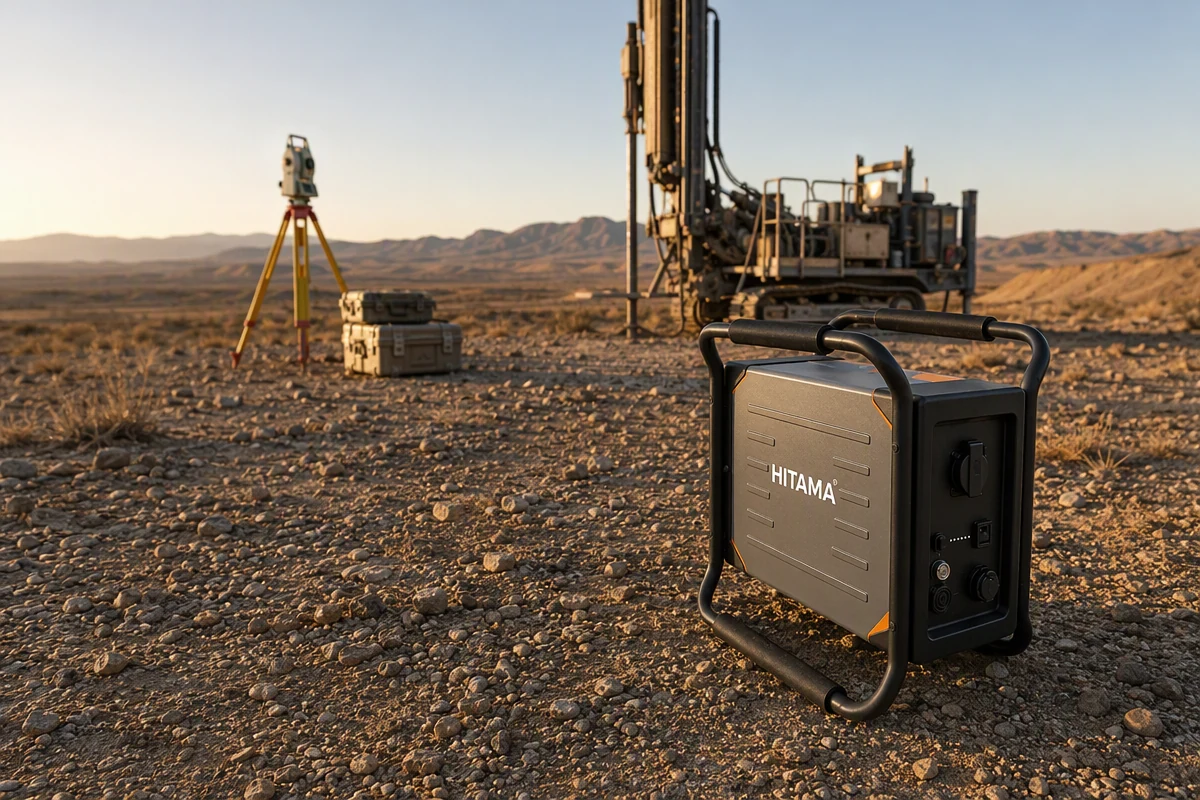
Power on a survey crew is a staffing question before it is an electrical one. A 29 kg unit is a one-person lift on flat ground and a two-person lift on a slope, and the recharge draws 500–1,500 W from an ordinary socket plus someone to plan the window. Where the crew has a driver and a fixed camp, the unit looks after itself; where every hand is on an instrument, it does not.
The task nobody wrote down
A survey crew's job list has no line for power. The geologist logs the core, the operator observes, the driller runs the rig, the driver drives. The unit that feeds all four belongs to everybody, so in practice it belongs to whoever notices it first.
That is where the cost hides. On a fixed camp the unit stands where it was set down and is charged when the vehicle is back at a socket. On a moving program a new station arrives every few hours.
No load list counts it. Load lists count watts, not the twenty minutes at each end of a shift spent finding the unit and getting a cable to the work. Both numbers are real; one is written down.
The sizing arithmetic is covered elsewhere. Drill surge, instrument continuity, laptop and charging belong to the geological survey power overview, the survey camp load lists and silent field camps. This piece covers what a load list leaves out: who does the handling.
Three jobs the unit quietly adds
Carrying. 29 kg is not heavy in the abstract. It is heavy at the end of a walk, on broken ground, when the same person is also carrying a tripod.
1. Who carries it the last 300 metres?
Usually the instrument operator. The vehicle stops where the track stops being a track, and the last stretch has no road, no trolley and no second pair of hands. A wet clay slope with a 29 kg box is where one person becomes two.
2. Who plans the recharge window?
Charging is an appointment, not a side effect. The unit draws 500–1,500 W from a normal 230 V socket, so it refills over a block of hours, and that block has to be found in a day shaped by daylight and the drilling schedule.
On a remote program the socket is usually a generator. A battery charged from a genset has not removed the fuel chain; it has moved the burn to one place and one time. What it removes is noise and exhaust at the work face.
Watching is the one job that disappears. No engine means no fuel run, no refuelling in the dark, no maintenance routine.
| Figure | Value |
|---|---|
| Continuous output | 2,500 W |
| Capacity | 2.7 kWh |
| Unit weight | 29 kg |
| Recharge from a 230 V socket | 500–1,500 W |
| Ingress protection | IP54 |
What 2.7 kWh buys at a survey station
Convert to hours before comparing anything. Capacity divided by the load gives hours at that load, and the divisor has to be measured on site.
How many hours does one unit cover?
The instruments are a light continuous load, the drill a short heavy one. HITAMA builds the P25 portable power station around that split: 2,500 W continuous and 2.7 kWh, in a unit one person can lift on flat ground. Whether a drill fits depends on its starting surge, from the drill's own plate.
The peak decides the unit, the average decides the day. Buying for the largest single start and judging the unit against a mostly small load is the common mistake.
Where the arithmetic stops
Capacity is finite. 2.7 kWh does not cover a camp running a rig, a compressor and a cabin from one box.
29 kg is a lift, not a drag. A route that needs a sledge is outside what the rating describes.
IP54 covers dust and spray. Not immersion, not a pressure wash, nothing about a hazardous atmosphere.
Recharge is a task with a duration. 500–1,500 W means hours, and those hours need a socket that is actually live – on a moving camp a planning problem, not a hardware one.
Questions before the unit goes into the load plan
How heavy is it to move between two stations?
29 kg, one person on flat ground and two on broken ground. The weight does not change with the terrain; the number of people needed to move it safely does.
How long does a recharge take?
It depends on the socket, because the input draws 500–1,500 W. A 2.7 kWh unit refills over a block of hours, so the window is scheduled like any other task.
Can one unit run the drill and the instruments together?
Only if the drill's starting surge fits inside the 2,500 W continuous rating with the instruments running. That surge figure comes from the drill's plate.
What does the crew still do by hand?
Carry it, connect it and plan the recharge. Removing the engine removes the fuel run and the maintenance routine, but the handling stays, and it lands on the same people every day.
Send us your station list, the instrument loads and where the vehicle can stop, and we will work out the configuration that keeps the operator at the instrument.