

Emissions & environment
A battery system has no combustion chamber. What that is worth depends on what it replaces and how it is charged — so this page shows the arithmetic rather than one headline number.
Three things that hold without a calculation
Nothing burns where you work
No combustion at the point of use, so no nitrogen oxides, no carbon monoxide, no particulate matter and no exhaust gas at the workplace. On an indoor or semi-enclosed site that is a health matter, not a comfort one.
No fuel comes to site
No jerry cans, no deliveries, no storage — and none of the handling and spill risk that comes with them. The energy arrives in the battery as electricity.
Charging is not emissions-free
A battery stores what it is given. Its emissions are the emissions of the electricity that charged it, which is why the charging source is an input below rather than a footnote.
Why replace the diesel generator
Zero emissions at the point of use, near-silent
Fan-less self-cooling: nothing burns where you work — no exhaust, no fumes, no engine noise. Usable indoors and on semi-enclosed sites, where this is a health matter, not a comfort one.
Safer sites
No fuel to transport, store or spill, no hot exhaust line. The energy arrives in the battery as electricity; the enclosure is dust-protected and splash-proof to IP54.
As much power as the job needs
One unit at 2.5 kW, two in parallel at 5 kW, three three-phase at 7.5 kW — the same platform scales with the load instead of swapping equipment.
Lower running costs
No fuel, no engine service, no oil filters. Energy comes from the grid or on-site solar — the cost per kWh is one you can check yourself.
Certifications & compliance
- CE (LVD, EMC, RoHS)
- IP54 protection
- UN38.3 transport
- EU new Battery Regulation compliant
- Custom certification on request
One unit, worked through
A P25 replacing a diesel generator for a 500-hour year at an average 1.5 kW.
485 kg CO₂
750 kWh × (1.000 − 0.353) kg/kWh
- 500 hours at an average 1.5 kW = 750 kWh delivered over the year.
- Diesel generator taken at 1.0 kg CO₂/kWh — the published default for gensets under 35 kW at half load, whose published range is 0.8–1.3.
- Charged from the German 2024 consumption mix at 0.353 kg CO₂/kWh (Umweltbundesamt).
- The diesel generator would have emitted 750 kg; charging emits 265 kg; the difference is about 485 kg CO₂ over the year.
Change any input
The same arithmetic — edit it to match your site.
CO₂ avoided per unit per year
485 kg CO₂
750 kWh × (1.000 − 0.353) kg/kWh
for each kWh delivered: 0.647 kg CO₂ avoided
Every figure below is an estimate from the assumptions printed beside it. This is not a certified life-cycle assessment: making the cells, the housing and the electronics is outside these numbers, and so is end-of-life recovery.
What this page does not claim
- It is not a life-cycle assessment. The cells, the aluminium, the electronics and end-of-life recovery are not counted here.
- The result depends on what is being replaced. Where mains power was already available there is no diesel to avoid — the saving is fuel handling and local emissions, not this arithmetic.
- It depends on the charging source. Charged from a coal-heavy grid the advantage narrows sharply; charged from on-site solar it is widest.
- And it is an estimate, not a measurement. If you need a figure you can publish or report, commission a study with a defined boundary.
Sources
- Diesel generator factor: SEforALL, Mini-Grid Emissions Tool methodology note, 2021, Annex 3 (0.8–1.3 kg CO₂/kWh for gensets under 35 kW at 50 % load; default 1.0).
- Charging factor: Umweltbundesamt, CO₂ emissions per kilowatt-hour of electricity, German consumption mix 2024 (353 g CO₂/kWh).
By the numbers
0
combustion emissions at the point of use — a battery has no combustion chamber
2.7kWh
P25 standalone capacity (2.5 kW rated / 5 kW peak)
8.1kWh
three-unit P25-T parallel system (7.5 kW, 400 V three-phase)
65°C
maximum operating temperature (minimum −10 °C)
Notes from the field
Application notes by industry: which loads, which wiring, what to watch for.
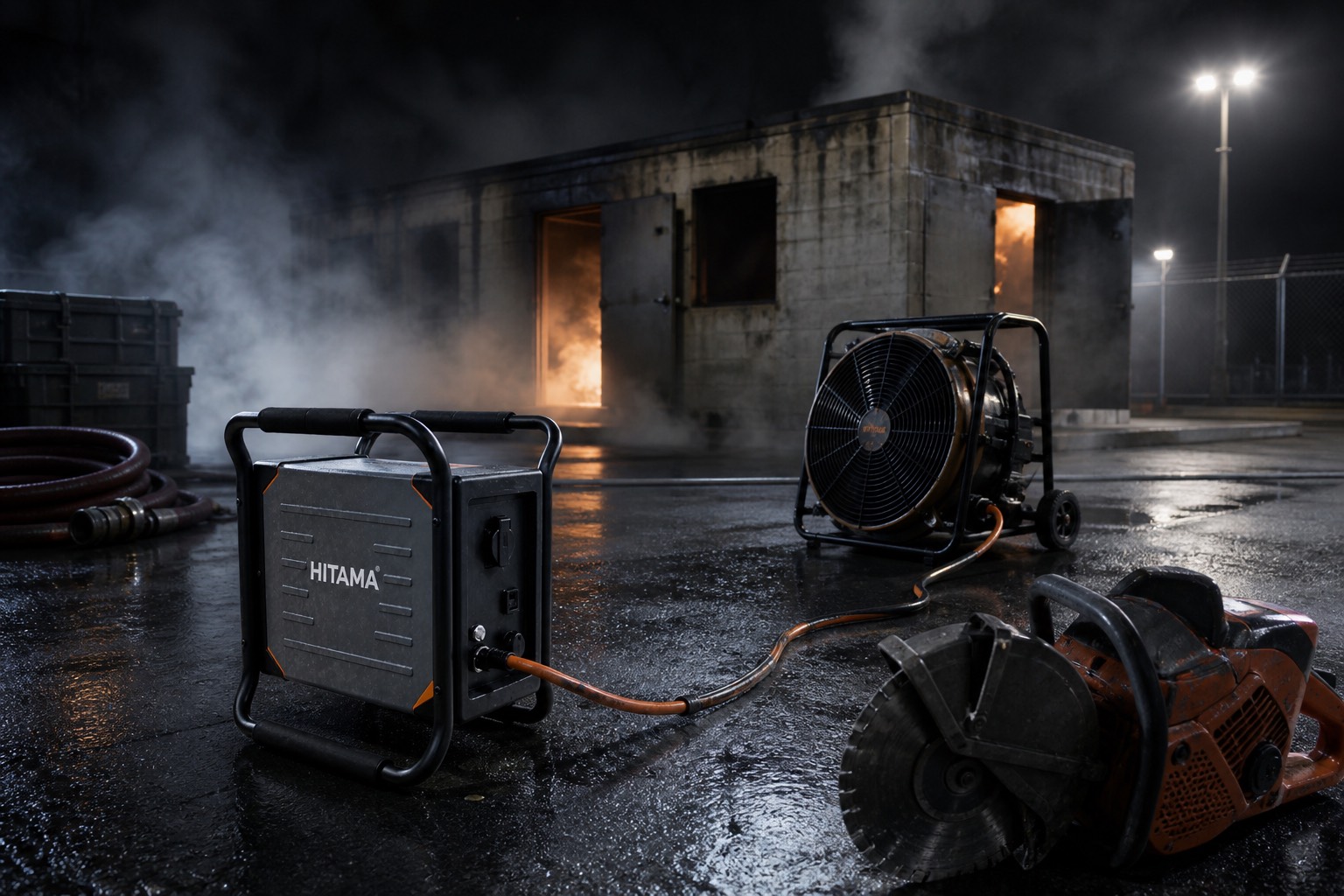
- Fire & technical rescue
Power at the incident: what changes when the generator stays on the truck
Three things a combustion generator does at an incident have nothing to do with wattage: it buries radio traffic, it puts exhaust where crews work, and it stops when the fuel runs out.
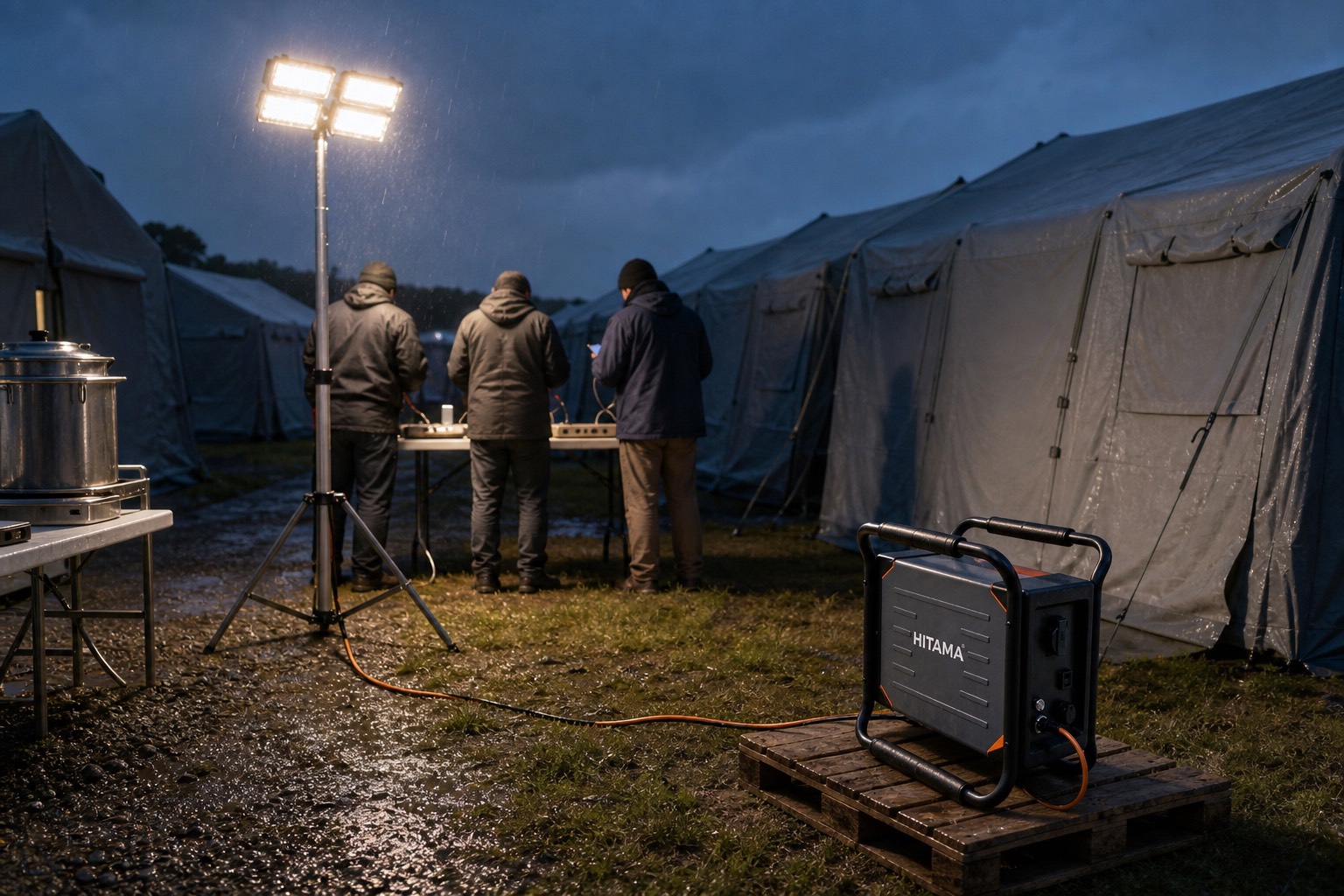
- Disaster relief & civil protection
When the grid is the casualty: power for a relief camp
In a relief operation the grid is often the thing that failed. What remains is a list of jobs that all need electricity — and several hundred people who need to charge a phone.
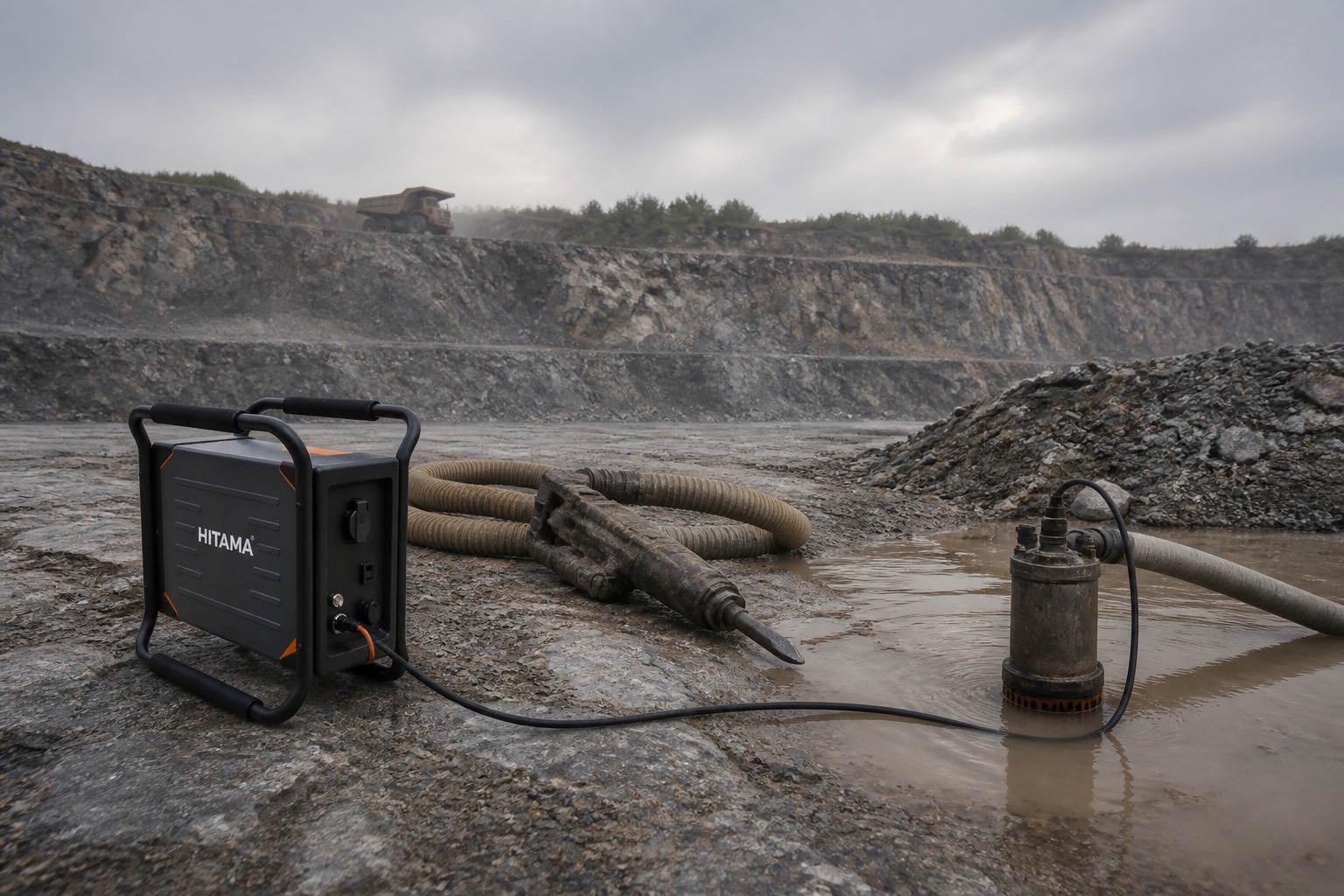
- Mining & quarrying
Dewatering and drilling at the face, without a generator on the bench
Dust, vibration, a slope nobody wants to carry a can up, and a rule against refuelling where the dust is explosive. The work moves with the face — the power has to move with it.
The product line is the solution
Three supply scales, one platform:
P25 · standalone
2.5 kW rated / 5 kW peak — the workhorse replacement for small gensets.
P25-D · 2 units parallel
5 kW / 5.4 kWh, 230 V single-phase, for crews with mid-size tool loads.
P25-T · 3 units three-phase
7.5 kW / 8.1 kWh, 400 V three-phase output for large cut-off and welding plant.
What happens when the battery is spent
Lithium batteries are regulated recyclable material — the EU Battery Regulation and the Waste Electricals Directive both set dedicated requirements. NMC cells and the aluminium housing both run in established recycling processes. We help you route retired units through your country’s channels — contact us for the arrangement.
Frequently asked questions
Are batteries really cleaner than diesel generators?
At the point of use — yes: nothing burns, so there are zero on-site emissions, no exhaust and near-silence. But the manufacturing emissions of the cells and housing are not part of “zero on-site”. The calculator on this page is checkable displacement arithmetic with its inputs, sources and limits printed beside it; it is not a life-cycle assessment. If you need a publishable LCA figure, we can discuss commissioning one.
Do spent batteries end up in landfill?
No — and they should not. Lithium batteries are regulated recyclables in the EU (Battery Regulation, Waste Electricals Directive) with dedicated collection channels. Contact us about retired units and we will help arrange return through your country’s channels.
Can the battery be recycled?
Yes. The P25 uses NMC cells and an aluminium housing, both established in recycling; circuit boards and other electronics go through specialist channels. Arrangements differ by country — contact us to confirm the channel in yours.
Will it work in cold or heat?
The P25 operates from −10 to 65 °C at IP54 (dust-protected, splash-proof — not submersible). Dusty, hot sites are its design case; if your duty cycle goes beyond that, tell us when specifying.
Which certifications does it carry?
CE (LVD, EMC, RoHS), UN38.3 transport certification, in line with the EU Battery Regulation; further certifications on request.
How many units can run in parallel, and what do they output?
Two in parallel (P25-D, 5 kW / 5.4 kWh, 230 V single-phase) and three three-phase (P25-T, 7.5 kW / 8.1 kWh, 400 V), both through the parallel distribution panel — wiring diagrams on the P-series page.
Industrial-gradeportable power,without the diesel.
Build scalable, industrial-grade power at roughly half the cost.