
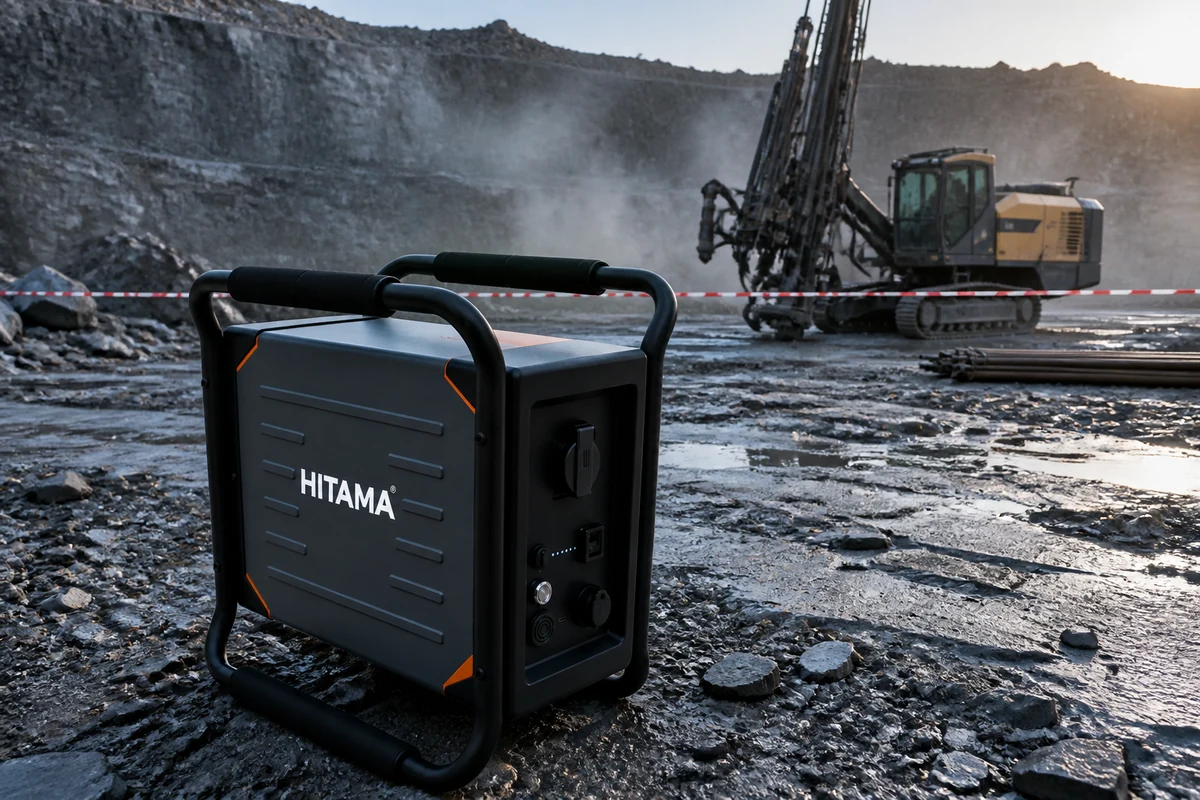
On a blasting day the bench is not sized in watts. It is sized in minutes — the minutes between the shot and the all-clear, in which everything that draws power has to be off the bench and then back on it.
Shot time is set by the shotfirer and the permit. Everyone else plans backwards from it: guards posted, machinery to the parking area, hoses drained, leads rolled. The clearance list is written before the load list, and it is a list of objects, not of kilowatts.
A lead is a decision to leave something inside the radius
A cabled supply is a decision to leave something inside the radius. Thirty metres of lead is rolled by hand on the way out, and rolled again after the inspection clears the face. Most sites have already written the rule: no lead crosses the clearance line, no exceptions.
The tools that cannot be disconnected quickly are the tools that lose the shift. When the schedule is counted in blasts, a supply that takes two trips costs one blast a week.
What a towed unit adds to the list
A generator can be moved; moving it is a second job with its own checklist. Hitch, tow, park, and after the all-clear re-site it, refuel it, start it. A hot exhaust and a fuel container are two more items on the clearance list, and every item on that list is paid for twice: once going out, once coming back.
Twenty-nine kilograms is a clearance plan you can carry out
The P25 weighs 29 kg, the P36 21–23 kg, the C24 23 kg. Two people carry it off the bench, and two people carry it back. No hitch, no fuel, no cooldown before it is lifted, and it restarts where it stopped rather than where it was parked.
The dust over a bench after a shot is the second reason. The housing is fully sealed: no intake, no fan, no moving parts, heat leaves through the shell. There is no air path to load with fines and no filter to change. IP54 covers rain and wash-down; the working window is −10 to 65 °C — a February morning and a July afternoon on the same bench.
A 400 V bench plans a route, not a lift
Three modules in parallel give 400 V three-phase, and the P25-T at roughly 90 kg is not a two-person carry. 7,500 W rated, 15,000 W peak, 8.1 kWh. That unit belongs on a parking position outside the radius, on a route walked before the first shot, not improvised at the barrier tape.
The 230 V bench is the simpler case: one to three P25 modules, 2,500 W rated and 5,000 W peak each, 2.7 kWh per module, 5.4 kWh as a pair. Anything with a motor — a dewatering pump, a drill feed — is sized on the peak column.
Re-entry is not the same as resumption
The all-clear starts a queue, and the queue is shorter if the power is already on the bench. Pumps go back first, then the drills, then the lighting for the face; the dewatering that ran all night has to be running before the water has time to matter.
A re-entry window is measured against an inspection and a refuel, and both take longer than lifting two handles. That is the case: less time between the barrier coming down and the first tool running.
What this is not
It is not part of the blasting circuit. The shot fires on the shotfirer's own licensed equipment.
It is not explosion-protected. CE under the EMC Directive 2014/30/EU, UN 3480 class 9 sea-packaging certification and IP54 are not zone certification, and none decides where a unit may stand; the area classification drawing and the permit do.
It is not a UPS. Clean sine at THD below 3 %, and no transfer time to offer.
It is not a substitute for the clearance procedure, the guards or the barrier. It removes one item from the list.
Send us the bench: what runs, for how long, at 230 V or 400 V, the walk from the parking area to the face, and the re-entry window you actually get. We will come back with the configuration and the position it should stand in.