
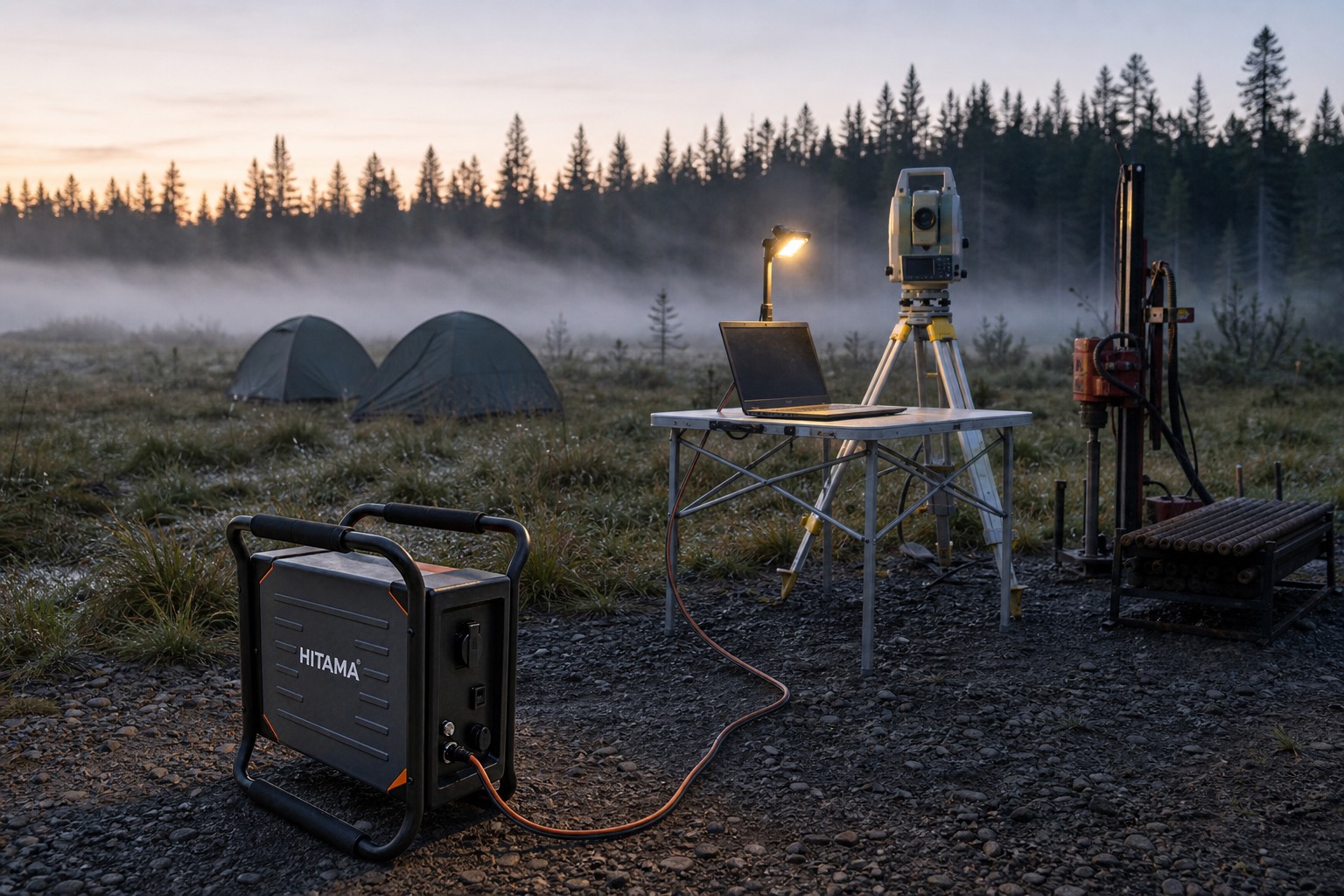
A survey camp is a load list in the middle of nowhere. Nobody is going to run a cable to it, and a combustion generator means carrying fuel to a place you walked into.
The loads, and why they are awkward
The core drill. Short, heavy bursts. Starting surge, not continuous draw, is what decides the configuration.
The instrument. A total station or a GNSS receiver runs for hours and cannot lose power mid-observation. It is the load where an interruption costs the day, not just the watts.
The laptop. Processing happens where the samples are, not back at the office.
Battery charging. Handhelds, radios, sample scanners: small each, constant in total.
What to power it with
One P25 is 2,500 W and 2.7 kWh, carried by one person at 29 kg. For a lighter camp the C24 starts at 2,048 Wh and grows in 2,048 Wh steps to 10,240 Wh — expansion at battery level, by stacking, not by adding units. Where the drill is three-phase, the P25-T system gives 7,500 W at 400 V.
The arithmetic that matters
Divide capacity by the load and you get hours, not days. A camp running an instrument and a laptop overnight is a different configuration from one that also runs a drill all morning. Size those two separately before buying one thing to do both.
Send us your instrument and drill list and we will write the run-hour estimate.