
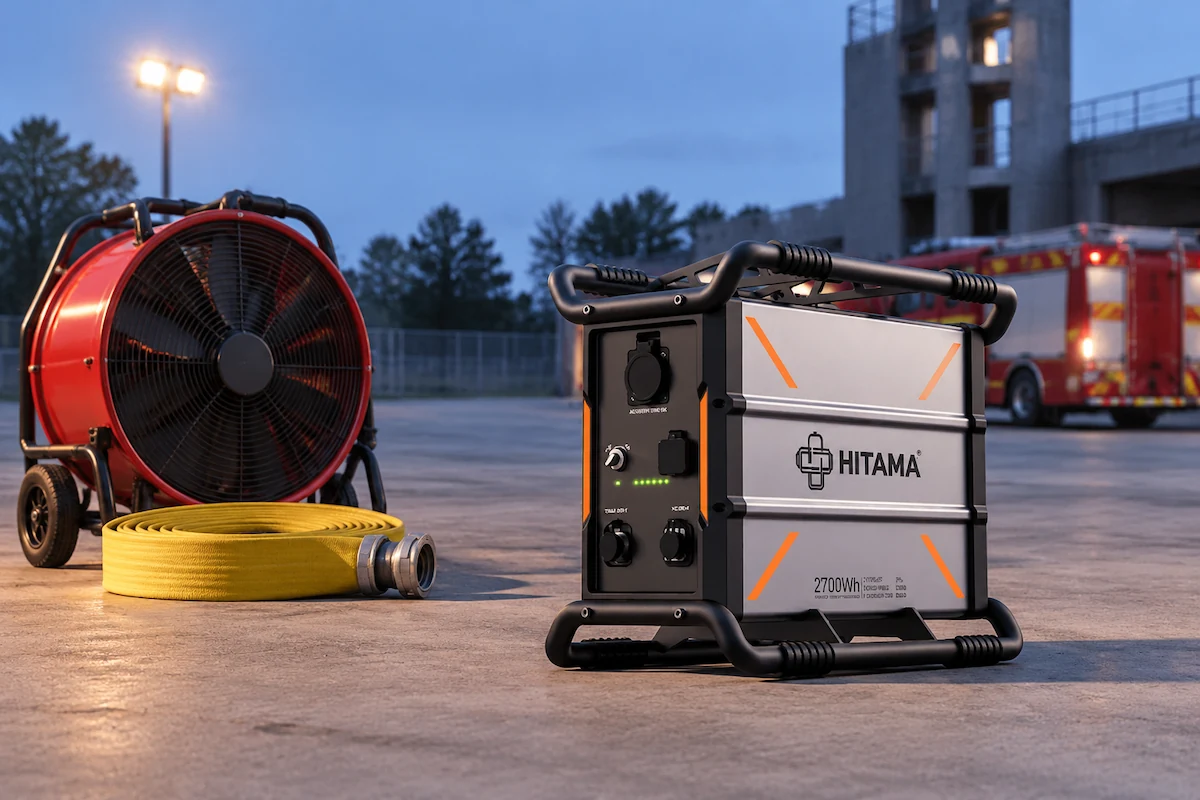
At a multi-agency scene the power question is an allocation question, not a capacity question. One HITAMA P25 stores 2.7 kWh and delivers 2,500 W continuously: enough for a command post through a long night, not enough for two parties running equipment at once. The arithmetic only fails when nobody decides, before arrival, which loads may stop.
The load arrives before the plan does
Four parties, one 230 V output. Fire, ambulance, police and the utility crew arrive within minutes of each other, each with a legitimate claim: a radio charging bank, a case of medical batteries, a printer for the scene log, a laptop, a work light. Nobody asks for too much, and the unit cannot serve them all.
Arrival order is the worst possible rule. The first vehicle keeps the socket for the rest of the incident, not because its load matters most but because it got there first. A 2.7 kWh store then feeds a phone charger while the lighting runs off an alternator.
The list is written before arrival. The incident commander sets three roles and three windows while the unit is still in the vehicle, not after the first extension lead is across the pavement.
1. What does the command post claim?
A command post never stops: radios on charge, a screen, a printer, a kettle at three in the morning. At 300 W over eight hours, 2.4 kWh is gone before a lamp burns at the scene, which is why everything else needs a window rather than a socket.
Allocation is a schedule
Uninterruptible first, then windows. The radio bank and medical charging hold a permanent claim. Lighting for a work phase and a cordless tool bank get defined windows. Phones, laptops and the printer wait.
Windows are cheap; simultaneity is not. A 500 W lighting set for three hours is 1.5 kWh. Run a 1,000 W tool-charging bank alongside it and the same hours cost 4.5 kWh, more than the unit holds. Staging loads costs a decision, not equipment.
1. Which loads can be interrupted?
Lighting can be, if it is task light rather than scene light; charging always can. A ventilation fan usually cannot, which is why the fan and the radio bank are modelled at full run time. The fan is also the load that decides the energy budget, because it runs while tools work in bursts.
2. What happens when a fourth party arrives?
The list gets shorter. A fourth claim means one window moves, or the configuration changes: a second unit in parallel, the P25-D arrangement at 230 V with 5,000 W and 5.4 kWh, or three-phase with the distribution box at 7,500 W and 8.1 kWh. Neither answer is free.
The numbers behind one night
| Item | Figure |
|---|---|
| Continuous output | 2,500 W |
| Stored energy | 2.7 kWh |
| Weight, carried by one person | 29 kg |
| Protection | IP54, spray and dust, not immersion |
| Recharge from a 230 V socket | 500-1,500 W |
The table is the argument. 2.7 kWh is about eight hours at 300 W, three hours at 900 W, or ninety minutes at 1,800 W. The third line usually ends the discussion.
Where the allocation breaks
It is a scene supply, not a building supply. The unit powers work in the open and in spaces made safe, not fixed lighting, smoke venting, an alarm panel or a sprinkler pump. What those look like once the main switch is out is a separate problem.
IP54 is a spray rating. Standing water, a flooded basement and a hose played straight at the unit sit outside it. Placement belongs in the allocation plan, and so does the cable route.
And the store is finite. An empty unit goes back to a 230 V socket and takes hours, not minutes. Ignoring that moves the problem to the next call.
Questions from shared scenes
How long does 2.7 kWh last?
About eight hours at a 300 W command post, or three hours if lighting and charging together pull 900 W. Total draw decides, not the number of devices: ten small chargers and one ventilation fan are not the same kind of load.
Can we add a second unit?
Yes, and it is the usual answer when two parties need power at once. Two P25 in parallel at 230 V give 5,000 W and 5.4 kWh, a different class of scene supply, with a different transport and charging task behind it.
Does the fan have to run on the unit?
It has to run on something that lasts the whole ventilation phase. A fan holds a permanent claim on the 2.7 kWh because it runs continuously while cutting and lifting tools work in bursts, so the window loads fit around it.
What if the scene runs until dawn?
Then the recharge matters as much as the capacity. Recovery is 500-1,500 W from an ordinary socket, so a night-long scene ends with a unit out of service for hours. Readiness is a charging schedule, not a battery rating.
Send us the roles at your next shared scene and the loads each brings, and we will build the allocation and the configuration with you. More on scene work in fire and technical rescue.