
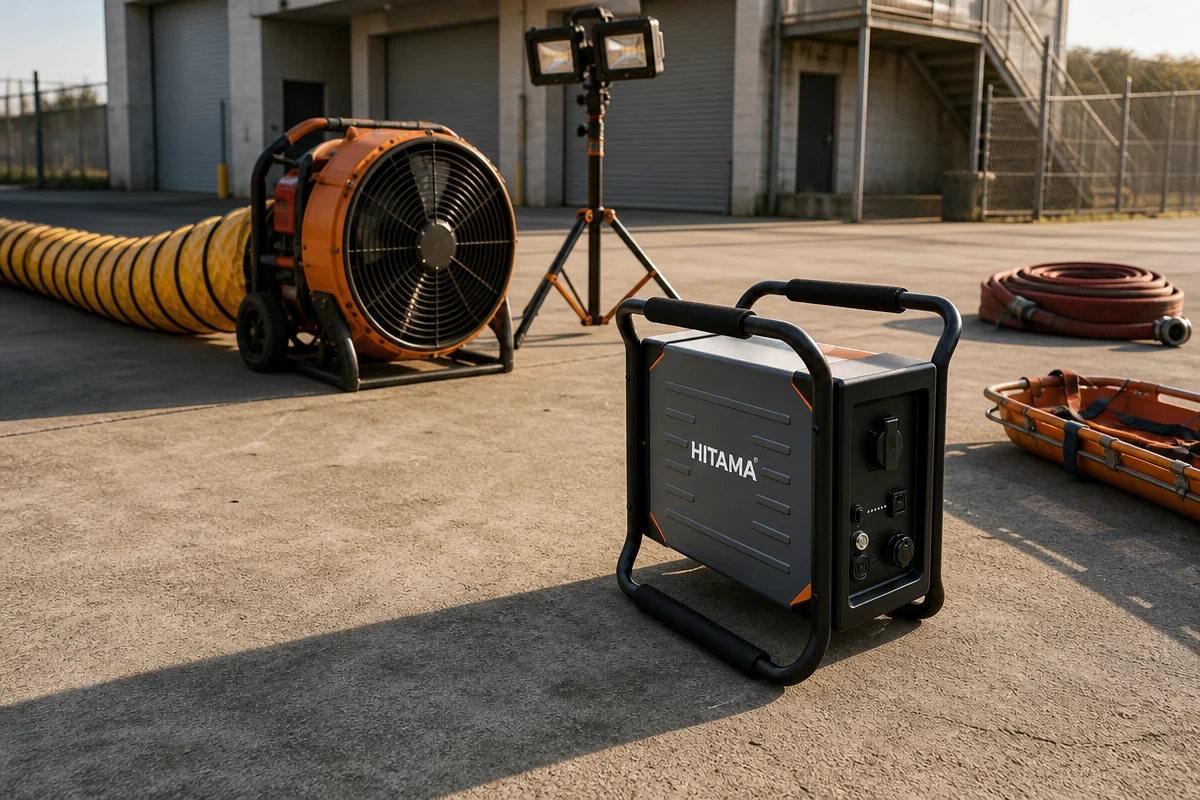
At a fire station the constraint on a battery unit is not what it gives at the incident, it is how fast it comes back. A 2.7 kWh unit recharges from an ordinary 230 V socket at 500 to 1,500 W, which is hours, not minutes, while the next call can arrive inside the same shift. A diesel refuels at the pump. A battery has to be planned as a rotation.
The incident is the short part of the cycle
The unit comes back partly empty and nobody writes it down. Whatever it carried — a ventilation fan, two floodlights, a charger for cordless tool packs — came out of the same 2.7 kWh. A diesel returns with a gauge and a refuelling routine. A battery returns with a display, and the number on it depends on someone remembering to look.
Recovery takes longer than the deployment. The energy goes back in through a normal 230 V socket at 500 to 1,500 W: under two hours at the top rate on paper, closer to five and a half at the bottom. Neither figure changes because the station is busy. The same arithmetic runs through our other fire and rescue notes.
How long does a recharge actually take?
Under two hours at 1,500 W, about five and a half at 500 W. 2.7 kWh divided by 1,500 W is 1.8 hours; divided by 500 W it is 5.4. Both assume the socket holds its rate for the whole window, which is why the slower number is the one to plan with.
A diesel refuels in minutes, a battery recharges in hours
That is a new constraint, not a defect. A fuel can is a five-minute task at any hour, and anyone on the watch can do it. A recharge needs a socket, an uncoiled lead and a slot in the day when the appliance is back and not needed on the road. A station with two calls in a shift fails that third condition regularly.
So readiness stops being a capacity figure. It becomes a schedule: energy spent per deployment, and how long the unit sits before it is asked again. The second of those is on no datasheet.
Does that make a battery unit the wrong choice?
Only where the appliance must carry the same load continuously across a whole shift. For lighting during overhaul, a fan, instrument and tool charging, the trade still works, because the alternative is an engine running where people are working. The same 2,500 W is what makes power at the incident workable; the difference here is what happens afterwards. The honest answer to a busy day is a second unit or a fixed charging window, not a bigger claim about capacity.
Count charges, not kilowatt hours
Two numbers decide the configuration. What one deployment draws, and how many hours the appliance is back before the next one. Multiply the draw by the number of deployments and compare it with 2.7 kWh; that comparison, not the rated output, says whether one unit is enough. The lighting after the main switch case has the same shape: short load list, long night.
A retained station and a wholetime station land in different places. One deployment a week recharges overnight at 500 W and never becomes a problem. Two deployments in a shift cannot: two draws of 1.3 kWh take a full unit below half, and the second call starts on a partial battery — with floodlights on it, a shorter night than the first.
| Figure | Value |
|---|---|
| Continuous output | 2,500 W |
| Stored energy in one unit | 2.7 kWh |
| Recharge input from a 230 V socket | 500–1,500 W |
| Recharge time, on paper | 1.8 h at 1,500 W / 5.4 h at 500 W |
| Weight, one-person deployable | 29 kg |
A second unit is also a charging answer. Two in parallel, P25-D, give 5,000 W and 5.4 kWh at 230 V, and one can recover while the other travels.
The charging point is a piece of equipment
A normal 230 V socket is enough, and that is the trap. Because nothing has to be installed, nothing gets assigned. The unit returns, is plugged into whatever socket is free — behind a stack of hose, on a bench needed in ten minutes — and the charge ends with the next turnout.
Give it a position, a lead and a name. A marked bay position, a socket not shared with the appliance's own chargers, a lead short enough not to cross the walkway, one person per shift who reads the display at handover. None of it is engineering; all of it decides whether the unit is full when it is needed.
What the unit cannot do
Stored energy is finite and does not regenerate at the scene. 2,500 W continuous and 2.7 kWh cover a night of lighting, a fan and instrument charging; they do not cover a pump's duty cycle, and a portable unit is not an emergency supply for a building. IP54 is dust and water spray, not immersion, so a flooded cellar is not a placement. And the recharge is a task with a duration — "no maintenance" is true of the engine that is not there, not of the day after.
Questions from stations
How long does the unit take to recharge?
About 1.8 to 5.4 hours from a 230 V socket, depending on the rate. It draws 500 to 1,500 W while charging, so 2.7 kWh takes under two hours at the top and closer to five and a half at the bottom. Overnight at 500 W is the safest routine.
Can one unit cover a full shift?
Only while the shift's total draw stays under 2.7 kWh. Two deployments of 1.3 kWh already leave a full unit below half, and a fan plus two floodlights reach that. Above it the options are a second unit, a longer gap between deployments, or a partial charge and a shorter night.
Does the recharge need a special installation?
No — an ordinary 230 V socket at 500 to 1,500 W is the whole requirement. What it needs is a socket that stays free, a lead that stays short and a handover check, because the failure mode is not electrical. It is a unit that was plugged in and then unplugged.
Send us the appliance list and the shift pattern the station actually runs, and we will work out how many charges a day it needs — and whether one HITAMA unit is enough.