
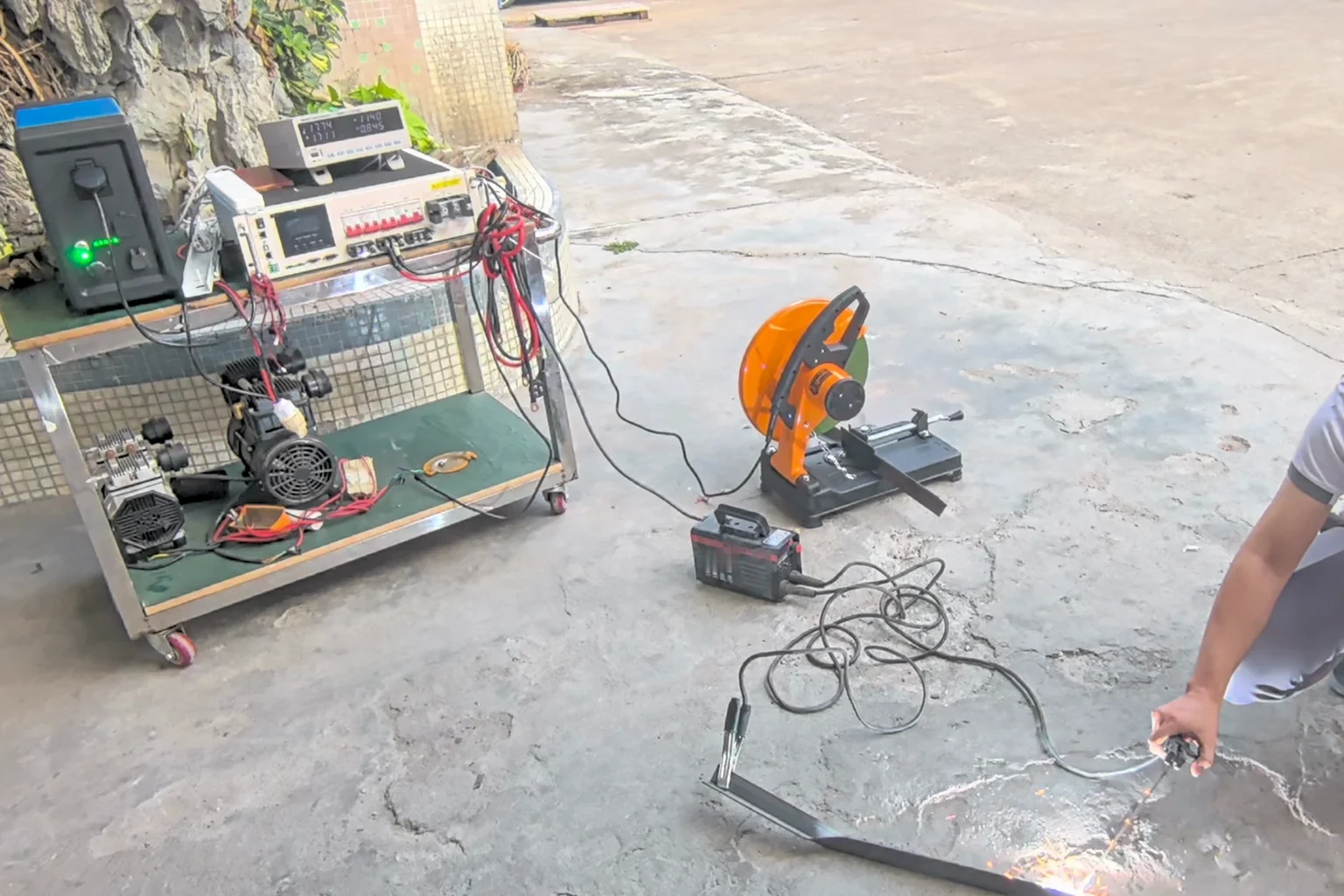
A welder is the only tool on site that looks like a short circuit at start-up. The electrode touches down, voltage collapses, current spikes — all within milliseconds. For the electronics in front of it, that is the worst case a site has to offer.
What was measured on day four
The unit: 2.4 kWh (48 V / 50 Ah), factory-standard configuration with no DC contactor. The load: a small welder rated 2,200 W, the kind found on shell-and-core sites.
- Inrush peak 4,680 W — more than twice the rated power.
- Deepest voltage reading 44.8 V — the lowest of all four load cases in the test.
- Converted to the 48 V level that is roughly 104 A for the duration of the strike.
- Operated normally, no protection tripped, no burnout.
For comparison, the other loads: cut-off machine 4,250 W at 46.2 V, industrial vacuum 3,600 W at 47.5 V, cut-off machine plus lighting 4,500 W at 45.1 V. The arc strike peaks above all of them — and it pulls the voltage lowest.
Why the arc strike is electrically a short circuit
At the strike the electrode touches the workpiece. On the secondary side of the welding transformer the voltage collapses and current rises abruptly — exactly the signature a protection system reads as a short circuit. The 48 V side only sees the current step, but that step is large: the transformer draws its share, and when the machine is switched on its own inrush is added on top.
The difference from a real short circuit is not the shape but the duration and the repetition: the arc burns for seconds, not milliseconds, and it is re-struck dozens of times a day. Across the two weeks there were more than 50 start-up events.
This is exactly where units that only know one current threshold fail. They trip, the site stops, and the rental company gets the unit back with the comment that it was faulty. In fact the cut-off threshold was simply set too cautiously.
How to tell at the buying stage whether a unit can do this
1. Ask for the inrush peak, not the rated power. 2,200 W on the nameplate and 4,680 W at the strike are not a contradiction, they are physics. Anyone calculating on the nominal figure is working with half the truth.
2. Ask for the deepest voltage under load. 44.8 V means the unit holds voltage instead of running into undervoltage cut-off. “48 V” on a datasheet says nothing about behaviour under load.
3. Ask whether the BMS distinguishes a short circuit from an arc. The difference lies in the time and current profile, not the magnitude. “Protection included” is not an answer to that question.
4. No DC contactor means one part fewer that wears. Contactors switch on every operation and wear while doing so. A design that omits one has to handle inrush another way — and has one fewer failure mode in service.
About the clip
The segment is cut from the running test, not reconstructed: on the left the source with power metering, in the middle the load bench, on the right the arc on rebar. At this camera position the unit itself is out of frame — what you see is the load side. The figures come from the test record, not from the video.
Anyone who wants the raw data before ordering gets it on request: load, inrush peak, voltage sag, cycle data, temperatures.