
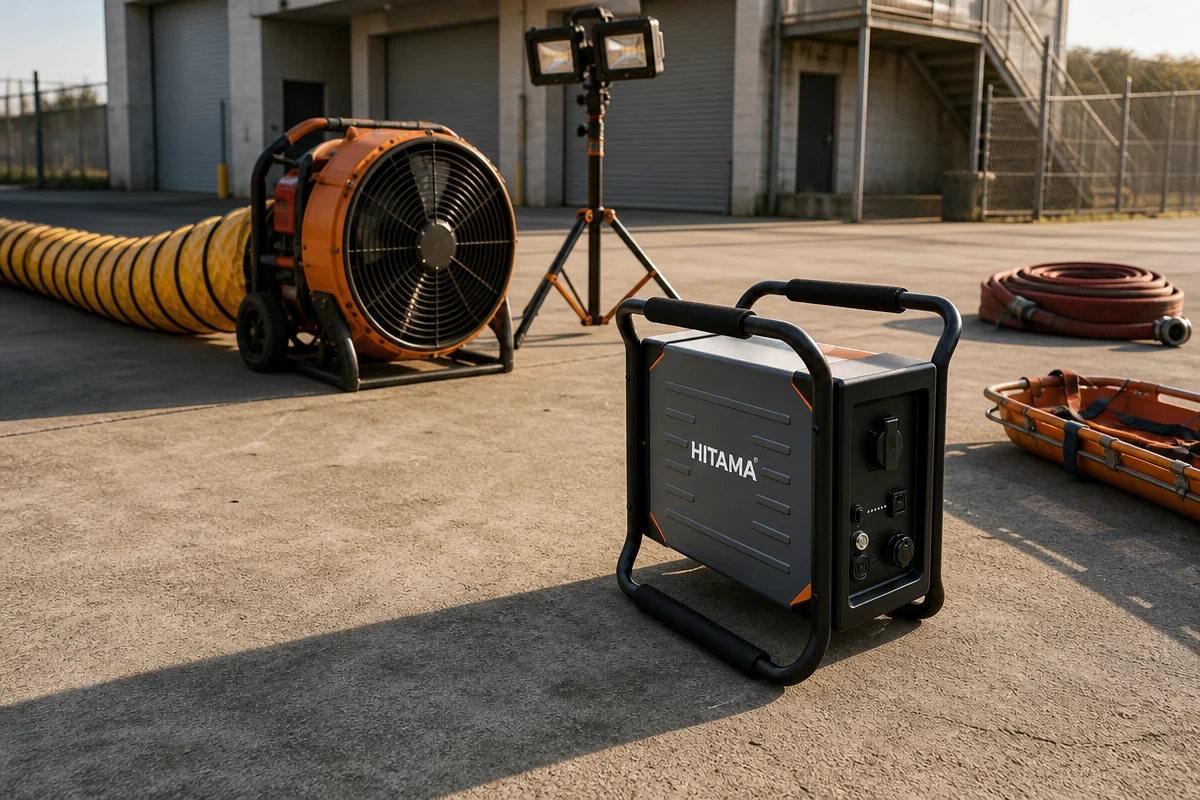
The alarm lasts minutes. The training day lasts hours. Both pull on the same ventilation fan, the same deployable lighting, the same chargers for cordless tools and radios. An incident is the reason the equipment exists; the training ground is where the energy is actually spent. So the useful sizing question is not what an alarm calls for — it is what the longest day of drill looks like.
The fan is the load that decides
Ventilation is the one job where run time, not output, is the problem. A cutting tool works in bursts. A fan does not: it runs while the building is cleared, and at a training ground it runs again in the next evolution, and again after that. Night evolutions add the deployable lighting, and the cordless fleet returns to the chargers between runs. Radios, a thermal imaging camera and the instructors' laptops are rounding errors beside those two.
So count evolutions, not tools. Instead of a list of everything that might be plugged in, the useful number is this: starting from a full charge on Monday morning, how many evolutions can the fan and the lighting be carried through, back to back.
Where the unit can stand
A training area has its own rules about fuel. Where live fire is used, an engine and a canister are two items that have to be argued for, and they have to stand away from the building and away from the side the students work on. A battery unit takes that argument out of the room, and it can be placed next to the fan or at the doorway.
Instruction needs the same quiet an incident does. Verbal orders and radio traffic must not compete with an engine note. Without one there is also no exhaust on the student side, no refuelling pause between two evolutions, and no daily maintenance routine.
The budget — and the recharge that follows
One unit is a working budget, not a supply. The P25 is rated at 2,500 W of continuous output with 2.7 kWh stored, 29 kg, fanless cooling and a pure sine output; on a training day it is the kWh figure that runs out first.
More units extend the day, not the shift pattern. Two units in parallel step the output up to 5,000 W at 230 V and the store to 5.4 kWh. Add the distribution box and a third unit and the same arrangement moves to 400 V three-phase — 7,500 W, with 8.1 kWh behind it.
Energy is load multiplied by hours. If the fan and the lighting together draw a little over 1,000 W, three hours of drill is roughly 3 kWh — already more than one unit stores. That arithmetic is the whole method, and it is why a training ground rarely stops at one unit.
Recharging is a task, not a given. From an ordinary 230 V socket the units charge at 500–1,500 W, so refilling a single unit takes hours. With a fixed supply on site that fits between training days; without one it has to be planned the way a fuel run used to be.
What this is not
It is a working power source, not a standby supply for a training centre. The energy is finite: one unit against a fan that may want it for hours. The ingress rating is IP54, which covers dust and spray; immersion is outside it, and an explosive atmosphere is not a place for this unit. A fan's starting surge has to be planned rather than assumed, because a hard start is a different problem from a running load. And a unit that worked all day still has to be charged before the next one.
Send us the load list for your longest training day — the fan, the lighting, the charging — and we will work the configuration out with you.