
Isolating first is correct, and it has a consequence
Nobody argues about the main switch. Before crews work inside a burning building the supply is isolated, and that single action is what makes the building safe to enter. It also removes every light, every socket, and the escape lighting that was sized to get people out of the building — not to light an overhaul that runs for hours. The darkness is not a fault. It is the result of doing the right thing in the right order.
The work continues after the switch. Ember hunting, opening ceilings and floors, the investigation of the seat of the fire, and the fire watch are all done in a building with no supply of its own. In a cellar, a stairwell or a roof space this is often the longest part of the night, and every one of those tasks needs light where the hands are working, not at the entrance.
What the load list looks like once the building is dark
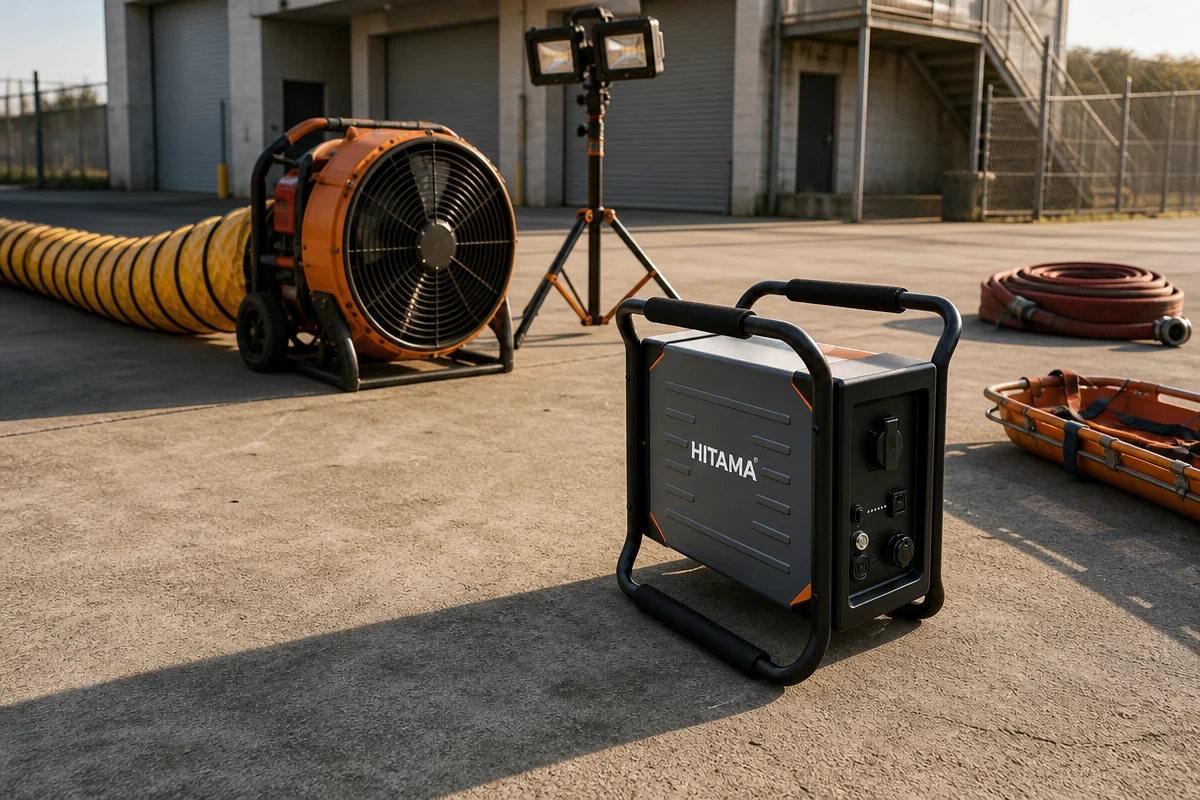
Three loads, none of them large. A hand lamp or two at the seat of the fire, a floodlight where a ceiling or a floor is being opened, and charging for the torch cells and the instruments that went in with the first crew. No pump, no fan. The list is short — the real questions are where the energy comes from and how long it has to last.
An enclosed space rules out the engine. A cellar, a shaft or a stairwell is not a place where a combustion unit can stand: exhaust in the air the crew is breathing, a motor note over the radio, and a fuel can that has to be carried in and out through the same opening. That, not the figure on the rating plate, is the reason a sealed unit belongs in this part of the job.
The numbers are small and they stay small. 2.7 kWh, 2,500 W continuous, pure sine wave, 29 kg. A night of hand lamps plus one floodlight sits well inside that. The margin only disappears when a kettle, a compressor or a heater is added to the same unit by someone who has not been told what it is for.
The limits, said plainly
This is not a building's emergency supply. Escape lighting has one job — getting people out — and that job ends at the door. Lighting an overhaul is a different task with a different duration, and no portable unit replaces a building's fixed installation.
IP54 is splash protection, not permission to work in water. A wet cellar floor is what the enclosure is rated for. Standing water is not: the unit stays outside it, not in it.
Recharging is a task somebody has to do. Bringing the unit back takes 500–1,500 W from an ordinary 230 V socket, which means it goes back on the appliance, gets plugged in at the station, and waits. If it returns at forty percent because nobody plugged it in, the next overhaul starts with a shorter budget than the last one.
Before the next call
Decide where it lives and who may take it off. The useful question is not how much energy the unit holds but whether the crew knows it is on the appliance and is allowed to lift it off. A unit that stays in its compartment while the ceiling comes down has done nothing at all.
Send us the loads you actually run during overhaul and the fire watch, and we will work out what the unit has to carry.