
Two digits, two very different promises
Almost every datasheet in a rental fleet says IP54. What that marking actually promises is far narrower than what gets read into it at the handover desk — and the limit is not where most people assume it is.
The marking comes from IEC 60529 (DIN EN 60529) and consists of two independent digits: the first describes protection against solid foreign objects, the second protection against water (BOPLA, IP 54 to DIN EN 60529). So IP54 does not mean "sealed". It means dust-protected and splash-proof — two promises that each have a ceiling.
The 5: dust may get in
In the wording of the standard, the first digit is not a statement of tightness. It says: dust can enter, but not in a quantity that impairs proper operation or safety. Testing takes place in a dust chamber with talcum powder, at slight negative pressure inside the enclosure.
For a rental business, this is the sentence that matters: dust-protected is not dust-tight. A unit rated IP54 is allowed to contain dust. It is only not allowed to fail because of that dust. Anyone selling the marking as "dust-tight" is selling a promise the standard does not make.
The 4: rain yes, water jet no
The second digit is the expensive misunderstanding in daily use. It covers splashing water from all directions, tested with a spray nozzle at 10 l/min for 5 minutes. That is rain, that is splash at the eaves — that is not a water jet.
The scale separates this explicitly: digit 4 is splashing water, digit 5 is a water jet, digit 6 is a powerful water jet, digits 7 and 8 are temporary and continuous immersion (GIRA, IP54 rating outdoors). A pressure washer works with a jet. That puts it outside what IP54 promises — regardless of how well the unit visually survives the wash.
The same applies to the unit that comes back after a burst pipe: immersion is not covered. IP54 is not watertight, it is splash-proof.
The third misreading: the test knows no age
This point appears in no product brochure, but it follows from how the standard is applied: the tests for the protection rating take no ageing into account. The enclosure is tested as delivered; that the rating holds over the service life is not part of the promise (BOPLA).
The mechanism is mundane and well known in rental: temperature cycling — afternoon sun, then a cold night — creates negative pressure inside a closed enclosure. That pressure difference can draw moisture in through sealing areas. Which is why enclosures use pressure-equalisation elements, and why a seal is a wear part, not a feature.
For a rental fleet this means: IP54 is a test result at the point of delivery, not a promise for the whole life of the unit.
Why we build without a fan
One design decision follows from this. It usually gets read as a detail; it is actually the precondition.
A fan needs an air path: intake, duct, exhaust. That air path is the same path dust and water take. Anyone cooling actively has to open that path — and then has to explain how the protection rating still holds at that opening.
The P25 series is built fanless: 2,500 W rated, 5,000 W peak, 29 kg, −10 to 65 °C. The P25-T delivers 7.5 kW and 8.1 kWh on 400 V three-phase for large cut-off saws and welders. Fanless here is not a cost saving; it is the condition that keeps "IP54" on the nameplate an honest statement: there is no air path to clog, and no opening to work around when cleaning.
Three moves at the rental yard
1. Look at sealing faces and flaps at handover. The rating applies to the closed enclosure. During cabling the flap is open — in that state IP54 says nothing. The flap therefore has to be not just closed, but visibly closed.
2. Clean with the spray, not the jet. Splash pressure is the quantity that was promised; the pressure washer is a different operating mode.
3. Put the sealing faces into the handover check. Not out of distrust of the unit, but because seals age — and because a damp interior does not show up in the invoice, it shows up on the next job.
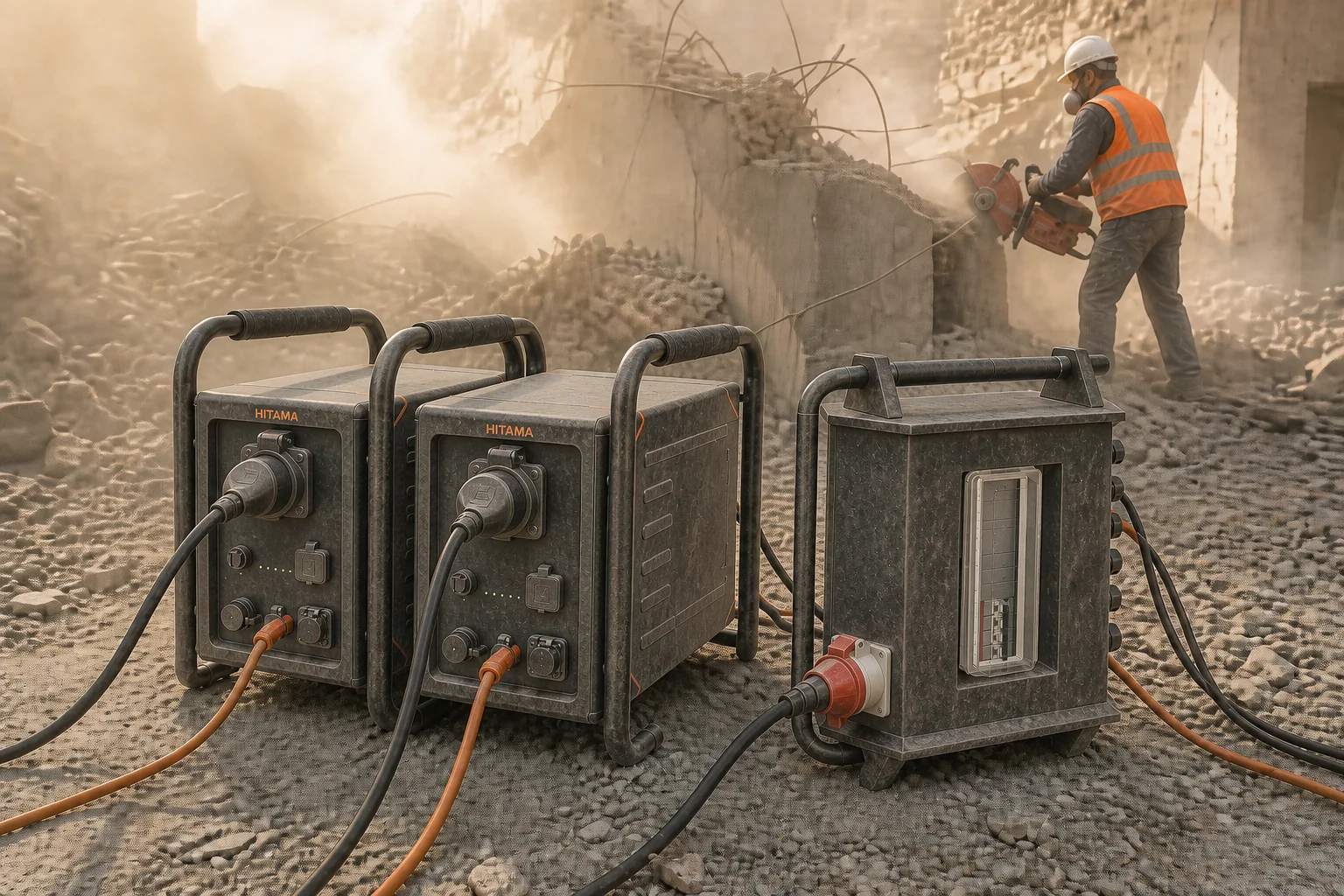
On a demolition site — cut-off saw, breaker and lighting running at once, the dust cloud standing in the wind — that is exactly the difference between a unit that stays on the job and one that comes back. The marking on the nameplate is only the beginning; the rest happens at the counter.
*Note: IP54 is an enclosure protection rating to DIN EN 60529, not a certification. The standard details above follow the publicly available explanations of the linked sources. Operating limits for individual units belong in the manufacturer's technical documentation.*