
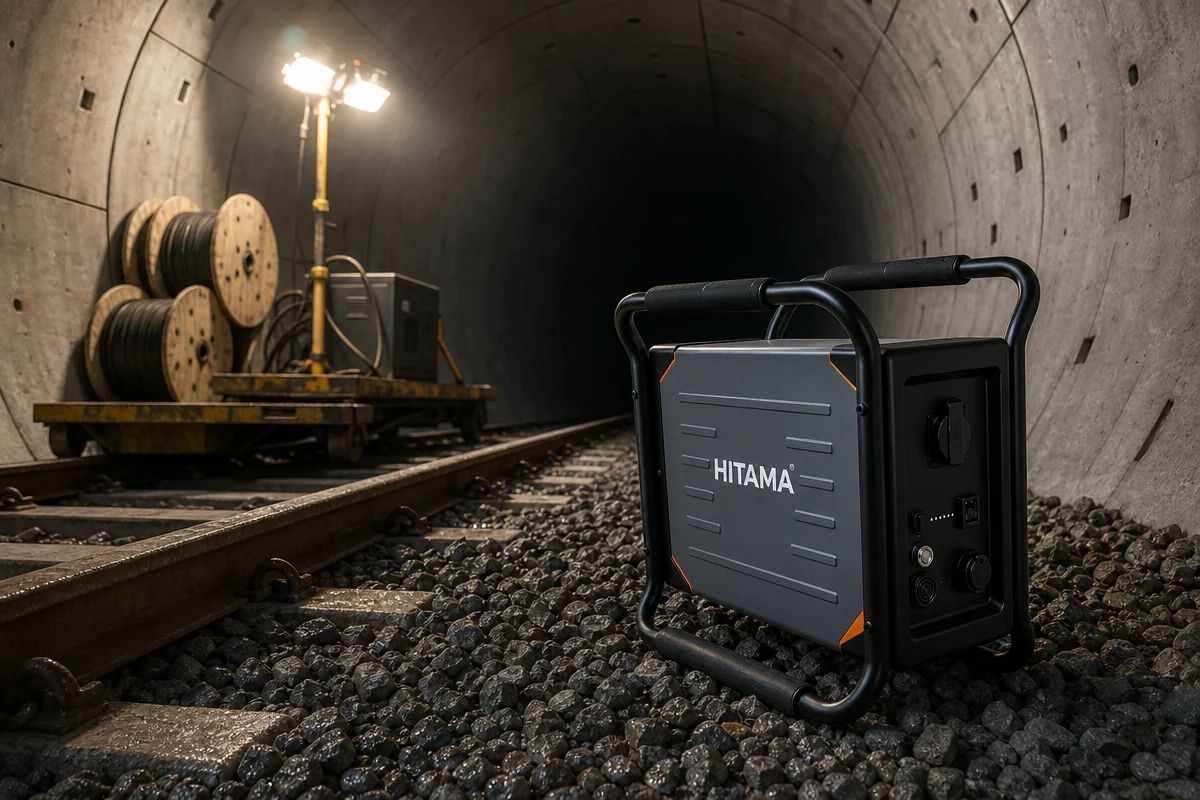
The work face is the last place the decision gets made. Long before the first tool is plugged in, someone at the section entrance has to sign a stored-energy device into a space that is dark, confined, and shared with track plant. That conversation shapes the configuration more often than the wattage does.
Consequences, not specifications
What burns, and where it stands. No fuel goes into the section: nothing to store, nothing to spill, nothing to carry down in cans. The unit is still stored energy, so the answer that gets accepted is a place to stand — outside the swing path of the plant, outside the walking route, and somewhere a person can see it.
What comes out of it. With no engine there is no exhaust, so the section's ventilation does not have to be sized for combustion. Ventilation has its own reasons — dust, heat, the work itself — but the unit is not one of them.
What happens if it is hit. Track plant moves in the dark, close to the wall. A unit standing at the end of a sleeper run sits in the swing path of something heavier than the crew's van. The answer is placement, not protection.
How it leaves. Whatever goes in has to come out, on the same route, at the end of the window when everyone is tired. 29 kg is one person's lift on flat concrete; on a ramp, over a cable tray or up a stair it is a two-person job, and it has to be planned as one.
The sheet that ends the conversation
A load list. Not the site total, but what will run inside the section tonight: the lights, the tools, and the one item with no end time.
A cable route. Where the leads cross, how they stay out of the drainage channel, and which side of the track the unit stands on.
An isolation point. Who can disconnect it, and how, without walking back to the portal.
A name. The person who carries it out at the end of the possession.
What the unit cannot answer
Capacity is finite, and that is the one item signing cannot fix. 2.7 kWh is the whole budget for the section; 2,500 W continuous is the ceiling, not the plan. Where the work needs a second unit, that has to be on the sheet before the window opens, not discovered at 02:00.
It is not tunnel infrastructure. Signalling, fixed lighting, and anything that has to stay live after the crew leaves are outside what a portable unit is for.
IP54 is dust protection and splash protection. It is not a waterproof rating. A unit standing in the water that collects in a drainage channel is outside its specification, however briefly.
No engine does not mean no hazard. It means a different one: stored energy in a confined space with plant moving past it. That stays a question of placement and supervision.
Send us the section plan and the load list, and we will put the configuration on one page you can hand to the supervisor.