
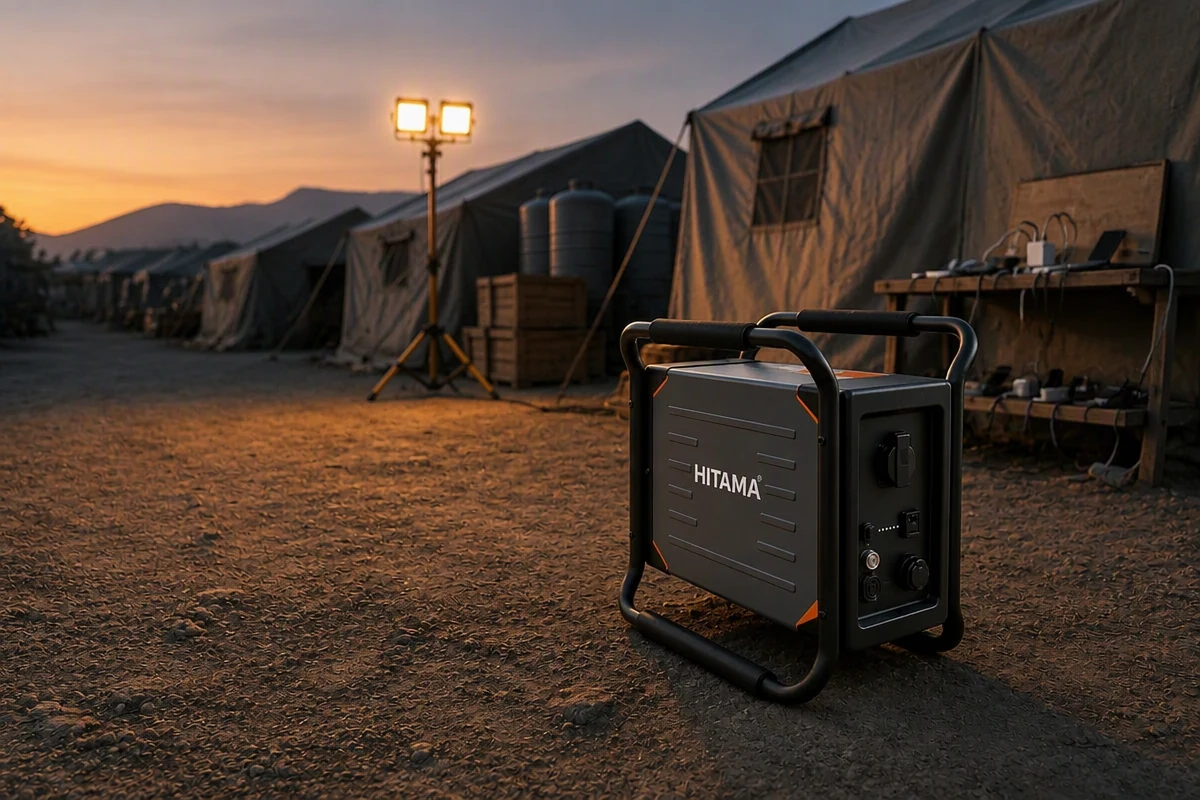
A flood pump is sized by how often it starts, not by how long it runs. One 1.1 kW pump on a float switch can fire dozens of times in a night, and a 2.7 kWh unit gives that draw about two and a half hours of running. That covers a cellar emptying into a sump, not a river moving through a car park for two days.
The pump does not run; it cycles
A flood pump is a switch, not a motor. In a cellar, a lift shaft or an underground car park the pump sits at the lowest point and a float decides when it works. Water arrives, the float lifts, the pump starts, the sump empties, it stops. Across a night that is not one long run but a series of short ones, and the supply has to be there for every one of them.
1. How many starts will one night contain?
Count, do not estimate. Stay with the sump for one hour at the worst inflow, note the time and length of each run, then multiply by the hours when nobody is on site. A pump starting four times an hour at 20:00 does not behave differently at 03:00.
2. What does a start ask that a run does not?
A start is a current event. For a fraction of a second the winding draws several times its running current, and a float switch can command that at any moment. The continuous output of a P25 is 2,500 W; the pump plate states running watts and almost never the start. Two measurements close the gap: the plate, and one observed start with a clamp meter.
The energy budget is a duty cycle
2.7 kWh does not care how the hours are spent. At a 1.1 kW draw the pack of a HITAMA P25 is spent after roughly two hours and twenty-five minutes of running. Across a 25% duty cycle that becomes about ten hours of clock; at 50%, about five. Same unit, same pump, two different nights.
| Figure | Value |
|---|---|
| Continuous output | 2,500 W |
| Usable capacity | 2.7 kWh |
| Weight | 29 kg |
| Ingress protection | IP54 |
| Recharge from a 230 V socket | 500-1,500 W |
The figures belong to the P25 series.
Everything on the same socket competes. A dehumidifier, two work lights and a freezer all draw from the same pack. Add them before the pump is connected, not after the first shutdown.
Nobody is in the room at three in the morning
The float switch does not call anyone. An unattended pump hides three consequences. A trip has to be reset by a person, and the float keeps asking for a start it cannot get. The pump's dry-run protection looks after the pump, not the supply; when the pack reaches its own cut-off, the pump stops and nothing announces it.
Placement is the one advantage worth using. With no engine there is no exhaust, so the unit can stand in the space it serves instead of in the stairwell with a cable through the door. It still has to stand out of the water: IP54 covers dust and spray, not immersion.
Where this stops
A pump that runs for days is not a battery job. Two days of continuous pumping at 1.1 kW is roughly 53 kWh, or about twenty P25 units, and nobody deploys twenty units to a car park. Where water has to move for a week, the honest configuration is a mains feed or a generator, with the portable unit covering the hours before either arrives — and after a storm the restoration arrives in instalments, so a socket is not a plan. That is also why relief deployment phases get planned before the camp is sized.
This is not a pumping station. No automatic transfer, no telemetry, no remote start. It is a source a person carries in, plugs in and checks, which is why the useful work happens before the flood, in the disaster relief and civil protection plan.
Questions we get before a flood season
Will one unit carry a cellar pump through the night?
Usually yes, when the pump runs a light duty cycle. A 1.1 kW pump at 25% duty draws about 0.28 kWh an hour, so 2.7 kWh covers nine to ten hours of darkness. At 50% duty the same pack covers about five, and the rest of the night needs a written plan.
Can the unit stand beside the pump in a flooded basement?
Yes on the exhaust question, no on the water. With no engine there are no fumes, so the unit can stand in the room it serves instead of outside a closed door. It must stay above the waterline: IP54 is protection against dust and spray, not against water around the base.
What should be measured on the pump before sizing?
Three figures: running watts from the plate, one observed starting current, and the duty cycle over a full hour. Reading only the plate is the most common reason a portable supply is chosen too small, because the plate says nothing about the start that trips the unit.
Send us the pump plate, the head it works against and the hours it runs per night, and we will size the unit and the recharge window together.