
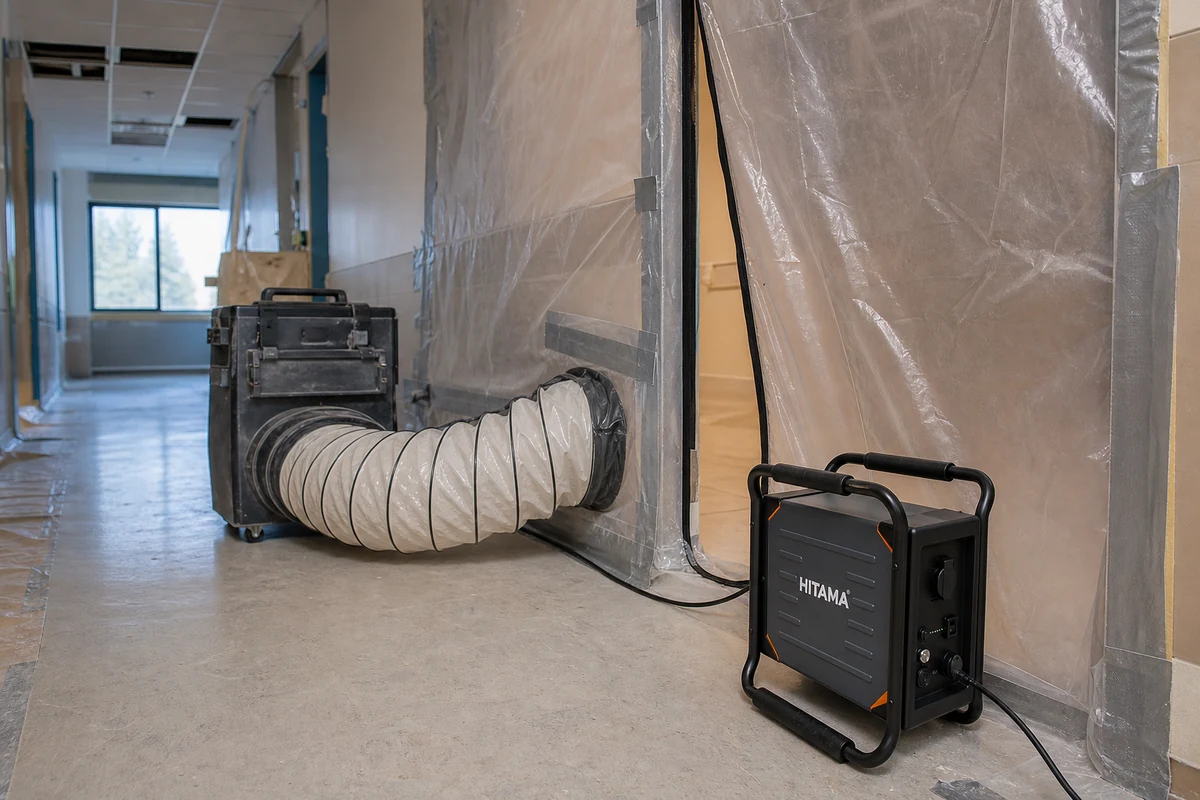
A remediation containment is not the plastic sheeting. It is the pressure difference held by a running air scrubber — and that difference ends the second the socket does. The power question here is a shift-length question, and the unit belongs outside the envelope it feeds.
The sheet is the label, not the barrier
The polythene and the tape are what the client photographs at handover. The barrier is a small pressure difference, held by a scrubber pulling air through a filter and discharging it outside the working area.
Stop the scrubber and the enclosure becomes an ordinary room. Nothing holds what is inside it there any more. Nobody plans for this, because the scrubber is not on the tool list — it is in the method statement, and method statements do not have a plug on them.
The load list is small and it never cycles
A shift draws very little at any moment: the scrubber motor, a HEPA vacuum, task lighting inside the enclosure, the pump and heater in the decontamination unit, a gas-monitor charger.
Almost nothing here is heavy, and almost everything here is continuous. The scrubber runs for the whole shift, the vacuum whenever somebody is scraping, the decon heater when the weather decides it should. A profile built from peaks sizes the job wrong; plate load multiplied by the hours the enclosure is live is the number that matters. Voltage belongs in the same conversation: the standard kit is 230 V single-phase, larger extraction sets are not, and that is settled before the order.
Nothing with an air path stands inside the envelope
A machine that draws air through itself and discharges it has to be placed relative to the containment, not relative to the cable. A combustion set at the entry puts its exhaust at the intake. A fan-cooled set in the clean zone makes its own air path part of the regime it was meant to stay out of.
A sealed unit with no intake, no exhaust and no moving parts turns this into a cable question. Heat leaves through the casing. The machine stands in the corridor, on the scaffold or at the fence, within −10 to 65 °C, and the only thing crossing the barrier is the lead to the scrubber. IP54 covers dust and splash from any direction; it says nothing about what is inside the enclosure.
The arithmetic is a night's, not a wattage
The step from one unit to two is cheap in cable and expensive in weight. A P25 is 2,500 W rated, 5,000 W peak, 2.7 kWh, 29 kg. Two in parallel give 5,000 W and 5.4 kWh; three give 400 V three-phase, 7,500 W and 8.1 kWh at around 90 kg.
What decides is the walk, not the capacity. 29 kg goes up a stair with one person and a free hand. 60 kg does not, and the barrier is often three floors up with the lift out of service.
Charging sets the rhythm of the week. From a 230 V socket the input is adjustable between 500 and 1,500 W; a P25 reaches 80 percent in about two hours and full in two and a half. That is a lunch break, not a night.
The clearance run has nobody in the room
Removal finishes, the enclosure stays up, the scrubber keeps running, and samples are taken before anybody signs the area back.
The one run that must not be interrupted is the run with nobody in the room to notice it stopped. Units get pulled for the next job because they look idle, and a scrubber that stopped on Saturday is found on Monday. A tag on the machine costs less than a re-clean.
What this is not
It is not a containment design, and it does not replace the method statement, the risk assessment or the contractor's competence. It does not filter, ventilate or create negative pressure; it carries the load of the equipment that does.
It is not explosion-proof and carries no hazardous-area approval. The certifications are CE under the EMC Directive 2014/30/EU and UN 3480 class 9 packaging for sea transport. Work needing a zone approval is outside that.
It is not a UPS. There is no transfer time and no changeover promise, so life-safety, alarm and monitoring equipment stays on the building's own backed-up supply.
Send the load list from your next remediation job — the scrubber, the vacuum, the decon unit, and the hours the enclosure stays live — and we will size it against the shift, not the peak.