
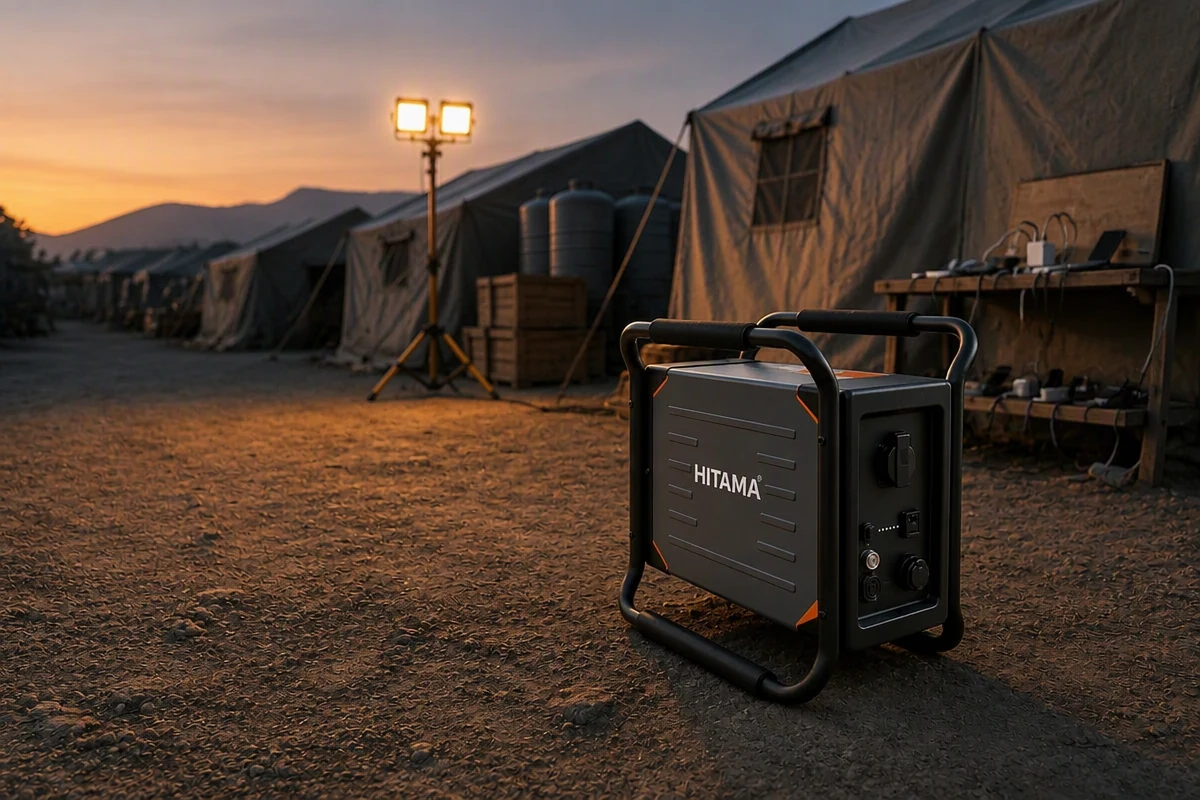
One operation, three places
Every deployment plan is written around the camp. That is the site with the visible load list, and it is the one that gets sized.
But a civil protection deployment is a sequence of places. Units assemble at a staging point, move to the operational site, and at the end hand over or withdraw. Each phase happens somewhere else, with a different load mix and a different amount of time available.
The phases that nobody sizes are the ones that get improvised. And improvisation happens exactly when there is no capacity left to improvise with.
The staging point has a load list too
Before anything is operational, people have to be able to see and to talk. Lighting for the assembly area, radio and command-post equipment, charging for the equipment that is about to be deployed. Individually, small loads.
They fall at the worst possible moment. Nothing is set up yet, the vehicles are still moving, and the first thing that gets patched together is often the power for the briefing itself.
Planning the staging point is not a separate project. It is the same list of jobs as the camp, at a different address and with an earlier start.
The transition decides the configuration
What limits a phased deployment is not the peak load of any single site. It is whether the same units can be packed, moved and reconnected at the next site without an unplanned recharge - and whether the crew arriving can set that up without a handover from the crew that left.
One unit holds 2.7 kWh and delivers 2,500 W of continuous output at 29 kg. Pairing two of them doubles both figures: 5.4 kWh, and 5,000 W on a 230 V output. A three-unit set with the distribution box goes further, to 8.1 kWh and 7,500 W at 400 V three-phase. Topping up needs nothing more than an ordinary 230 V socket, drawing 500-1,500 W.
No engine changes what a phase can look like. No exhaust, no fuel and low noise mean a unit can stand inside a command post or a shelter, which removes both the fuel run and the question of where an engine is allowed to be.
Where the phase model breaks
Parallel output and coverage compete for the same units. A pair gives 5,000 W at one address. Split across two sites, both fall back to the output of a single unit. That trade-off is settled by the phase plan, not by the equipment list.
2.7 kWh is a time window, not a phase. If a phase runs longer than planned, the energy does not stretch with it. A phase that lasts for days needs a different source for its base load, with the battery carrying the positions where an engine cannot run at all.
IP54 is dust and splash protection, not immersion. And recharging is a task in its own right: it needs a reachable socket and an hour in the plan, at the place where the unit will be next.
Send us the sequence of sites for your next deployment, with the hours planned at each. We will mark the point where a single unit stops being enough.