
Two supplies, one site
Restoration is a list of addresses, not a moment. After a flood the network returns bus by bus: the pumping station on Tuesday, the school on Thursday, the shops once someone has tested the circuits. For a week the site has power and no power at once, depending on which door you walk through.
Plans assume one clean handover. Deployments read as if the utility returns on a date and the battery's role ends there. In practice circuits are energised, trip and are energised again, and each cycle is a decision taken with incomplete information.
That window is where portable power is least understood. Not because it cannot supply, but because its job changes twice in a few hours and nobody has written down who decides.
What must not restart twice
Count restarts, not kilowatts. The costly loads now are those where an interruption costs more than the energy: the command post with its sessions and radio programming, a pump that loses suction when it stops, a tool caught mid-cut, a compressor whose restart draws a surge the circuit cannot carry yet.
Keep them on the unit until the utility has held - not until it flickers on once, but through a full working period. Restoration failures are common: "the power is back" often describes the last ten minutes, not the afternoon.
Send the boring loads back first. Lighting, charging benches, anything without a state to lose. That frees capacity for the loads that cannot be interrupted, and lets returning circuits prove themselves under light load.
Three roles in a few hours
Supply, then bridge, then consumer. It starts as the only source on site, covers the gaps between returns, and ends the week as a load on the network it replaced. Each role asks a different question: how long it runs, what must stay up, when a socket is free.
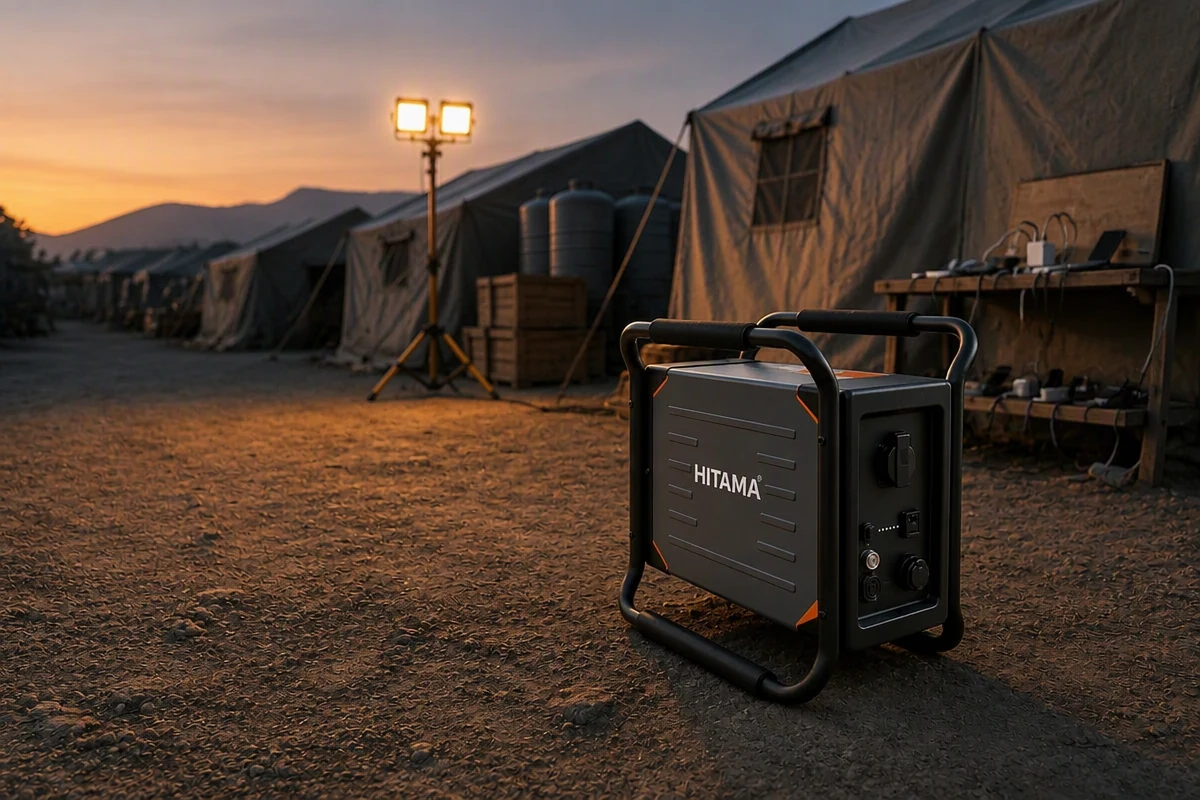
The figures set the frame. One P25 holds 2.7 kWh and delivers 2,500 W continuously at 29 kg; two in parallel give 5,000 W and 5.4 kWh at 230 V, three with the distribution box reach 7,500 W and 8.1 kWh at 400 V three-phase. Refilling from a 230 V socket draws 500-1,500 W - an hours-long task to schedule, not to squeeze in.
Charging competes with what is being restored. The socket you refill from may sit on a circuit still under test. That is a planning problem before an electrical one: charge in stable hours, keep one unit full in case restoration rolls back.
Where the role ends
2.7 kWh is a working window, not a deployment. If the base load must run for days, the battery covers the positions where no engine may stand and another source carries the base. This phase is the last moment anyone still thinks about it.
No engine means no exhaust, no fuel run, no maintenance schedule. It does not mean unlimited energy. IP54 is dust and splash protection, not immersion - and a flooded site is where that distinction gets tested.
A portable unit is not the building's installation. Re-energising a building is an electrician's act, with a signature on it. A battery with its own outlets is not part of that changeover; treating the two as the same is the one mistake here a recharge will not fix.
If you are planning the restoration phase of an exercise, send us the sequence you expect: which building comes back first, and which loads must not drop. We will mark where a unit has to stay.