
Why the usual question is the wrong one
On almost every site the question is: diesel or battery? That question rarely leads to the right answer, because it puts two different jobs into one pot — continuous load and working load.
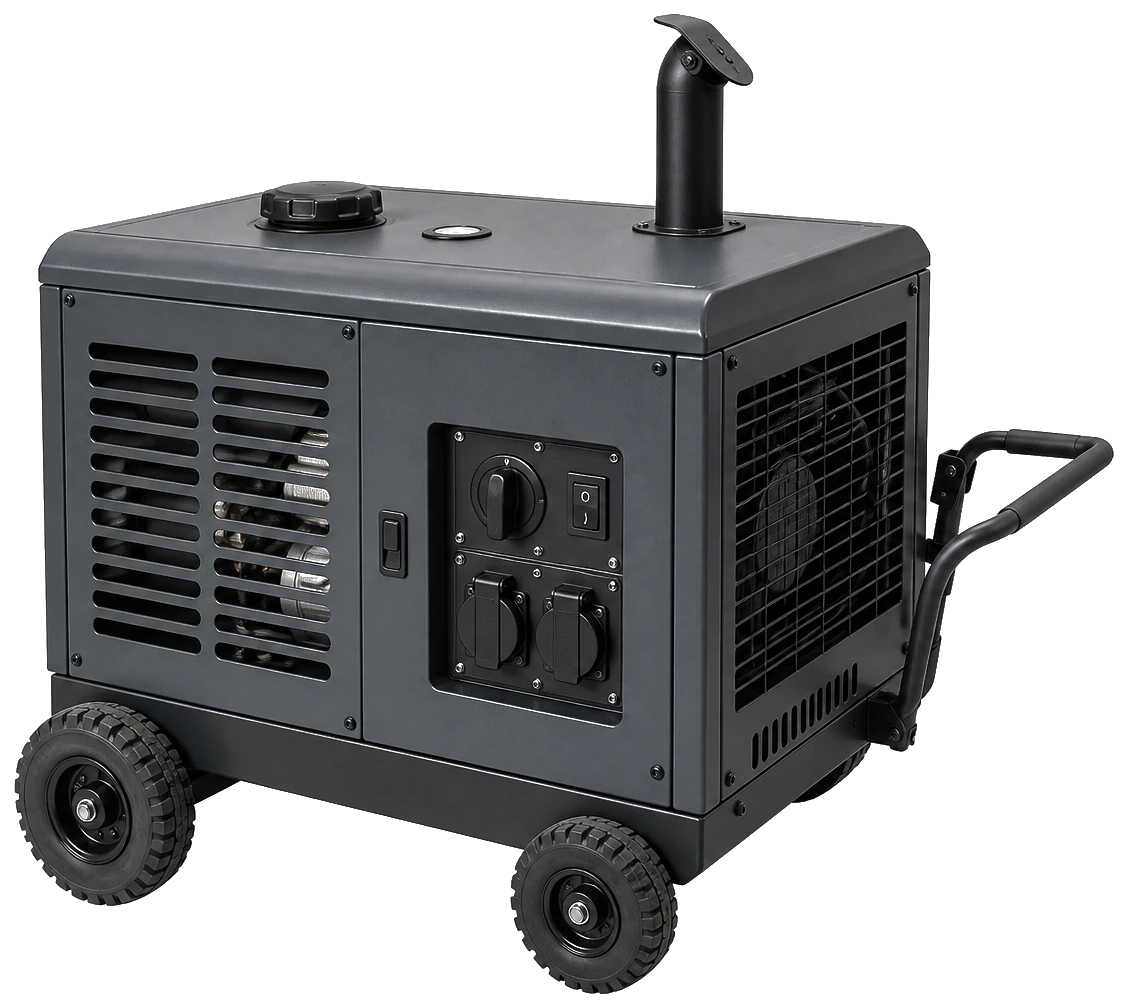
A diesel generator is built for continuous load. It runs for hours at part load while burning nearly as much fuel as at full load, needs service intervals, a fuel supply chain and a standing place with exhaust routing. A portable power station is built for working load: it delivers short, high peaks (angle grinder, core drill, welding set) and then idles down — with no idle consumption.
The practical consequence: if your tools do not run at the same time but in rotation, the power station is the smaller and cheaper solution. If you need a consistently high load over many hours, the generator keeps the advantage.
Four questions that actually settle it
1. How many tools run *at the same time*?
Do not add up every tool on site — only those that run in parallel. A typical interior fit-out rarely exceeds two simultaneous consumers. This is exactly the difference: a generator is sized on the sum of all connections, a power station only on real simultaneity.
2. How high is the *start-up* load of your largest tool?
Motors and transformers draw a multiple of their rated current on start. The binding constraint is therefore not the continuous rating but the peak. Check the inrush of your heaviest tools before you select a power class — not after.
3. Will work happen indoors, in a tunnel or in a hall?
Exhaust is where the arithmetic tips. As soon as you work indoors, in basements, tunnels or confined areas, exhaust routing, extraction and special operating equipment come on top — or the work has to stop. Electric supply produces no exhaust at the point of use.
4. What does operation cost, not just purchase?
Count three items that are regularly left out of generator comparisons:
- Fuel and fuel logistics (tanker runs, refuelling breaks, theft risk)
- Service and downtime (oil, filters, spark plugs, service intervals)
- Permits and compensation (conditions where noise and emission limits apply)
A generator burns fuel even when it is only standing by. A power station consumes nothing at idle.
Where a power station has limits
We state this explicitly, because an honest limit is worth more than a smooth answer:
- Very long continuous load over many hours remains the generator's domain.
- Continuous heat generation (heating, drying over days) is not a typical battery case.
- Recharging off-grid has to be planned. Without grid access you need either solar or a charging concept.
Scale up instead of oversizing
The most common planning error is a one-off sizing: you buy the capacity for the largest stage and carry it through all the smaller ones.
HITAMA P25 series units are parallel-expandable — 2,500 W single, 5,000 W with P25-D, or 7,500 W as 400 V three-phase with P25-T, at 230 V / 16 A, IP54 and 29 kg per unit. That means: you start with one unit for the first stage and expand when simultaneity rises, instead of buying the largest class up front.
What to require in writing from any supplier
Whichever manufacturer you choose — ask for these five points in writing:
1. Continuous and peak rating separately, with duration of the peak in seconds
2. Start-up behaviour with inductive loads
3. Degree of protection and behaviour under dust, heat and humidity
4. Depth of discharge and cycle figure against a named end condition (not "lifetime" without a number)
5. Spare parts availability and who handles service in your region
Point 5 is the decisive one in practice: a unit that cannot be serviced in year three costs more than any purchase-price difference.
---
Want a sizing for your stage? Send us your tool list with simultaneity and inrush figures — we will work through the sizing with you. Prices on request, because the configuration depends on the application.