
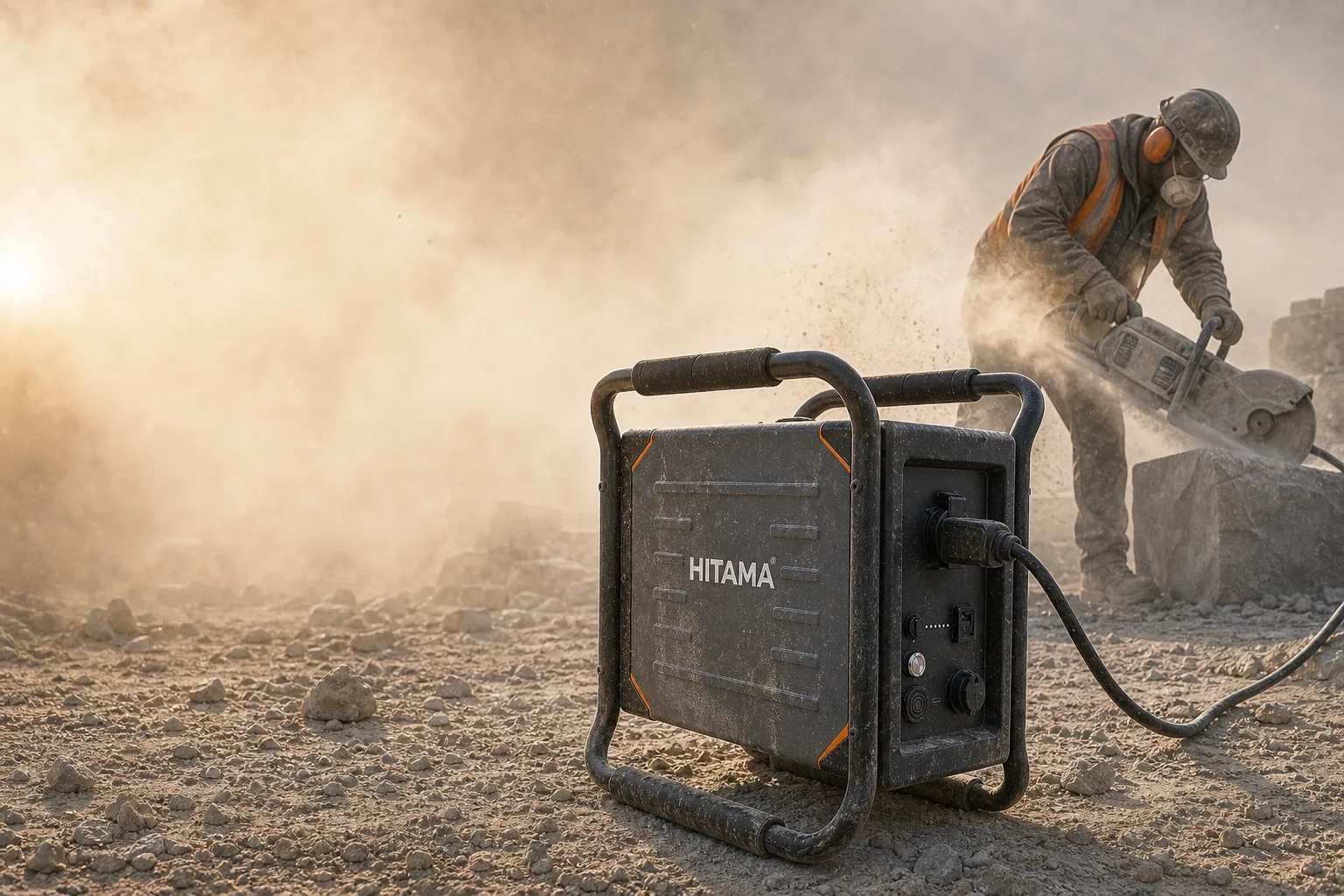
A fan is an intake
When people compare two power stations they compare capacity first. That is the obvious metric — and in dusty, hot and humid environments it is rarely the decisive one.
The reason is simple: a fan needs an air intake. And an air intake is where dust, lime, grinding particles and moisture get into the electronics. On sites with cutting and breaking tools, grinding or concrete work that is not a theoretical risk, it is the normal case.
A fan moves heat by pushing air through the enclosure. It does that well — as long as the air is clean. Once it is not, the effect reverses: the heatsink and the intake duct clog, cooling performance drops, internal temperature rises, and the unit works at its upper limit exactly when ambient temperature is already high.
The alternative: heat through the enclosure
A fanless unit does not release heat into the environment via an air stream, but through the enclosure itself. Three things fall away at once:
- no air intake — dust and moisture find no path inside
- no moving parts — no fan bearings to age or fail
- no intake duct — no component that can clog and whose cleaning can be forgotten
HITAMA P25 series units work on this principle: fanless self-cooling, no moving parts, no intake duct, designed for dust, heat and humidity — at 29 kg per unit and degree of protection IP54. IP54 means: protected against dust ingress in harmful quantities and against splashing water from all directions.
> What IP54 does not mean: it does not mean you may hose the unit down, and not that it can stand in the rain permanently. When a supplier sells IP54 as "waterproof", that is an overstatement.
When the design matters — and when it does not
An honest classification:
| Situation | Relevance of the cooling design |
|---|---|
| Cutting, grinding, demolition, concrete dust | high — the main load case |
| Indoors, basements, tunnels | high — dust plus restricted air exchange |
| Coastal or damp sites | high — humidity combined with dust |
| Clean workshop, laboratory environment | low — a fan is uncritical here |
| Short outdoor use in dry weather | low |
If your profile falls in the first three rows, the cooling design is not a detail — it decides whether the unit still delivers the same output in year three.
Three questions to ask any supplier
1. How is the unit cooled — actively with a fan, or passively through the enclosure?
2. Is there an air intake, and how is dust kept from drawing in?
3. Which degree of protection is stated, and against what exactly does it protect?
Question 1 is deliberately open. The answer should be one sentence and not a product pitch: "through the enclosure" or "with two fans". Both are legitimate designs — but you should know which one you are buying before you put it on a dusty site.
The link to serviceability
A design without moving parts in the cooling circuit has a second, often overlooked advantage: it creates no recurring maintenance task. There is no filter whose replacement interval someone must keep to, and no bearing that becomes audible after years.
That is the decisive point on sites with changing staff. Maintenance that depends on the discipline of whoever is operating will eventually not be done — maintenance that does not exist by construction cannot be missed.
---
Planning a deployment with dust or moisture exposure? Describe the environment and the tools you intend to run — we will tell you whether the configuration fits. Prices on request.