
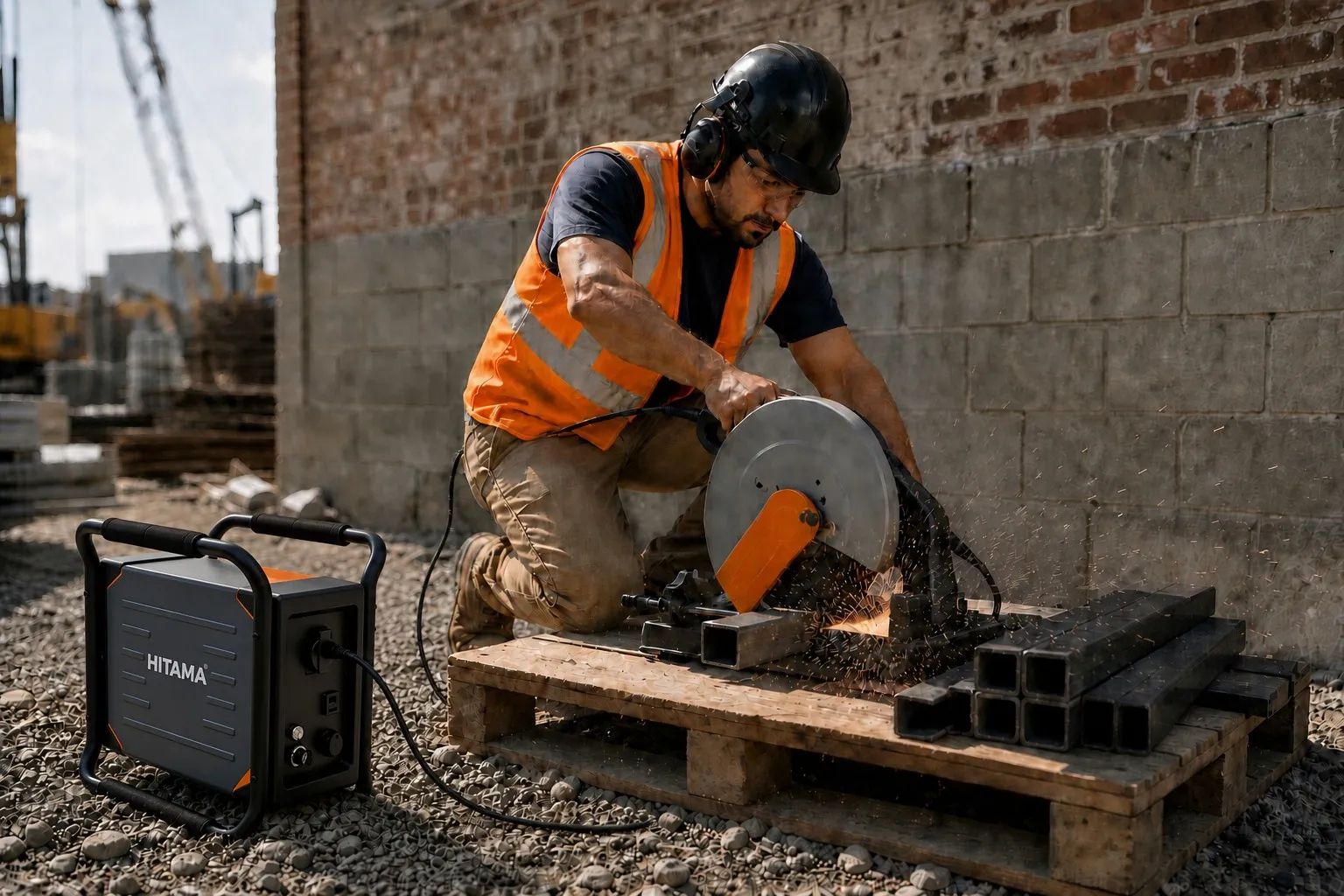
A hire desk is rarely asked for a battery unit. It is asked for a generator, because that is what the last job ran on. Whether the order should leave on a battery instead is decided by four questions, and all four can be answered at the counter in a few minutes.
The four questions
What is actually plugged in? Not “a few tools” — a list. Take the nameplate rating of each item and add the starting surge for anything with a motor: a compressor, a pump, a breaker, a circular saw spinning up. Peak output starts a tool; continuous output keeps it running. The waveform matters too, because some electronics and chargers will not accept anything other than a pure sine wave.
Where will it run? This is the question a combustion unit cannot answer. A basement, a hall, a stairwell, a sealed room — anywhere the exhaust would collect is closed to an engine and open to a battery unit, which has no engine, no exhaust and nothing to fuel. It is also quiet enough to work next to, which is a practical difference on a residential street or a night shift.
How long, and how long really? Runtime follows the distance between the average draw and the stored energy, not the rated output. This is where the counter conversation either earns its fee or produces a complaint.
Who carries it in, and how far from a socket? One P25 is 29 kg and takes one person, with no lifting gear and no start procedure to demonstrate. Recharging is a task in its own right: 500–1,500 W from any ordinary 230 V socket — at the depot, in the yard, or on the customer's supply.
Sizing is energy, not just watts
Rated output and stored energy are two different numbers. A P25 is 2,500 W continuous with 2.7 kWh of capacity — roughly an hour at full rated load, and considerably longer on the mixed, intermittent loads a real site draws.
Parallel units scale both. Two P25 units in parallel (P25-D) give 5,000 W and 5.4 kWh at 230 V. Three with the P25-T distribution box give 7,500 W and 8.1 kWh at 400 V three-phase — the configuration when a three-phase tool or a welder appears on the order.
Nothing to maintain. No oil, no filters, no fuel and no hours-based service interval sitting on a unit that is idle between hires. Fanless self-cooling means there is no filter to clean either.
The hires that should still go out on an engine
It is not a building standby supply. If the customer wants a fixed installation backed up, or a high continuous load run beyond the capacity of the configuration, the honest answer is still an engine.
IP54 is dust and water spray, not immersion. Say that at the counter rather than letting the customer discover it.
Recharge has to fit the job. Where there is no socket and no return window long enough to recharge, plan a second unit — or a different machine.
What we need from you
Send us the tool list, the job location and the shift length. We will size the configuration against it — P25, P25-D or P25-T — and give you the runtime you can quote.