
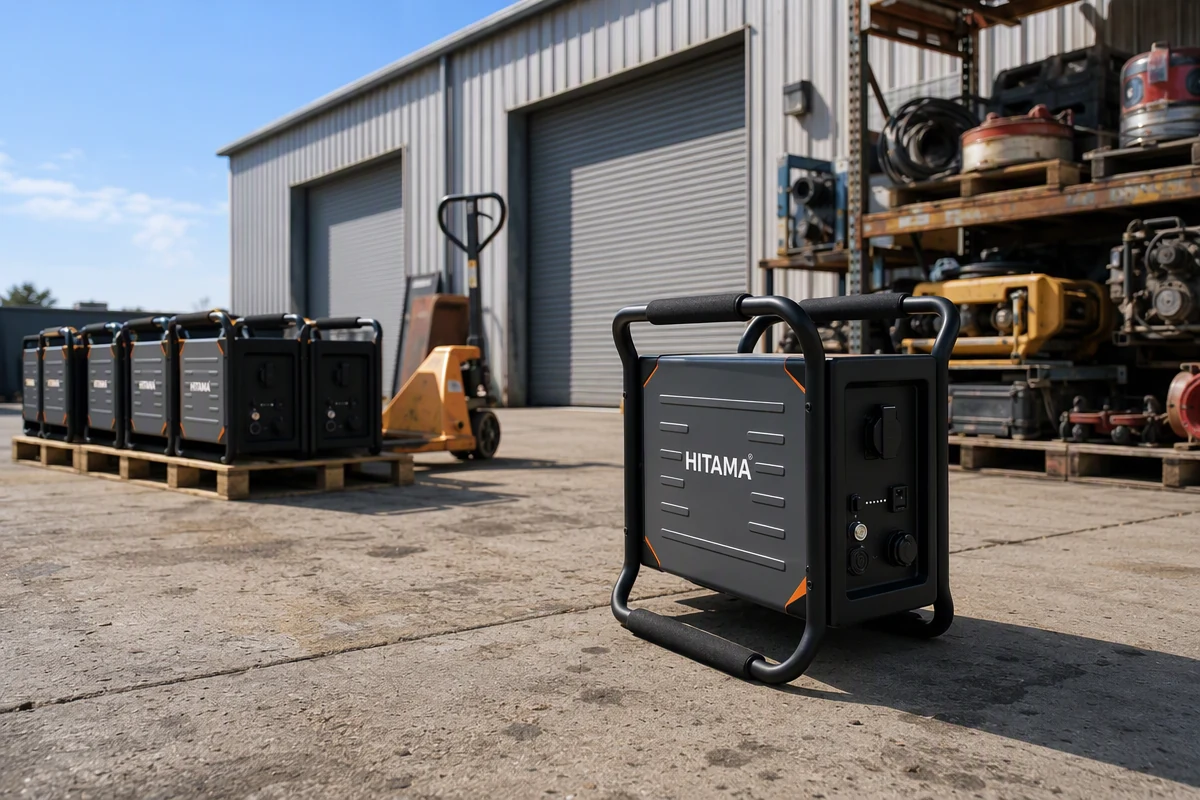
The second box decides
When you build a fleet, you compare units first. The decision actually falls one level lower: not on the strongest machine, but on whether the second one can join it.
A unit standing alone is a single point. If it fails, the work stops. Two units of the same series are a reserve, three are a reserve with headroom – but only if they can be coupled, not merely placed next to each other.
What stays the same across the P series
The series is built so that the differences sit in the power class, not in the architecture. Standard equipment per data sheet: bidirectional inverter, fanless self-cooling, pure sine output with total harmonic distortion below 3 percent, modular parallel expansion.
The steps themselves, in the registered rated data:
- P25 – 2,500 W rated, 5,000 W peak, 2.7 kWh, 29 kg, 230 V single-phase, two to three units in parallel.
- P25-D – 5,000 W / 10,000 W peak, 5.4 kWh, around 60 kg, 230 V single-phase, two to three units in parallel.
- P25-T – 7,500 W / 15,000 W peak, 8.1 kWh, around 90 kg, 400 V three-phase, three units in parallel.
- C24 – 2,400 W / 4,800 W peak, 2.0 kWh, 23 kg, 230 V single-phase, no parallel operation.
Parallel operation is standard equipment for us, not an accessory. That is the difference that carries a fleet: a requirement above the single-unit class is not answered with a bigger machine, but with a second identical one.
Why this hits the rental desk, not purchasing
For purchasing, "which power class" is answerable. For the rental desk a different question comes up: what happens on Tuesday morning when one unit is in the workshop with damage and three tools are running outside?
With a series that supports parallel operation there is an answer without buying anything new. One spare-parts kit, one cable set, one operating logic – and in a bottleneck two units move together instead of a rental contract collapsing.
That is not a performance claim but the direct consequence of coupling: where two units can be connected electrically, the failure question is a different one than with a collection of stand-alone devices.
Where the unity ends
Two limits belong in the same paragraph, otherwise parallel capability turns into a promise.
The first is the series. Coupling happens within a product line, not across models. A mixed stock offers more choice on paper and less reserve on the shelf.
The second is the grid form. 230 V single-phase or 400 V three-phase is decided on the tool side, not the unit side. A 400 V load does not become three-phase because three 230 V units stand next to it. Anyone holding both has two answers – and has to keep them apart at the counter.
And a third that is often missed: peak power is not a reserve. It is a short-term allowance for starting, not the second half of rated power. Whoever plans with peak will size continuous load too high.
What buying direct from the factory really changes here
We build the units ourselves. That sounds like a brochure line, but it has a practical consequence: the series is our own design – core construction, parallel system and industrial design are protected by invention patents, utility models and design rights. When a rental fleet reorders over several years, the second batch comes from the same construction, not from a newly sourced supplier lot.
The comparison with brand owners who have their units manufactured in Europe is not meant as a slight – that route has advantages of its own. But the chain of responsibility differs: there, a purchasing department sits between the rental fleet and production; here, it is the line.
What we deliberately do not say in this text
No quantities, no prices, no lead times. Minimum order quantities, tiered pricing and delivery dates are project questions negotiated per order – they do not belong in an article, because they would already be wrong for the next reader.
No runtime. Capacity in kilowatt-hours is a rated figure. How long a unit carries a specific load depends on that load's input power, its starting behaviour and temperature. While we have not measured it ourselves under site conditions, we do not quote a number for it.
No certificates we do not have. CE under the EMC Directive and the transport data under UN 3480 are documented and available on request with report numbers. LVD, RoHS, GS or TÜV we do not claim.
The sentence that stays
A rental fleet is not a collection of strong individual units but a stock that can stand in for itself. Whoever compares only power classes at purchase buys ten machines. Whoever also checks coupling buys a system – and notices the difference on the day one unit fails.
To see the series in context: P series overview and battery storage in the rental fleet.
---
Note on the figures: All power, capacity and weight figures are rated data from the data sheet, not measurements under site conditions. Parallel figures refer to units of the same series.