
The figure nobody has seen since 1991
On 23 October 2026 Germany's Federal Statistical Office (Destatis) published order intake for main construction for August 2026. Real order intake, adjusted for calendar and seasonal effects, rose 23.0 percent on July. It was the sharpest seasonally adjusted month-on-month rise since the series began in 1991.
The same release contains the sentence that most follow-up coverage leaves out: the rise was "driven by several large orders".
What the release actually says, figure by figure
- +23.0 % – real order intake in main construction, August 2026 on July 2026, calendar- and seasonally adjusted. Highest monthly figure since 1991.
- +12.4 % – building construction.
- +31.6 % – civil engineering.
- +7.6 % – three-month comparison June to August 2026 against the preceding three months, calendar- and seasonally adjusted. Within it: building construction +0.6 %, civil engineering +13.8 %.
- +17.3 % – against August 2025, real and calendar-adjusted. Within it: building construction −1.7 %, civil engineering +36.4 %.
- +4.9 % – real turnover against August 2025; nominal +10.1 % to EUR 10.9 billion.
- +1.5 % – persons employed against August 2025, roughly 548,000.
All figures cover enterprises with 20 or more persons employed. Source: Destatis press release 375 of 23 October 2026.
Why 23 is not the number you plan a fleet with
Two things sit right next to it, and neither is convenient.
The first is the previous month. In July 2026 order intake had fallen 9.2 percent on June – also real, also calendar- and seasonally adjusted, also Destatis. A month with large orders and a month without produce a spike in this series, not a trend.
The second is the year-on-year comparison. Against August 2025, building construction is 1.7 percent down. The gain comes from civil engineering, at 36.4 percent. Anyone reading a broad construction upturn into the 23 is reading it wrong.
Destatis states how the two comparisons are meant to be used: the month-on-month comparison shows short-term development, the year-on-year comparison a longer-term level. It supplies the less volatile version itself – the three-month comparison, plus 7.6 percent.
For fleet planning that means the durable statement this October is not "23 percent" but "civil engineering is pulling, building construction is flat". That is a different statement about a fleet than a record month.
What is different in civil engineering
A building shell has one connection point. The distribution board stands next to the site cabin, load grows with each floor, and anyone who needs power goes there.
Civil engineering has no connection point. It has a length.
The work moves: today the trench section along the road, tomorrow the stretch behind the embankment, the day after the crossing. The loads move with it – submersible pump, compressor, lighting, abrasive saw, welding set on the sheet pile wall. And they are not steady: a pump runs intermittently, a welding set draws several times its rated load for a moment when it strikes, lighting wants power when nobody is left in the trench.
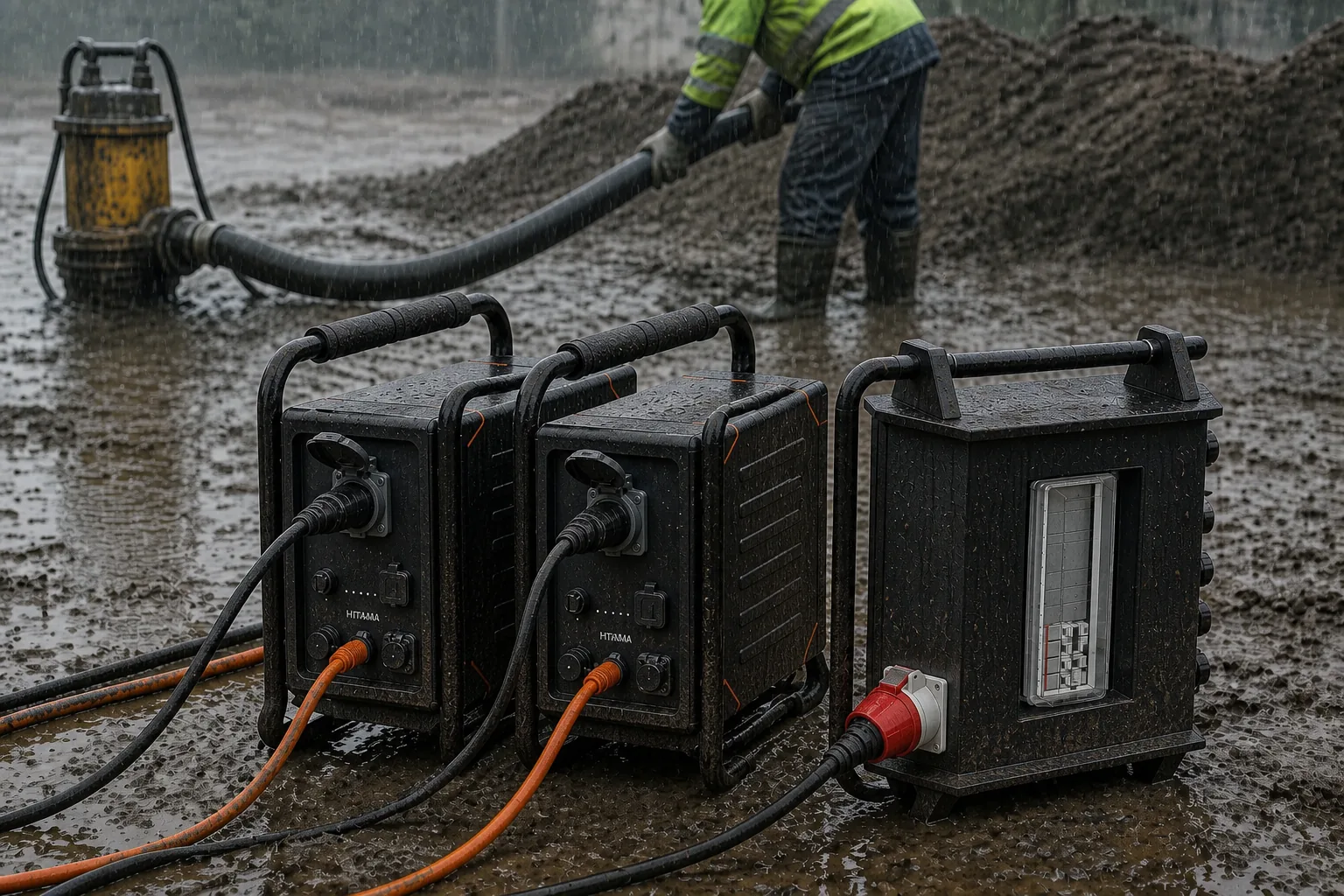
Then there is weather, and in civil engineering it is not a footnote. Water in the trench is the normal case. Whoever dewaters needs power at the lowest point – and that is where a combustion engine is the least popular answer: exhaust in the pit, refuelling in the rain, and when the water rises, the question of who carries it out.
Three questions a rental desk has to answer today
Where does the energy stand? At the cabin or at the point of work. That is not a matter of taste: a cable run once across the haul road is a different product from a unit that walks along with the trench.
How often does it move? A civil engineering section can stand for weeks or change daily. Whoever does not ask plans by average and delivers on the wrong day.
What happens when it rains? The pump is the load that counts when it rains – and the least plannable one.
None of these three questions is answered by order intake statistics. They say how much work is in the market, not where it sits.
What follows for your own set-up
No order quantity follows from these figures. A priority does: if growth sits in civil engineering while building construction runs sideways, the question is not "do I have enough units" but "do I have units that fit the trench".
For us those are the 230 V and 400 V units with modular parallel operation, described on our site power page. Rated data of the P series: P25 at 2,500 W rated, 5,000 W peak, 2.7 kWh and 29 kg; P25-D at 5,000 W and 10,000 W peak, 5.4 kWh, around 60 kg; P25-T at 7,500 W and 15,000 W peak, 8.1 kWh, around 90 kg, 400 V three-phase. Two to three units run in parallel, spreading the load across several enclosures.
These are rated figures from the data sheet, not measurements under site conditions. How long a unit carries a specific pump depends on that pump's input power, its starting behaviour and ambient temperature. We do not quote a runtime for it while we have not measured one ourselves at the trench.
The sentence that stays
Order intake is the number you make headlines with. The number you plan a fleet with is the three-month comparison – and in it this October, civil engineering sits at 13.8 percent and building construction at 0.6 percent.
Anyone who concludes from that to put more units at the trench rather than more at the cabin has read the release more carefully than most.
---
Sources
- Federal Statistical Office (Destatis), press release no. 375 of 23 October 2026: order intake in main construction, August 2026 – destatis.de
- Federal Statistical Office (Destatis), press release no. 338 of 25 September 2026: order intake in main construction, July 2026, −9.2 % on the previous month – destatis.de
- Product data P25, P25-D, P25-T: own technical data, rated values. Not measured under site conditions.