
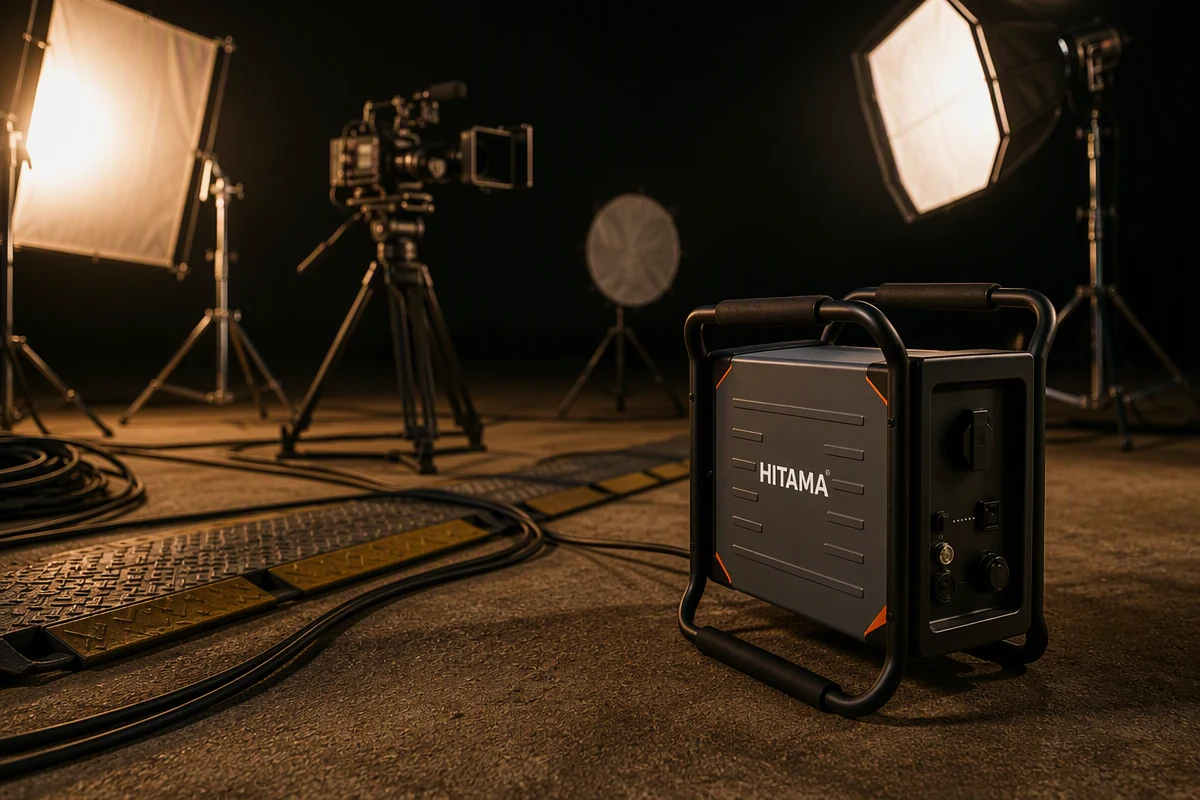
23:40, third setup, and sound turns around
On a night shoot the first department to complain is not camera. It is sound.
The engine runs because something somewhere is lit. And the engine is the only thing on set that does
not know a take is rolling. So the take is repeated, and the repeat costs more than the power it saved.
Anyone who has spent a night on a set knows the order: lighting is built, camera is lined up, sound is
set - and then there is a machine at the edge that calls all of it into question again.
Who actually needs power
A set is not a construction site with one connection point. It is four departments with four different
load profiles that happen to stand in the same place.
Lighting is the big item, but not the steady one. Softboxes and LED panels are switched in groups,
and between two setups the load changes in seconds. Add the short, high inrush when several drivers
come up at once.
Camera and DIT draw little, but continuously: monitors, card offloads, charging batteries, a
machine that runs all night. That is the load nobody switches off.
Sound is the smallest item and the most sensitive. Charging radio mics, a mixer, a headphone amp -
and the requirement that nothing in the background is audible that does not belong there.
Video village wants the monitor and the link. Also at three in the morning.
Four departments, four answers to "how much power" - and none of them is on a unit's data sheet. Which
is why the first task on set is not ordering, but metering: what does this production actually draw,
and in what order.
What a battery changes here - and what it does not
Three things change, and all three concern sound.
No exhaust. An engine cannot go where people work and there is no extraction: tents, containers,
interiors, narrow courtyards. That is not a comfort question, it is the reason a unit may come near the
set at all.
No fan. Our units are fanless, self-cooled. A fan on a take is not background noise, it is a
component in the shot - and it runs hardest when the load is highest.
Pure sine. The inverter delivers a pure sine with total harmonic distortion below 3 percent. LED
drivers and monitors repay that with less hum; with cheap modified-sine inverters you hear the power
supply working.
What does not change: a battery is not acoustic insulation. It is quieter than an engine, but it is
not silent. We publish no decibel figure for use on set, because we have not measured it there - and a
number from a data sheet is not evidence for a take at two in the morning.
The calculation nobody can do for you
A unit's capacity is a number. Runtime is a result - and it hangs on the load you connect, not on what
is printed on the case.
The frame is simple: usable capacity divided by the actual draw of the consumers running at the same
time. 2.7 kWh with a steady 900 W gives different hours than the same unit driving a lighting group
with short peaks.
That is why we give no runtime for this scenario. Not out of caution, but because the number would be
a claim without your load. What we do state is capacity and rated power - the rest belongs on a meter
on set.
Cable discipline is part of the power supply
On a night shoot a cable across a walkway is not clutter, it is an accident. Two rules that have
nothing to do with electrical engineering and still decide every job:
Ramps wherever people walk. A cable across the path to catering becomes a trip hazard at 02:00,
and nobody sees it lying there in the dark.
One person plugs and unplugs. When three departments pull from a unit at once because they need
"just a moment", the load calculation was wrong before the night started - and nobody knows why the
breaker tripped.
Neither rule is in a manual. Both decide whether the unit makes it through the night.
When one unit is not enough
When the load exceeds the unit's class, the answer is not a bigger machine but a second identical one.
Our P series runs in parallel within a series - two to three units on the P25. The load spreads across
several enclosures instead of one, and the failure of one unit is not the failure of the set.
That is the point where a production stops talking about power and starts planning it.
What remains
A night shoot does not need a lot of power. It needs the right place for the power, a calculation with
real loads, and someone who knows which cable goes where.
The engine is not the problem. The problem is the engine that keeps running while sound is rolling.
---
Notes
- Rated values from the data sheet, not measurements under set conditions.
- Capacity and power figures: P25 rated 2,500 W, 5,000 W peak, 2.7 kWh; P25-D 5,000 W / 10,000 W and
5.4 kWh; C24 2,400 W / 4,800 W and 2.0 kWh.
- We state no runtime for this scenario because the production's load is not our measurement.