
Three names, one datasheet
See the P25 series for the first time and you read three devices: P25, P25-D, P25-T. Three names, three enclosures, three prices. The datasheets tell a different story.
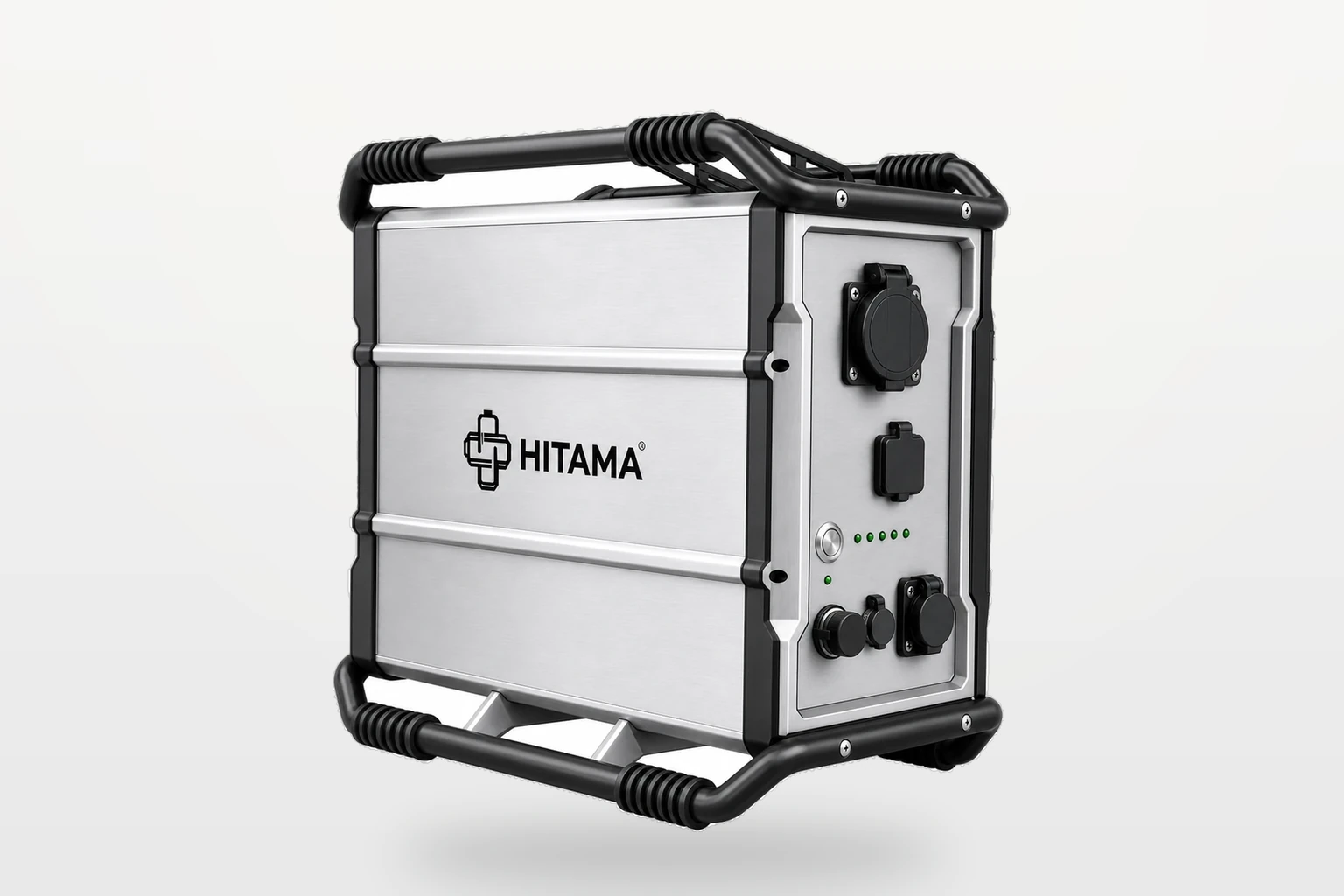
P25 — 2.7 kWh, 2,500 W continuous, 5,000 W peak for ten seconds at most, 29 kg.
P25-D — 5.4 kWh, 5,000 W, 10,000 W peak, around 60 kg.
P25-T — 8.1 kWh, 7,500 W, 15,000 W peak, around 90 kg, plus 400 V three-phase.
Every one of those rows is the previous row multiplied. 2.7 times two is 5.4. 2.7 times three is 8.1. 2,500 times two is 5,000, times three 7,500. Even the weight follows: 29 times two is 58, quoted as around 60; times three is 87, quoted as around 90.
That is not a coincidence and not marketing rounding. It is how the product is built. P25-D and P25-T are not larger machines, they are several P25 running in parallel — two and three units respectively, managed through a shared controller. Which is why the series specification lists "2–3" as the parallel range rather than "1".
What that means for a rental fleet
Capacity is divisible, not stepped. Buy one P25 today and need more energy in two years, and you do not buy a new series — you put a second unit next to it. Charging infrastructure grows with it, operation stays the same, spare-parts holding stays the same.
And energy per kilo stays flat. 2.7 divided by 29 gives roughly 0.093 kWh per kilogram. 5.4 by 60 gives 0.090. 8.1 by 90 gives 0.090. Across the whole series the figure sits at about 0.09 kWh/kg — the bigger number is not a better cell, it is the same cell, more often.
Which is the actual message for a site manager: more capacity is paid for in weight and footprint, not in efficiency. Two units weigh twice as much as one, and take twice the space in the charging bay.
What does not stack
One thing does not scale with it: the voltage level.
Two P25 give 5,000 W at 230 V. They do not give 400 V. If you run a three-phase load — and on site that is the rule as soon as larger equipment appears — then the P25-T is not an option, it is the precondition. And that decision is made when the system is bought, not when it is set up.
In practice: "one P25 or two?" is a quantity question and can be answered later. "230 V or 400 V?" is a structural question and cannot. That is why it comes first in every quotation conversation — before capacity, before unit count, before delivery date.
Three things worth taking away
1. Count devices, not product lines. If a customer needs 8 kWh, the answer is not "the big machine" but "three units". That changes transport, footprint and charging time — and those three decide the margin in rental.
2. The phase is the only one-way street. Everything else can be added later. The voltage level cannot.
3. Weight is the price of capacity. Around 0.09 kWh per kilogram, across the entire series. Plan with 29 kg per unit and you plan correctly — at three units as well.
Where the numbers come from
Every technical value in this text comes from the P25 series datasheets as published on this site and in the product datasheet: capacity 2.7 / 5.4 / 8.1 kWh, continuous output 2,500 / 5,000 / 7,500 W, peak output 5,000 / 10,000 / 15,000 W for ten seconds at most, weight 29 kg and around 60 and around 90 kg for the parallel systems.
For calibration: the doubling and tripling in this text is arithmetic on those datasheet values, not a measurement. The kWh-per-kilogram figures are likewise calculated (capacity divided by weight) and rounded to two decimals; they describe the ratio, not the cell chemistry. Runtime, revenue and savings are not quoted here because we hold no measurements of our own.