
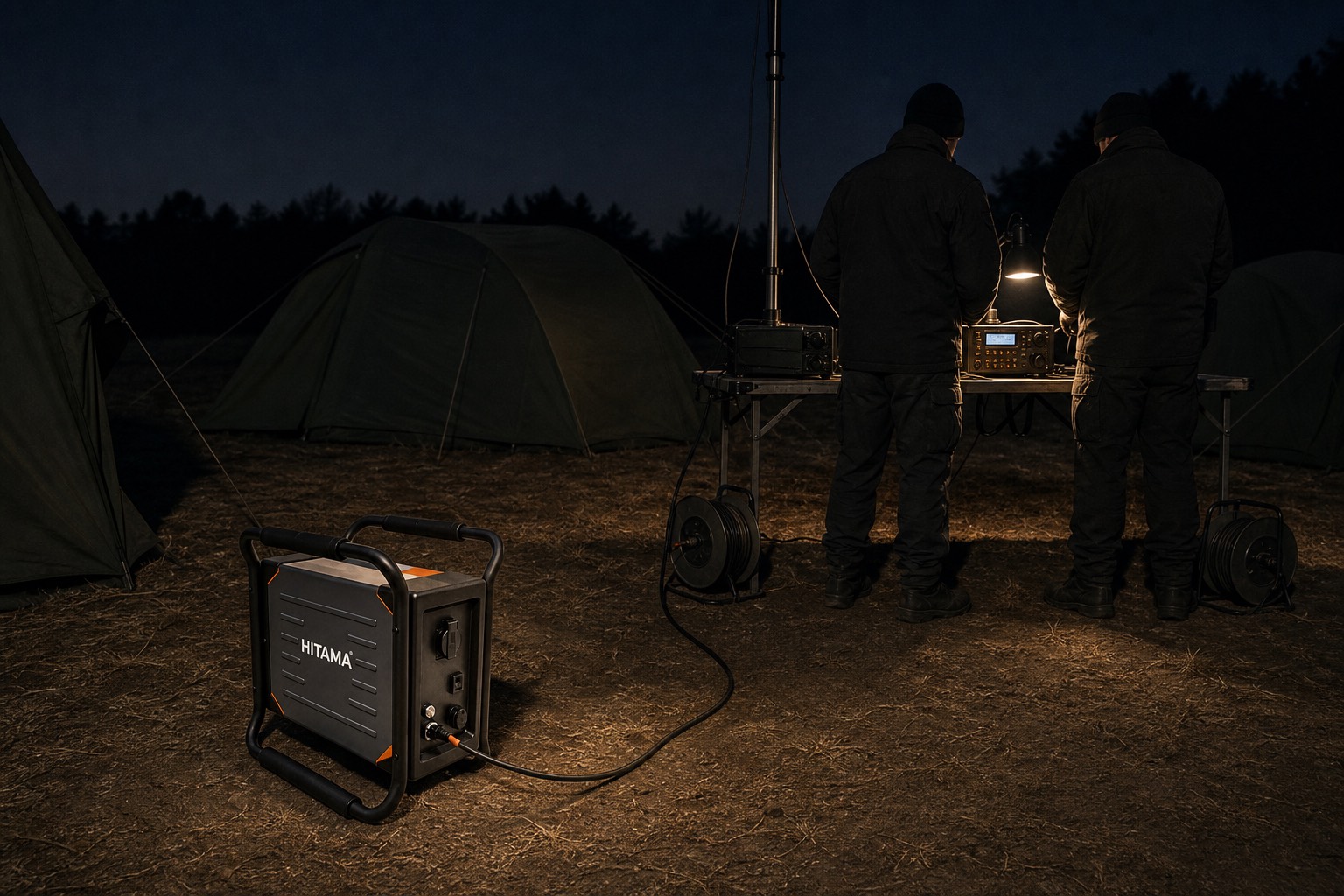
A field camp has three electrical needs and one constraint. The needs are radio, charging and light. The constraint is that a combustion generator brings noise, exhaust and a fuel chain with it.
What is actually plugged in
Radio and communications. The load that must not drop. Continuous, modest, and the reason a camp carries power at all.
Equipment charging. Radios, night optics, handhelds, laptops. Small per item, large across a section, and it happens on a schedule — at stand-down, all at once.
Lighting. Working light for the command table and the cook line, not floodlighting.
What a battery changes, in plain terms
No engine means no noise and no exhaust — the two things you cannot put beside a tent. No fuel means nothing to carry in and nothing to refill in the dark. One P25 is 2,500 W, 2.7 kWh and 29 kg, carried by one person. P36 reaches 3,600 W; the P25-D pair reaches 5,000 W and 5.4 kWh; the P25-T system gives 7,500 W at 400 V.
What it is not
It is not a base power plant, and capacity is finite: a section's charging schedule is a real load, not a rounding error. Units recharge from a normal 230 V socket at 500–1,500 W. IP54 covers dust and water spray, not immersion, and this is not equipment for a hazardous atmosphere.
Give us the equipment list and the stand-down schedule, and we will size it.