
The first question is not about watts
Placement comes before sizing. In a fit-out, a refurbishment or a conversion, the building's own distribution is often dead: the old supply is being replaced, the temporary board serves hand tools and lighting, and the room where the weld has to happen is nowhere near either. Before anybody asks what output the welding set needs, the honest question is where the power source can be put at all.
Why an engine stops at the door
A combustion unit needs somewhere to send its exhaust. In an occupied building that somewhere usually does not exist, and the noise travels further than the fumes. So the generator stays outside, which means the welding lead has to come back in through a doorway, along a corridor and up a stair. At that point the machine is no longer the constraint on the job. The lead run is, and so is every door that has to stay usable as an escape route.
What changes when the unit stands at the weld
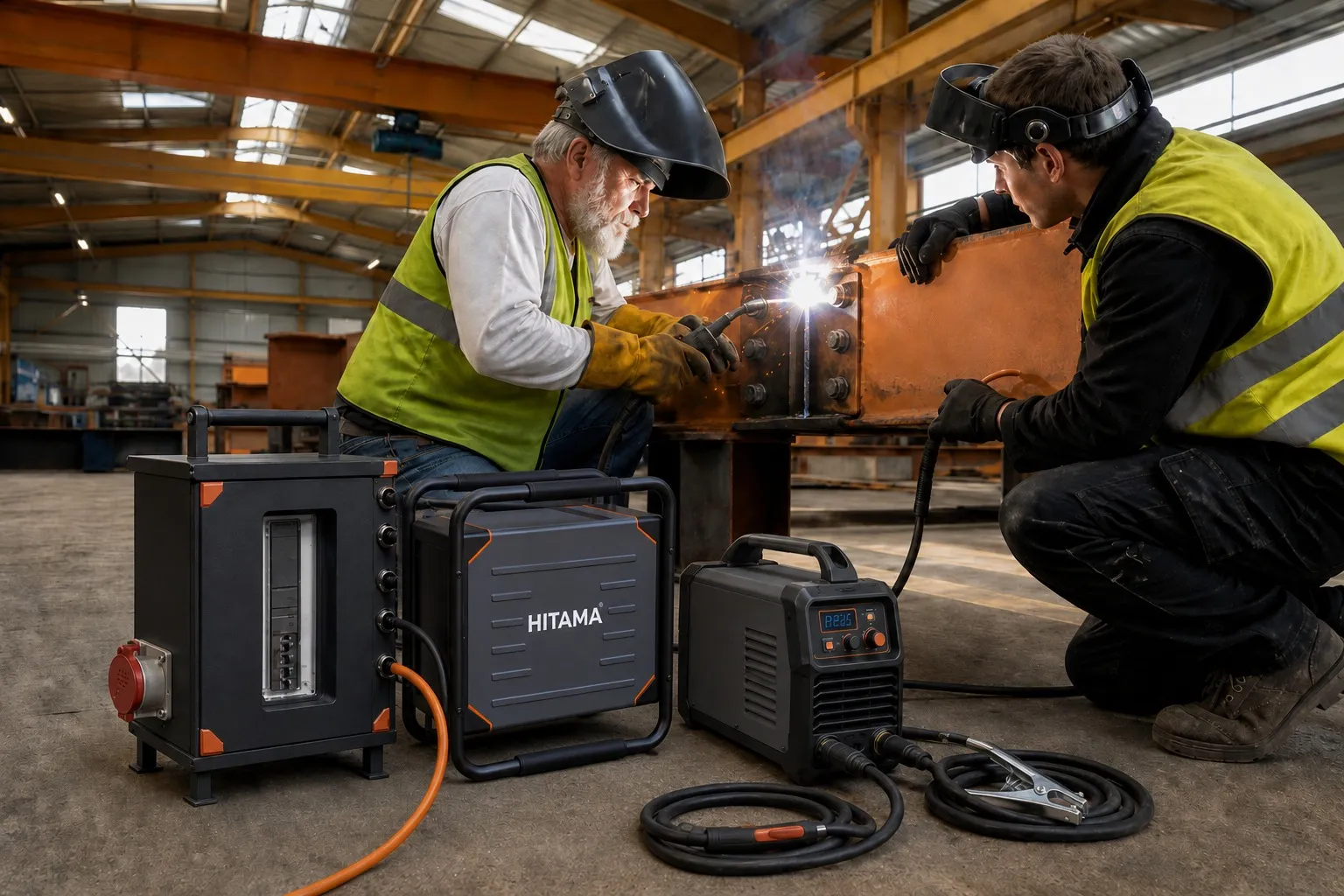
Take the engine away and the placement problem goes with it. A battery unit has no exhaust to route and no combustion air to supply, so it can stand in the room where the weld is, with the welder's own lead kept short. The P25 provides 2,500 W of continuous output and 2.7 kWh at 29 kg, fanless, with a pure sine wave output. For a 400 V three-phase welding machine, three units with the distribution box (P25-T) deliver 7,500 W and 8.1 kWh; for a 230 V single-phase set, a P25-D pair covers 5,000 W and 5.4 kWh. Recharge is from an ordinary 230 V socket at 500-1,500 W.
What this does not change
Hot work is still hot work. Fire watch, clearance of combustibles and the building's own permit rules do not move because the power source changed. The energy stays finite: 2.7 kWh per unit against a welding duty cycle, so the working day has to be planned in electrodes and duty cycle rather than in hours. Recharging needs a live socket, which is precisely what an unpowered building may not offer, so the recharge point deserves the same planning as the weld itself. IP54 covers dust and water spray, not immersion; the units are not intended for explosive atmospheres; and this is a power source for the work, not a standby supply for the building.
Tell us where the weld is. Send the welder's nameplate, the position of the weld and the point where the building can give you power, and we will work out the configuration with you.