
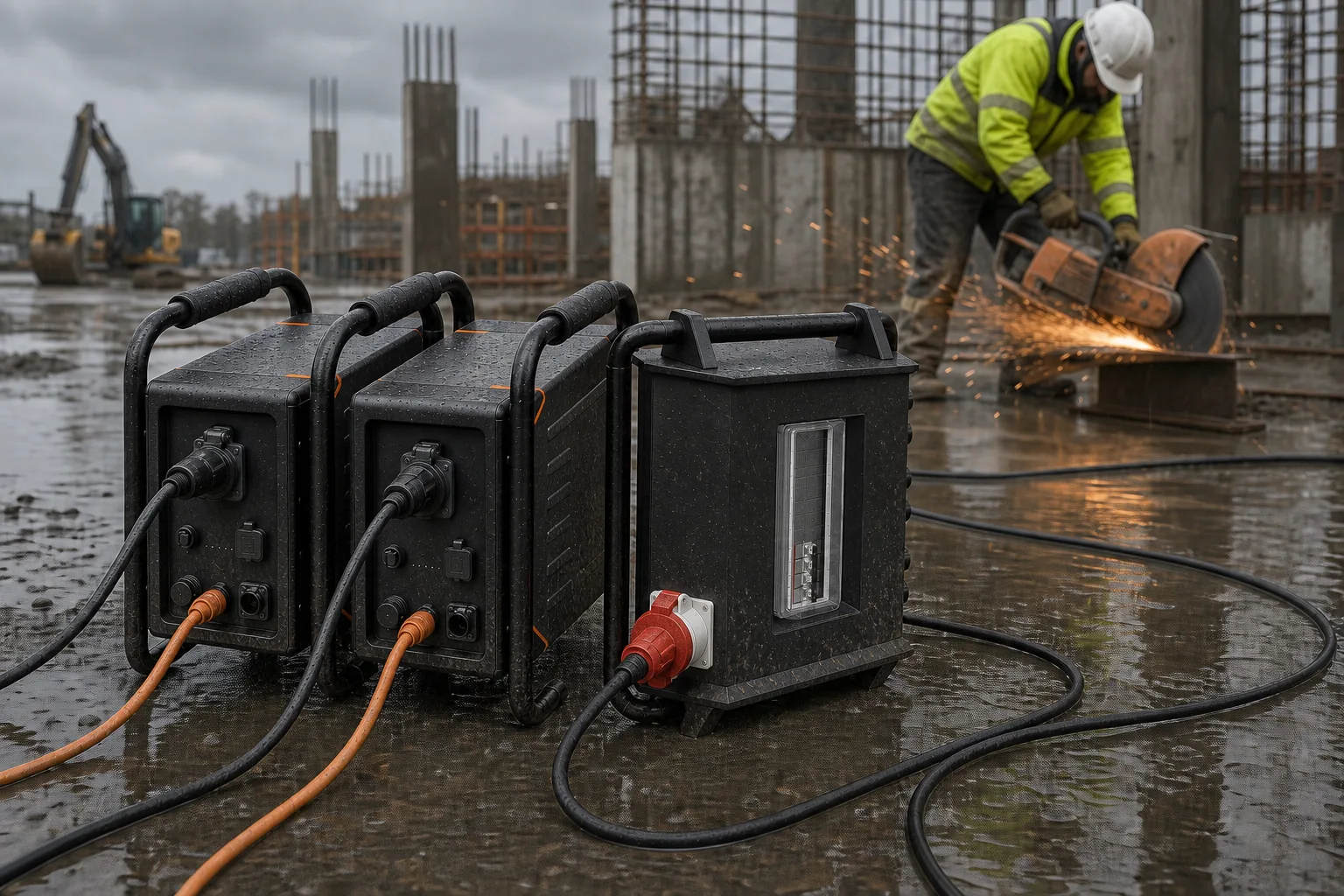
A cut-off saw on wet steel is the moment many configurations tip over. Not because of the continuous load — that is manageable. It is the second in which the disc spins up and the motor pulls the current it needs to reach speed at all.
With only one unit on site, you do not notice it on the meter but in the sound: the machine audibly sags, the speed hangs, and what should be a clean cut turns into chatter.
The limit sits at the output, not at the tool
A single P25 delivers 2,500 W rated and 230 V · 16 A at the output. That carries a lot. For a cut-off saw it gets tight — not because of the tool's rated power, but because of the current in the first moment.
Two things decide, and neither is printed on the tool's nameplate: how high the inrush current actually is, and how long a cut takes. A short cut into thin material forgives a tight design. A long cut through solid steel does not: the load stays on, temperature rises, and the unit shuts down — often exactly when the cut is almost through.
The step to two units
Two P25 on the P25-D give 5,000 W rated and AC230V · 20 A. 16 A becomes 20 A, and a borderline case becomes a working range.
The distribution box is not an accessory here; it is the part that fixes the assignment. Three faces, three jobs — the front carries only the breaker viewing window, the load sits on the red CEE socket on the left, the parallel cables run from the glands on the right. With two units, four of the six glands are occupied. The detail is in Three faces, one rule.
In practice: the load hangs on the left, never on the front. Plugging the saw into the front face breaks the rule before the first cut starts.
Wet steel: what it means for setup
Water and grinding dust are not edge cases on this site; they are the normal case. Three things follow:
- The units do not stand in the puddle. IP54 protects against water spray from all directions — not against standing water at the base of the enclosure.
- The load cable does not cross the cut line. A cable running under the disc is no longer a cable, it is a cutting attempt.
- The box stands upright with the front facing the operator. That keeps the breaker state readable without anyone reaching around it.
When 400 V is the better choice
If the cut is long and the material thick, the route via three units and the P25-T is often the calmer one: 7,500 W rated, AC400V · 10 A three-phase. The difference is not only power but whether the tool is built for three-phase at all. Settling that before ordering saves a conversion on site. The decision between 230 V and 400 V is covered in Grid form: 230 or 400 volts.
Three checks before the first cut
- Inrush current checked against output current — is 16 A enough, or does it need 20 A?
- Load on the red socket on the left, parallel cables paired on the right, nothing on the front.
- No standing water at the unit, no cable inside the cutting area.
Three checks, one minute. After that, the difference between "it runs" and "it runs through" is settled.
Configurations and their ratings are on the product page: https://www.hitama.net/en/p25-d