
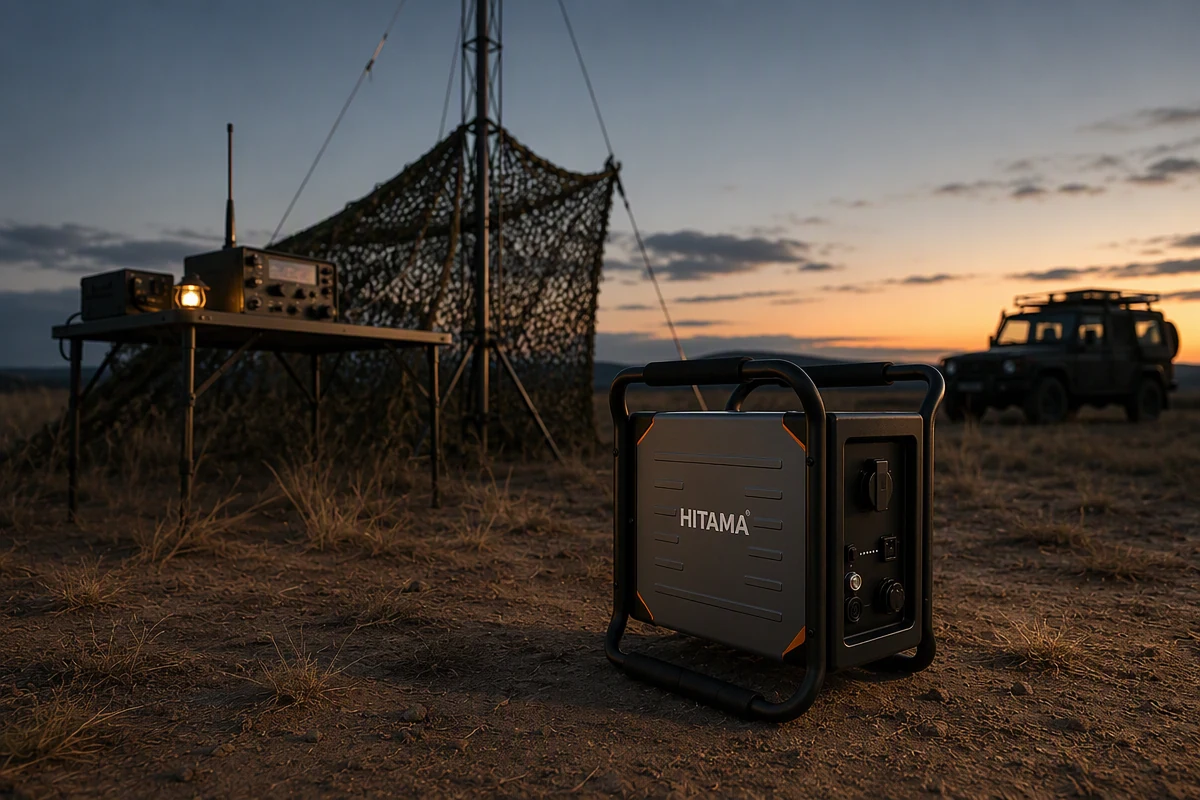
Every radio on the table has a test routine and a logbook entry. The power unit on the ground beside it usually has a note saying how much energy it held when it was last put away — and that note is the only history the deployment plan gets.
A field power unit spends most of its life switched off. The datasheet describes the hour it is switched on. What decides whether that hour happens at all belongs to the interval in between, and the interval is rarely anyone's job.
The interval is not empty
A stored unit changes while nothing is connected. Energy drains on its own, slowly, so the figure written down at the last handover is not the figure standing in the store three months later. Without a measurement, the only honest assumption is that it is lower than the note says.
The combustion alternative has its own standing regime. Fuel has to be managed and turned over, oil and filters carry a calendar as well as an hour meter, the starter battery is a second battery that appears on no equipment list, and the set wants to run under load now and then to stay serviceable. None of that is difficult; all of it falls due before a deployment rather than during one.
Both regimes fail in the same place, which is ownership. A generator with stale fuel and a unit at half charge look identical on a kit list.
Three numbers before it leaves the store
Remaining energy, not rated output. 2,500 W says what the unit can carry. 2.7 kWh says for how long — and only if the energy is still in there.
The date of the last full charge. One line that turns an assumption into a fact, and the cheapest line in the whole plan.
The recharge window where it is going. A full 2.7 kWh takes a little over five hours from a normal 230 V socket at 500 W, and under two hours at 1,500 W. That window has to fit inside the first day on site, competing with everything else the first day is for. If there is no socket where the unit is going, the plan has to name the source.
What the check does not fix
Capacity stays finite, and a check adds nothing to it. A section's charging schedule is itself a load on the same stored energy. Readiness only decides whether the job starts with the energy the plan credited it with.
IP54 covers dust and water spray, not immersion, and this is not equipment for a hazardous atmosphere.
With no fan, heat leaves through the housing. That asks for air around the unit — in a vehicle or a store, not closed into a crate with the rest of the kit.
A base power plant is still a different product. This is power at the point of work, for hours, from something one person can carry.
Send us the equipment list and the interval between deployments, and we will lay the charge plan against both.