
The question comes before the quote
On a site there are two kinds of load: those that run on 230 V, and those that need three-phase. An angle grinder sits in the first group. A three-phase welder, a large circular saw, or any machine that only exists as a three-phase unit sits in the second.
When an energy storage system is ordered and this question is settled later, the output often does not match the machine — not because the unit is too weak, but because the supply form is wrong.
So the question belongs before the quote, not after it.
Three configurations, three output ratings
The P25 parallel configurations are fixed in the design specification. Each output rating is stated at the distributor's left outlet:
- P25 + P25-D, two units — output AC 230 V / 20 A
- P25 + P25-D, three units — output AC 230 V / 30 A
- P25 + P25-T, three units — output AC 400 V / 10 A
Two observations explain the difference:
The number after the slash does not grow with the voltage. 30 A at 230 V is more current than 10 A at 400 V. Current and voltage are not the same thing — comparing amps alone compares the wrong quantity.
The supply form decides which machines are eligible at all. A three-phase motor does not run on a 230 V supply. No current rating changes that. That is the switch.
What the distributor separates
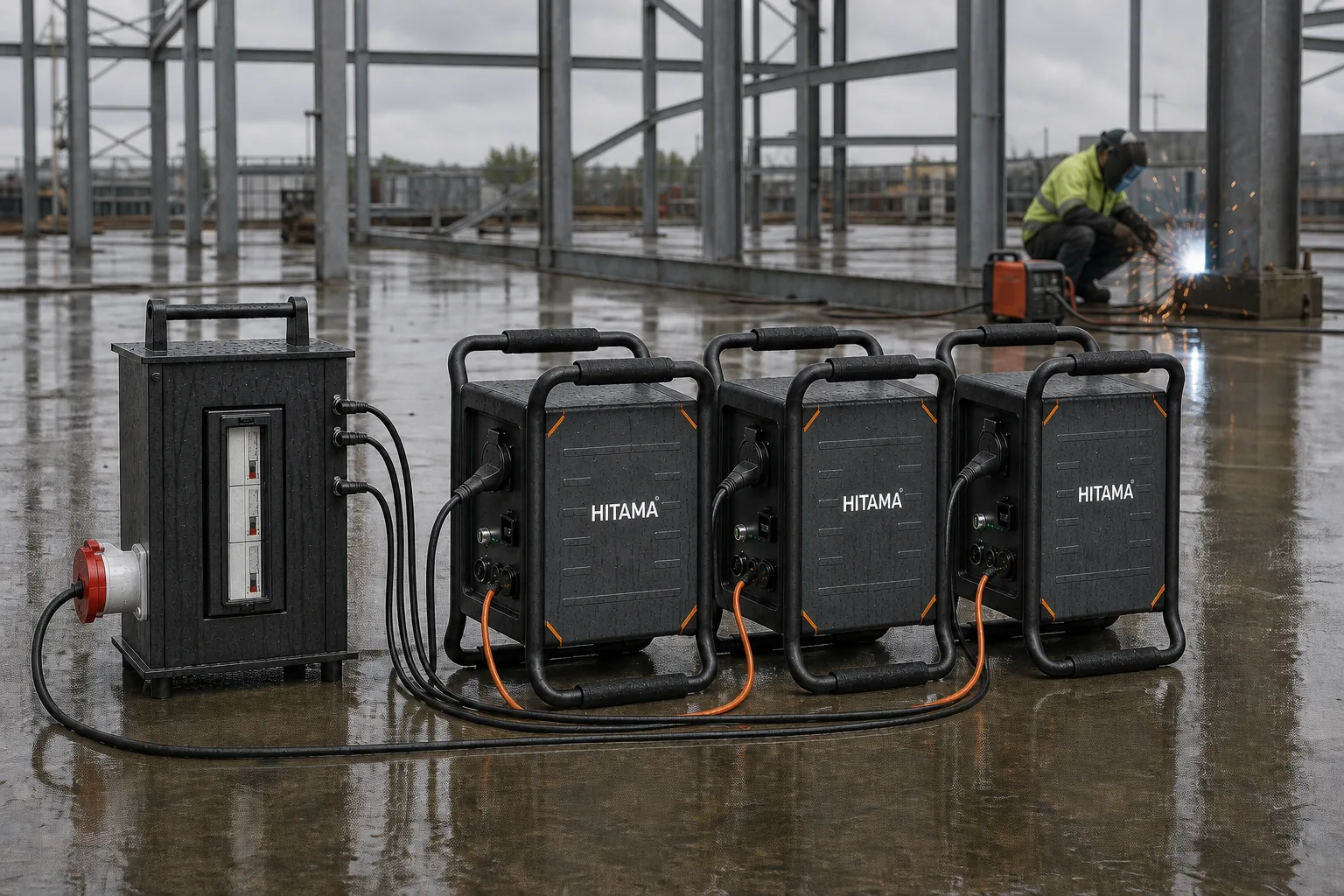
On the P25 series the distributor separates two things from each other:
- power — each unit connects to the distributor with its own black cable,
- communication — one orange cable runs alongside it.
Exactly one pair per unit, star-shaped back to the distributor rather than daisy-chained from unit to unit. The outputs sit on the distributor, not on the individual unit.
Three features you can check it against
Anyone inspecting a unit or an image can read the design from three features:
- The front of the distributor carries only the breaker inspection window, nothing else.
- The load is taken from the red industrial socket on the left side.
- The parallel cables leave through the cable glands on the right side — one black and one orange per unit.
An image that shows sockets or glands on the front does not show what is built.
Four questions before the order
1. Which machines run on the site — and which of them are three-phase units? That answer decides 230 V or 400 V.
2. How many units are needed? Two units on the P25-D give 20 A at 230 V, three units give 30 A. The P25-T goes to 400 V with three units.
3. How long is the longest working day without recharging? That is the load profile. Peak power is not.
4. Who checks the output side before the order? Whoever orders the configuration without knowing the outputs is ordering by feel.
What this article does not prove
- The figures above are nominal ratings at the distributor output. They do not replace a sizing calculation for a specific site.
- Whether a particular machine starts also depends on its inrush current and its motor, not on the nominal voltage alone. Check the machine's datasheet before ordering.
- A nominal rating at the distributor is not evidence of durability over years.
We provide the configuration's output ratings and the distributor's layout on request.