
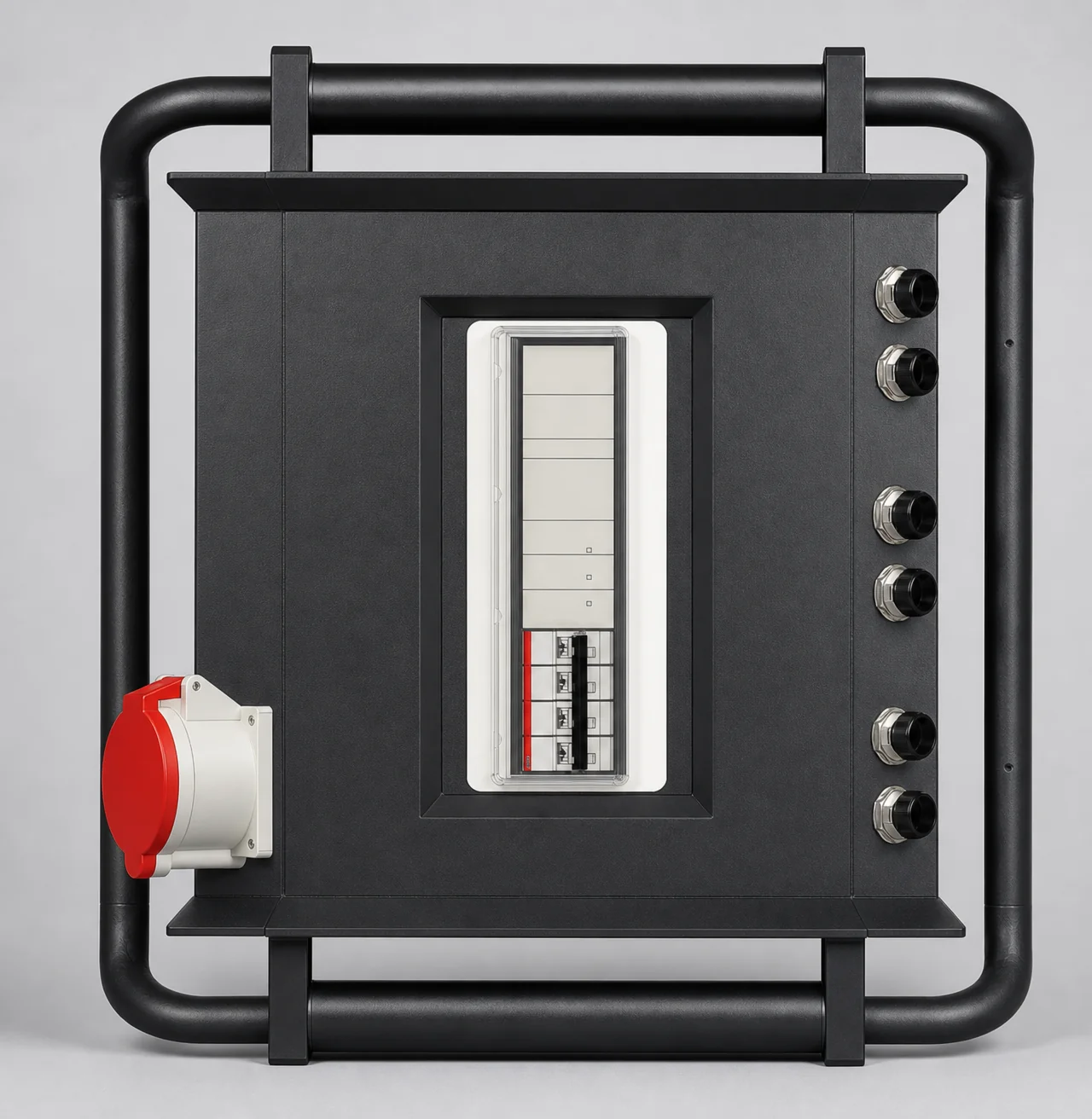
Anyone holding the distribution box for the first time turns it once — and finds a viewing window at the front, a red flap on the left, a row of glands on the right. Three faces, three jobs. And one rule that stays the same on every site.
Front: look, don't connect
The front carries nothing but the breaker viewing window — a white DIN breaker behind a clear cover, centred. No outlet, no socket, no cable.
That is not a cost saving but a decision: whoever stands in front of the box should be able to read the switching state without reaching live parts. An outlet on the front would defeat exactly that.
Left: the load
The load cable — black — leaves through the red flap of the industrial socket on the left side. Not from the front, not from a cable drum next to it.
That makes the mapping unambiguous: tools hang on the left, everything else is not load. Once that is internalised, nobody plugs it wrong under time pressure either.
Right: the parallel cables
On the right side there are six cable glands. One black and one orange cable per unit. Two units occupy four of them, three units use all six. The cables run horizontally to the right — not to the front.
The mapping is not a detail: two P25 on the box give 230 V / 20 A, three P25 give 230 V / 30 A, and with the P25-T it is 400 V / 10 A. The wiring therefore helps decide what actually arrives at the tool.
Why the split matters
Anyone renting out the box knows the difference between “it runs” and “it is wired correctly”. Plugged wrong means unbalanced load, a warm plug, and in the worst case a failure mid-job — plus a customer calling the next morning.
The three faces are therefore not a drawing question but a hand-over question.
Three checks at issue
- Is the front facing the operator — and is there no cable in front of it?
- Is the load on the red socket on the left — and only there?
- Are the parallel cables paired (black plus orange) and complete, with no torn ends?
Three questions, twenty seconds. After that the hand-over is done, and the call the next morning does not happen.
Configurations and their ratings are on the product page: https://www.hitama.net/en/p25-d