
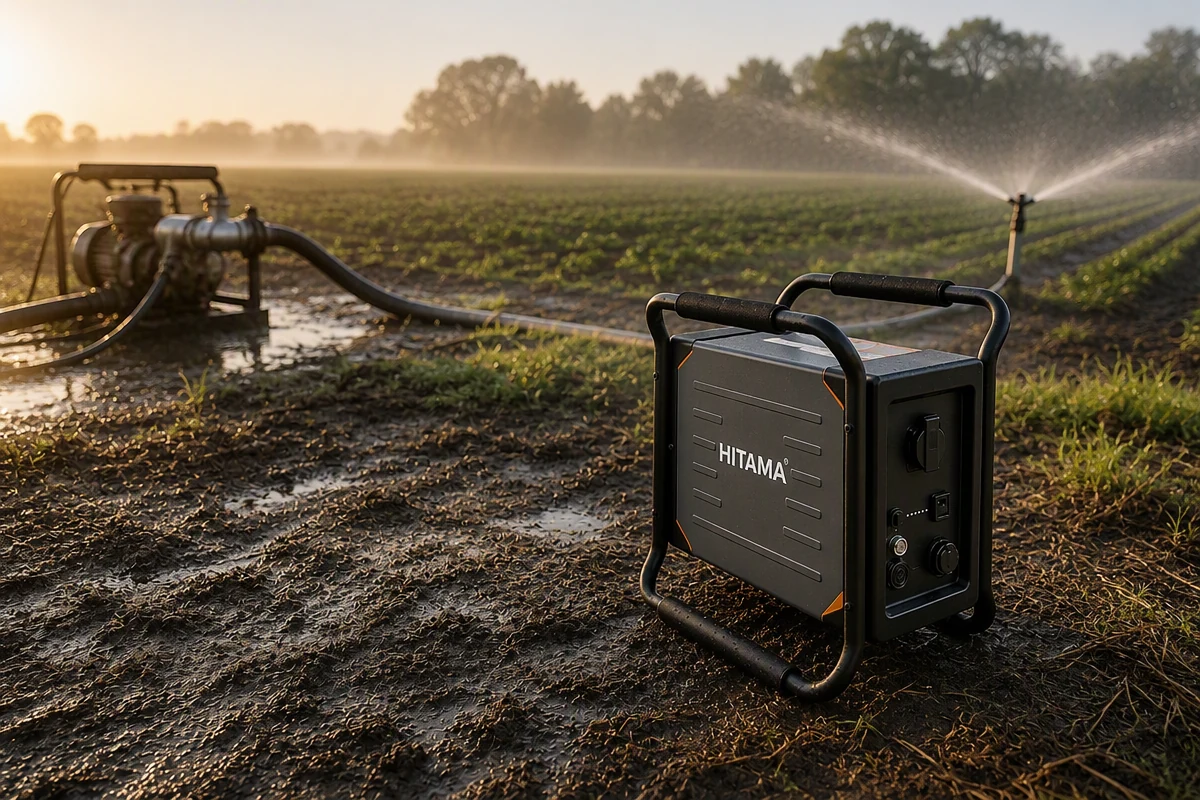
Most farm three-phase problems are not wattage problems. The 400 V socket is fixed inside one building, while the augers and roller mills that need it travel to the grain. HITAMA's P25-T puts that point on a frame: three 2,500 W units and a distribution box, 7,500 W of 400 V three-phase from 8.1 kWh. That covers a shift of intermittent motor work, not a mill running all day.
The socket is fixed. The work is not.
A farm gets one three-phase point, and it is a building. It went in years ago for one machine — a dryer, a mill, a bench — and stayed there. Buildings added since were wired for lighting: 230 V, one phase, a few sockets.
The machines that need 400 V are the ones that move: augers between silo and trailer, sweep augers following the grain, mixers working between two yards. A fixed socket is the wrong shape of supply, and a long extension is no answer for a motor.
1. Where does the load actually stand?
Record a location, not a number: the yard each 400 V machine works in, and whether it moves weekly or twice a season. Weekly movement justifies a transportable supply; a bolted mill does not. The list usually shows the fixed socket covers the smallest share. The agriculture docket asks the same question in other clothes.
2. What does a distribution box change?
It is not three units cabled to the load. In the P25 range each unit runs to its own input pair on the box, and only the box output feeds the machine. Removing a unit takes the phase away instead of quietly derating the supply.
A motor's start is not its rated draw
The plate is the smallest number in the decision. A 3 kW auger motor does not ask for 3 kW. A direct-on-line start draws several times its rated current for a fraction of a second, and the supply must survive that at every throw of the switch — including the restart after a jam.
Sizing on the plate gives a unit that runs the machine and trips on the third start. The note on grain dryer fan loads makes the point for one motor: start and run are different numbers.
1. What does the ten-second peak cover?
2,500 W continuous, 5,000 W peak for up to ten seconds. That window is what a start needs; it is not permission to run a 5 kW machine.
2. Why is a compressor a separate case?
Its start current sets a dairy's supply, not its running draw, and the pull-down afterwards has its own clock; the milking interval article works that through. Farm motors follow the same physics.
Energy is the ceiling, not power
Eight kilowatt-hours is a shift, not a season. 7,500 W at plated power empties 8.1 kWh in a little over an hour — arithmetic, before losses. Real work is intermittent: minutes on, minutes off. Ask for motor-minutes per day, not kilowatts on the plate.
P25, single. 2,500 W · 230 V · 2.7 kWh stored · 29 kg.
P25-D, two units. 5,000 W · 230 V · 5.4 kWh stored.
P25-T, three units + box. 7,500 W · 400 V three-phase · 8.1 kWh stored.
Peak, per unit. 5,000 W for up to 10 s, not a continuous rating.
Three units, or no phase
The third unit is not a spare. 400 V three-phase needs all three present. With two, the set is a 230 V supply and a three-phase motor will not start — which is why the configuration is settled before the season. Keep the set together the way you keep the fuel key.
What this is not
It is not a 400 V service. 8.1 kWh is a working window; a mill at plated power outlasts it in about an hour. IP54 covers dust and spray, not immersion. Each unit weighs 29 kg, so the set moves with two people and a barrow. Recharging runs at 500–1,500 W from a 230 V socket — hours, scheduled like any other task, as with loads that run unattended.
Questions we get asked
1. Can three P25 units really start a 400 V auger?
Usually yes, if the motor stays inside the 2,500 W continuous rating and the start fits the ten-second peak. Check the motor plate and the start method, not the advertised size. Send both and we will say where the margin is thin.
2. How long does 8.1 kWh last on a farm job?
About one hour at the full 7,500 W, longer the more intermittent the work. An auger running four minutes in ten gets roughly two and a half hours of clock time. Measure a normal morning before choosing capacity.
3. What if the machine needs more than 7,500 W?
Then this configuration is the wrong one, and adding units does not fix a motor of that size. Above that class a fixed 400 V connection or a different machine is the honest answer, and we will say so before quoting.
Send the motor plates and the yards they work in, and we will size the set against the real start pattern.