
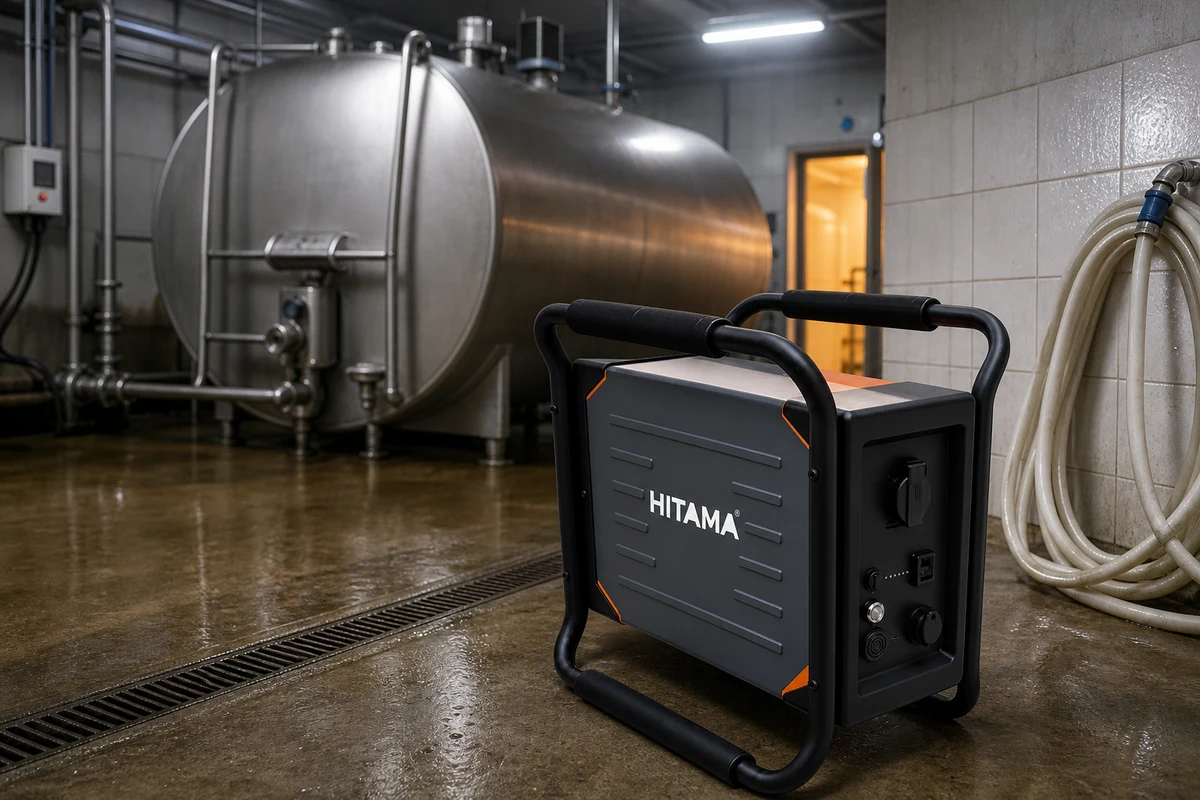
A dairy does not run out of power during milking. It runs out between milkings. The parlour empties, the bulk tank pulls down, the unit goes back on charge, and the next shift starts on a fixed clock. The question is not what the plant draws, but whether the unit is full when the clocks meet.
The heaviest hour starts when the work stops
Milking ends and the compressor takes over. The last cluster comes off, the milk leaves the parlour warm, and the tank brings it to its setpoint. That pull-down is the largest load of the day, and it begins as the shed empties.
The tank carries its own clock. Its manual states a pull-down time at a stated ambient, and that is what the unit covers. A daily total understates the first hour and describes nothing else.
The plant room is empty while this happens. Between milkings the door is shut and the load runs on. Anything that needs watching between shifts is the wrong choice there.
A compressor is not a welder
Start current is the first test, not running watts. A compressor motor draws a multiple of its running current as it comes up to speed, so the unit is chosen on two columns: rated for the shift, peak for the start.
A trip at the start is a headroom problem. If the unit drops out when the compressor kicks in, more kilowatt-hours will not fix it: P25 is rated 2,500 W with a 5,000 W peak, P36 3,600 W with a 20,000 W peak from 2.1 kWh.
The controller is the load that complains quietly. Tank boards, parlour panels and chargers prefer a clean wave, and total harmonic distortion stays under 3 percent.
Two clocks, one configuration
Charging is half the cycle. From a 230 V socket the input draws 500–1,500 W: P25 reaches 80 percent in about two hours and full in 2.5, P36 in about 1.5. That window has to fit between milkings.
Capacity is a duration, not a headline. P25 holds 2.7 kWh at 2,500 W continuous, P25-D two modules in parallel for 5,000 W and 5.4 kWh, C24 2.0 kWh at 2,400 W for a smaller tank. The useful figure lasts from one milking to the next.
Separate feeds are a module question. One to three modules run in parallel. Where tank and parlour should not share a strip, P25-D gives two feeds from one configuration.
Four hundred volts is not a wattage question. A three-phase vacuum or wash pump does not run from a single-phase unit at any rating. P25-T combines three modules to 400 V three-phase, 7,500 W rated and 15,000 W peak from 8.1 kWh.
The plant room is wet, warm and dusty
IP54 is splash protection, not submersion. Wash-down water crosses the floor and stands in the drains. The unit belongs outside the wet zone, cable off the floor.
No intake and no fan means nothing to clog. Feed dust and bedding do not fill a filter, because there is none. Heat leaves through the casing, so clearance matters more than air moving through it.
Measure the temperature beside the compressor. −10 to 65 °C is the working range. A plant room in July is not the yard, and the door is not the tank. C24 is 23 kg and P25 29 kg as a carry; P25-D is around 60 kg on a trolley.
What this is not
It is not automatic standby. There is no changeover; someone has to connect it. Where the requirement is a supply that starts itself when the mains fails, this is the wrong device.
It is not part of the farm installation. It feeds its own outlets and cannot be wired into the fixed distribution. It is not a UPS either: there is a gap between the mains going and the unit being plugged in, and the tank sees it.
IP54 is not submersion, and no Ex rating is claimed. The certifications are CE under the EMC Directive 2014/30/EU and UN 3480 class 9 packaging for sea freight.
Send the load list — the tank's rating plate and starting method, its pull-down time at the setpoint, the pumps with their voltages, the hours between milkings, and the temperature beside the compressor. We will size the configuration against the interval and tell you where it stops.