
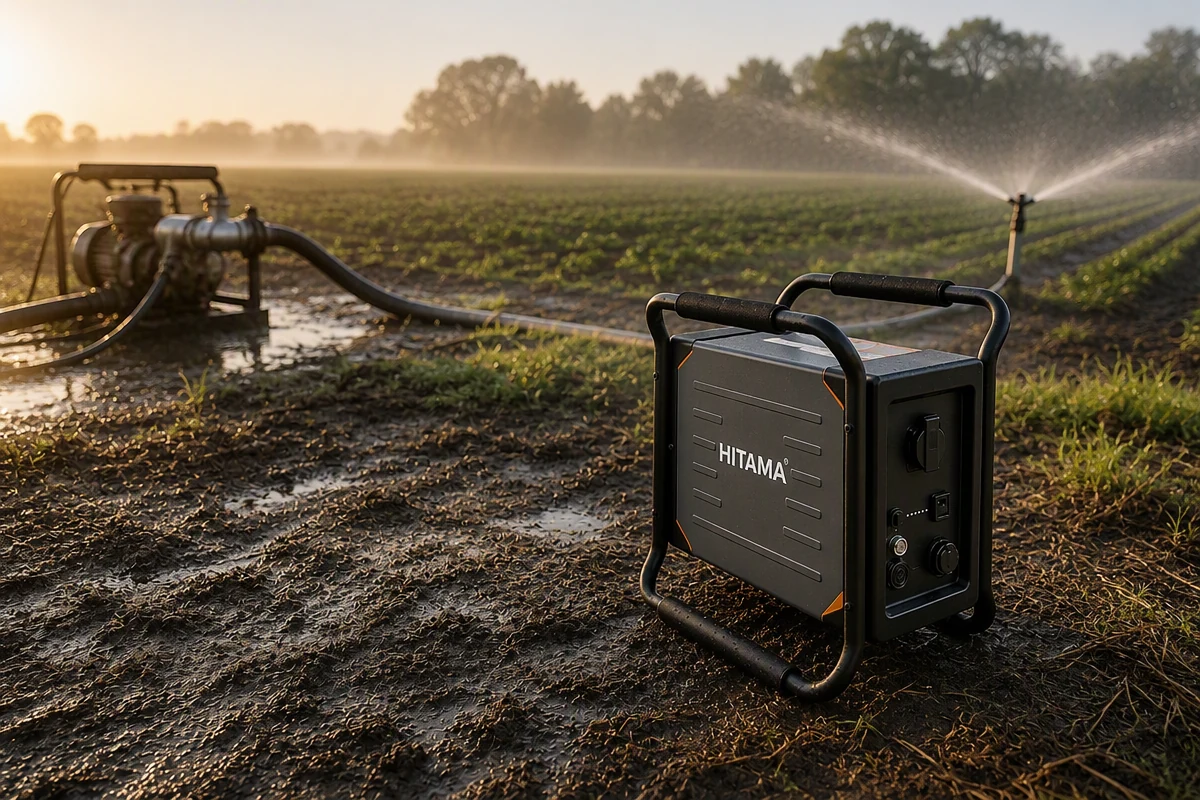
The load that matters is the one nobody is standing next to
Farming has a night shift with no shift on it. An irrigation cycle, ventilation in a livestock building, a tank that has to hold its temperature: none of these are decided by what somebody happens to be holding at the time. They run in windows where nobody is on site, and they follow a pattern rather than a decision. That is a different requirement from a tool list, and it decides what a power source has to be.
Why an engine makes that shift harder
A combustion unit puts a person back into the loop. Fuel does not arrive by itself, so an unattended load becomes an attended one: somebody has to be there when the tank runs low, and somebody has to be there to shut it down. With the engine come two more constraints — exhaust, which rules out the inside of a shed, and noise, which is the thing the neighbours hear at three in the morning. Take the engine away and all three go with it: no fuel chain, no exhaust to route, no combustion noise.
What changes with a battery unit, and what it adds
The constraint moves from fuel to calendar. The P25 delivers 2,500 W of continuous output with 2.7 kWh of stored energy at 29 kg, pure sine wave, fanless cooling, no daily maintenance. A P25-D pair gives 5,000 W and 5.4 kWh at 230 V; three units with the distribution box (P25-T) give 7,500 W and 8.1 kWh at 400 V three-phase. The battery also adds a task the engine never had: recharging from an ordinary 230 V socket at 500-1,500 W. That means the socket has to be near the work, or the unit has to come back to one.
The failure mode is part of the specification
A flat battery is discovered late. An engine usually announces itself first: louder, hunting, then off. A silent source simply reaches its limit, and on an unattended load nobody is there to watch it happen. So the sizing question is not only the output figure, it is how much margin one night needs and how a shortfall gets noticed. That is settled by duty cycle, not by peak: hours at running draw against stored energy, with the pump's start surge counted separately, because it is a separate problem.
What this does not do
It is a working power source, not a standby supply for the farm. The energy is finite: 2.7 kWh per unit against a load that may want it for eight hours. IP54 covers dust and splashing water, not immersion, and the unit is not for explosive atmospheres. Where a three-phase pump has a hard start, the surge has to be planned rather than assumed. And a unit that works all night still has to be recharged the next day.
Send us the loads that run when nobody is on site — the duty pattern, the hours, and where a socket is available — and we will work the configuration out with you.