
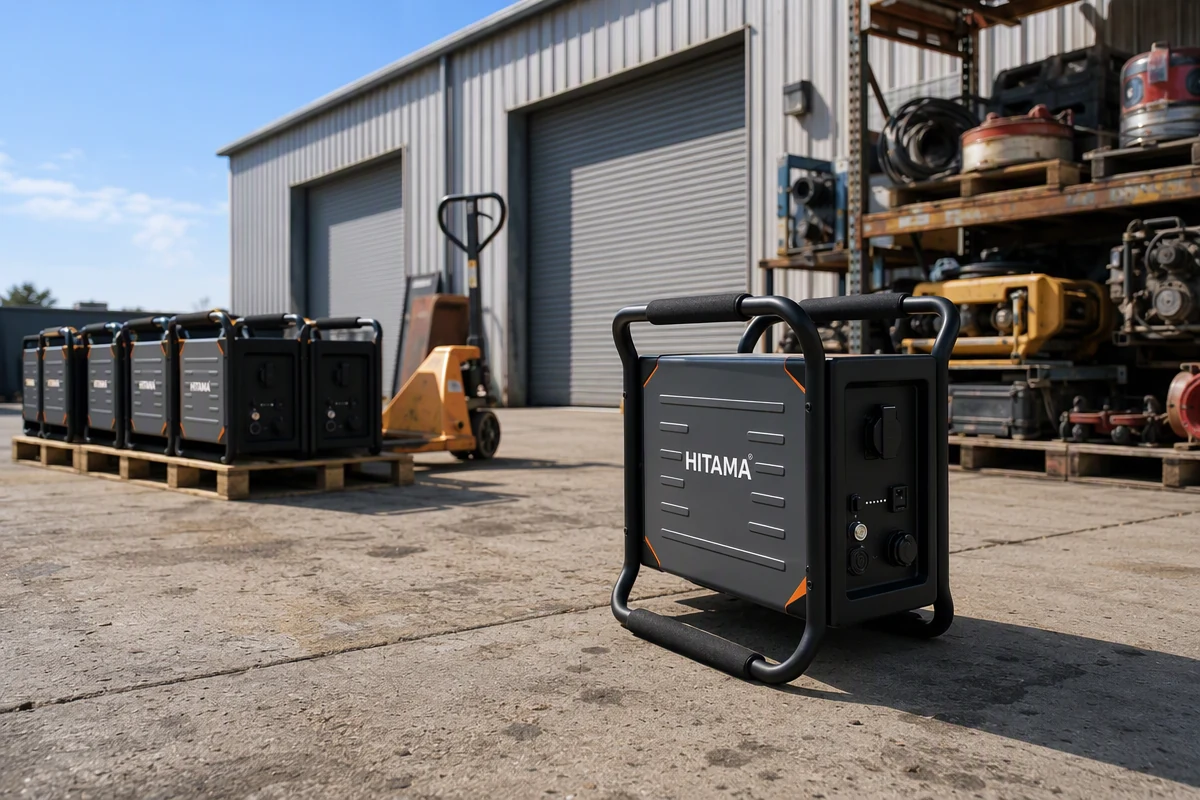
The asset that loses value is the one nobody photographed
A three-year-old power station is priced on its case and valued on its cells, and only the case is in the advert. Dents, a faded decal, a missing cable all show in a yard photo. How much energy the pack still accepts is invisible, and it decides what the machine earns in year four.
Depreciation in a battery fleet is not a curve, it is a spread. Two units from one invoice can leave the yard three years later as different machines, one still near its 2.7 kWh and one well short of it, both on the asset list at the same book value.
The diesel gave the buyer something to listen to. A cold start, oil pressure, the colour of the exhaust: a mechanic forms an opinion in twenty minutes without an instrument. A pack that shows 100 percent and collapses an hour into the shift looks healthy until the shift ends.
The hand-over sheet records damage, not energy
Rental paperwork is built for liability, so it records what can be charged for. Scratches, a missing cable, a broken latch, the hour meter. No standard sheet asks how much energy came out of the pack, because until recently nobody could invoice it.
Hours on the display are hours of standing, not hours of working. A season running a 300 W site light and a kettle collects hours without collecting cycles; the same hour count driving a 2,500 W tool at the top of its rating describes a different life. One number, two histories.
A capacity test is a load, a clock and two numbers
The measurement is not complicated: apply a known load and time it. A 1,000 W resistive load on the 230 V 16 A outlets, run to cutoff, hours multiplied by load. A pack delivering 2.4 kWh against a 2.7 kWh nameplate has lost roughly a tenth — and now there is a figure for the contract.
What makes it awkward is that the test costs a working day. The unit cannot be hired while it is measured, and the yard needs a load bank or a heater of known size. Fleets skip it because the machine earns more on the road than on the bench.
Small packs age in a different shape
Capacity per kilogram decides how often a pack works, and use decides how it ages. A P25 carries 2.7 kWh in 29 kg, which is why one person walks it to the work face instead of running a cable. That convenience is also a cycle count: what is easy to move gets discharged every day.
The larger boxes trade cycles for handling. A P25-D at 5.4 kWh and around 60 kg, or a P25-T at 8.1 kWh and around 90 kg, delivers twice or three times the energy per cycle and needs two people or a lift. The machines that lose value fastest are the ones that ran most, not the ones bought cheapest.
What parallel running changes is the arithmetic, not the cells. Two P25 on the parallel box reach the P25-D figures, 5,000 W continuous and 10,000 W peak, and stay two 29 kg units one person carries; one weak pack does not condemn the whole capacity.
What this is not
This is not a valuation service and we will not quote a residual value. We publish no cycle-life figure and no capacity-fade guarantee; a dealer offering a three-year percentage without a test protocol is guessing.
It is not a claim that a battery holds value better than an engine. A diesel has a liquid market, a scrap value and mechanics who can price it in an afternoon. A battery has a thinner market and a measurement problem; for some fleets that combination is simply worse.
And it is not a compliance statement. Our CE marking sits under the EMC Directive 2014/30/EU, test report A2409245-C01-R01-V1: electromagnetic compatibility. IP54 is an enclosure class for dust and splashing, not a seal; UN 3480 class 9 packaging covers sea transport, not shelf life.
The third year is a documentation problem
A fleet that cannot state its capacity cannot price its used machines, and the gap appears in the trade-in offer. The buyer discounts for uncertainty, and uncertainty is what an untested fleet is made of. One page per unit — date, load, hours to cutoff, delivered kilowatt-hours — turns that discount into a negotiation.
Start with the units you intend to keep, and write the figure where the next person will find it. A capacity reading in a file outlives the person who measured it.
If you are building a hand-over or trade-in routine, send us the unit list, the age spread and the loads actually run: https://www.hitama.net/en/contact