
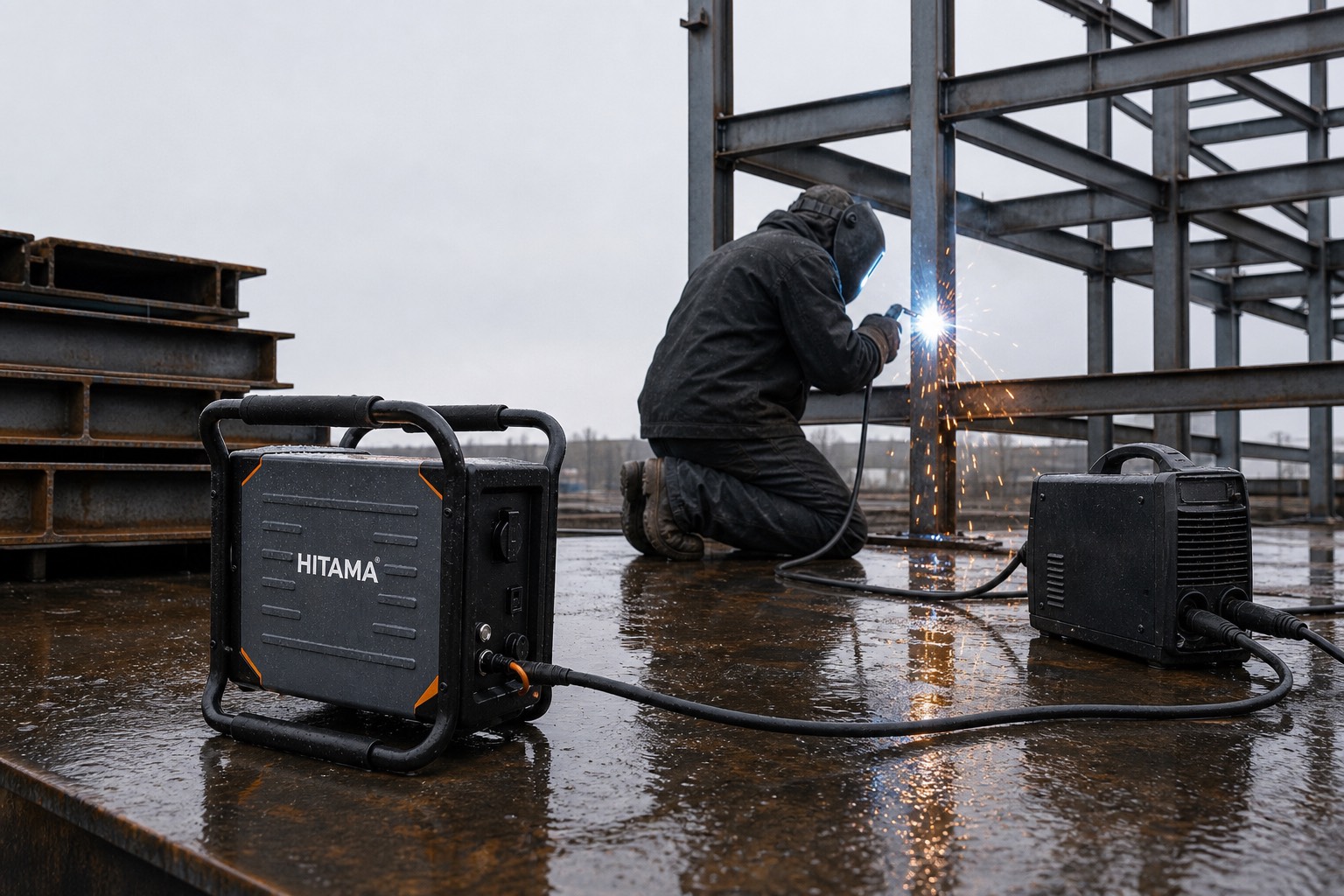
Welding on site has two requirements that a generator used to settle by default: 400 V three-phase, and enough surge to strike an arc without the machine cutting out.
What the welder actually asks for
A 160–200 A inverter welder runs to a duty cycle, not continuously. What it needs at the moment of striking is a short burst well above its running draw. That is why continuous output is the wrong number to buy on: peak output is what decides whether the arc starts at all.
Configuring it
The P25-T system — three units with the distribution box — gives 7,500 W and 8.1 kWh at 400 V, which is the configuration for three-phase welding machines. For a single-phase 230 V welder, a P25-D pair covers 5,000 W and 5.4 kWh.
What you keep, and what you give up
You keep the process: no fuel, no exhaust, and no engine noise beside the weld — which matters in a workshop, in a basement, or anywhere a generator cannot be placed at all. You give up the idea of welding indefinitely from one unit: 8.1 kWh is a real amount of welding, but the honest way to plan it is electrode count and duty cycle, not hours.
The limits
Not for explosive atmospheres. IP54 means dust and water spray, not immersion. Recharge is 500–1,500 W from a 230 V socket, so a two-shift welding day needs a recharge plan — not only a second unit.
Send us the welder's nameplate and duty cycle and we will size it.