
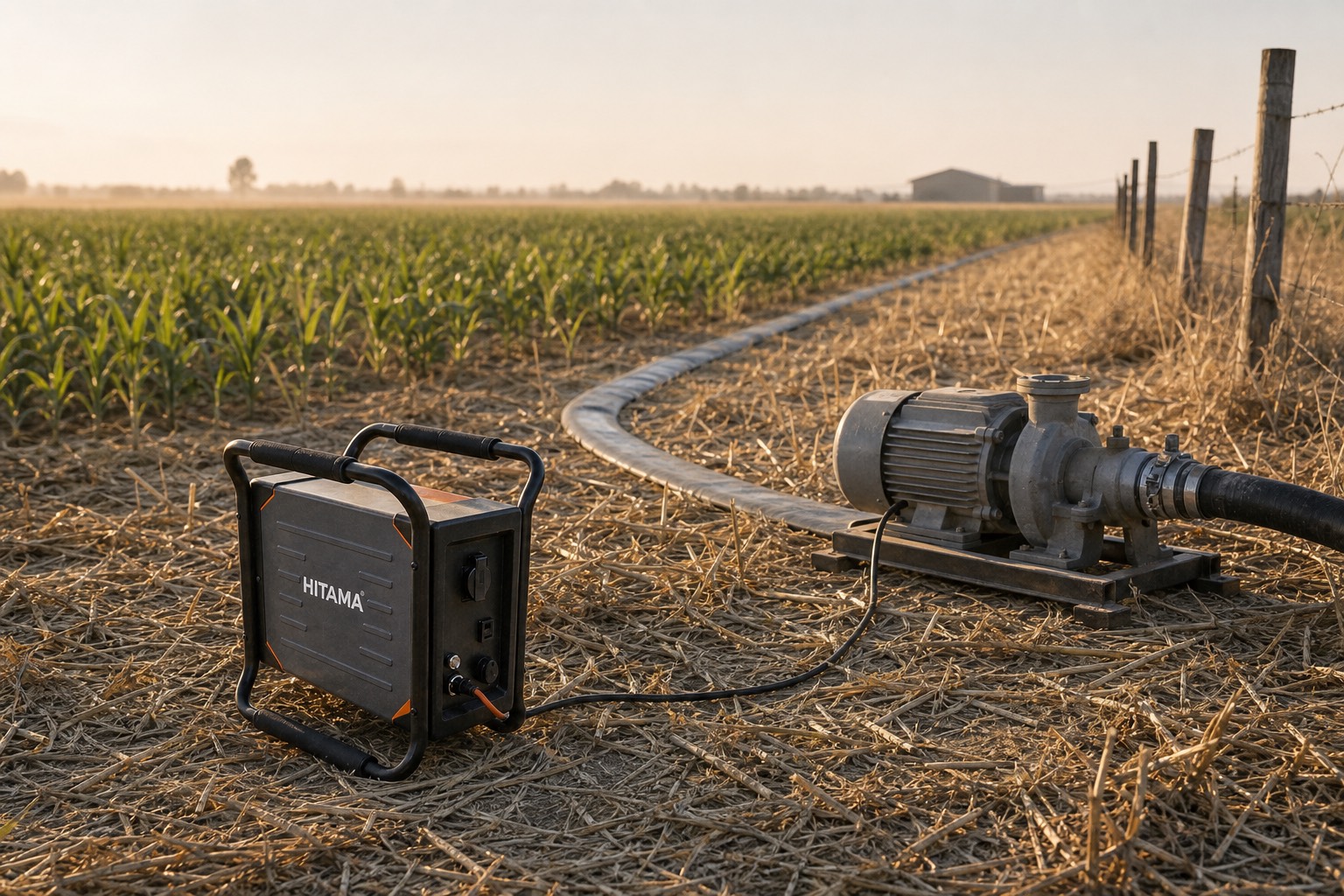
A pump is the clearest test of any power system. It has to start against a head of water, which means a surge far above what it draws while running — and then it runs for hours.
The loads
Irrigation pumps. Surge at start, then a long, steady draw. Check the pump's starting current, not only its rated watts.
Fencing and gates. Small, intermittent, and often a long way from any building.
Remote buildings and workshops. Lighting, hand tools, the occasional compressor.
Charging. Handheld tools and battery packs, on a schedule.
Sizing
One P25 is 2,500 W and 2.7 kWh; a P25-D pair is 5,000 W and 5.4 kWh. Where the load is long and light rather than heavy and short, the C24 starts at 2,048 Wh and expands to 10,240 Wh by stacking — capacity without a second unit to carry.
The limit
It is not a grid connection. Capacity divided by load gives you hours, and a pump running all afternoon is a real, continuous load — not a rounding error. Recharging is 500–1,500 W from any 230 V socket. IP54 covers dust and water spray, not immersion: the unit can stand in rain and on wet ground, but not in water.
Send us the pump's nameplate and how many hours a day it runs.