
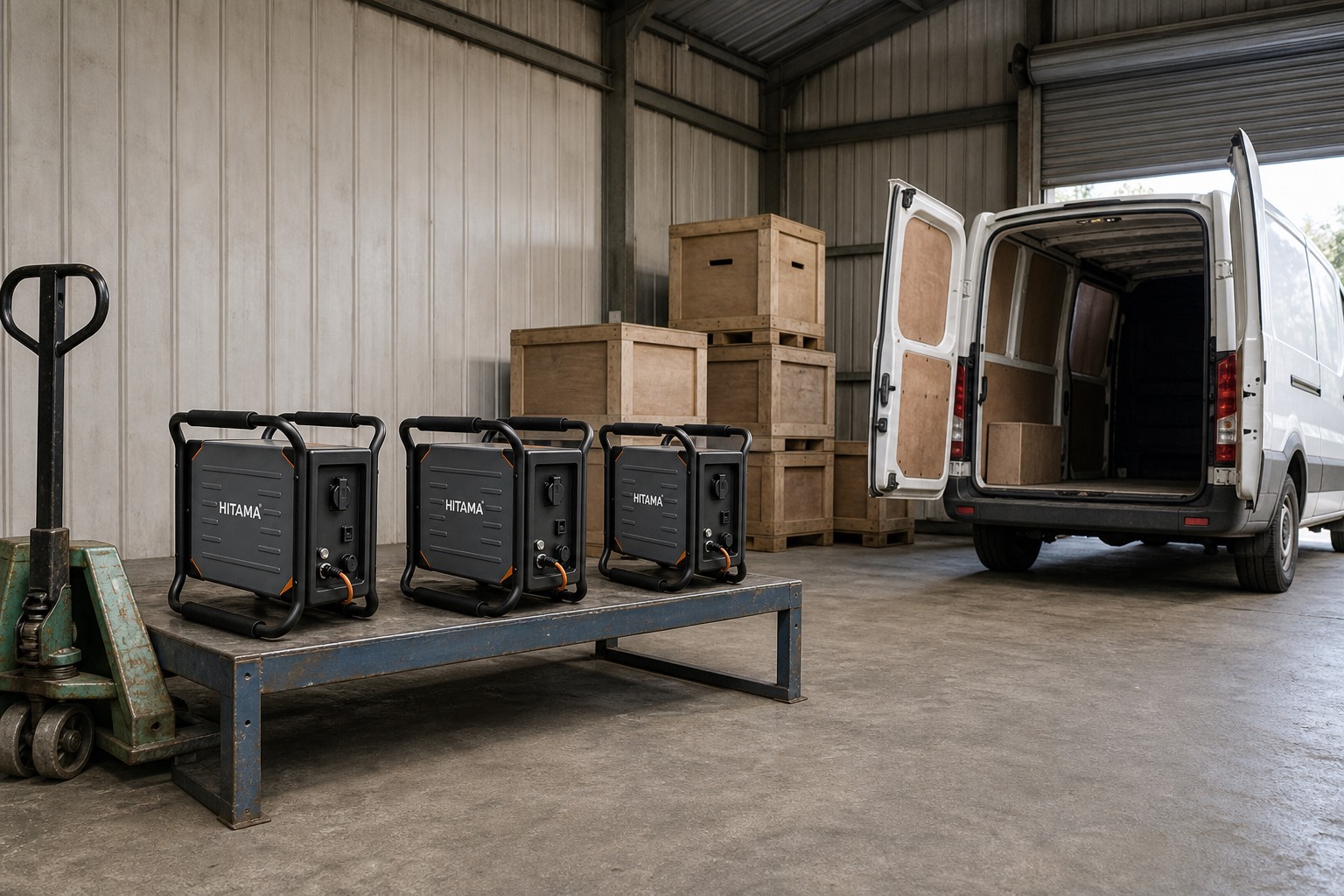
A tool-hire business does not buy power, it buys turnover. The question is not what a unit can do but how quickly it goes out, comes back and goes out again.
What actually changes at the depot
No fuel logistics. Nothing to order, store, deliver or spill — a whole column leaves the depot's day.
No engine to service. No oil, no filters, no spark plugs, and no hours-based service interval waiting on a unit that sits idle between hires.
No exhaust in the customer's premises. A customer who wants to work inside a hall or a basement can be served at all — a request many hire desks have to turn down today.
One person hands it over. 29 kg, no start procedure to demonstrate, no lifting gear.
What to keep on the shelf
P25 covers the general hire: 2,500 W and 2.7 kWh. Where a three-phase tool or a welder appears on the order, the P25-T system gives 7,500 W at 400 V and 8.1 kWh. And plan the charging row at the depot: units take 500–1,500 W from a normal 230 V socket, so the shelf turns over at the rate the power points allow.
Say the limit out loud
Capacity is finite, and a hire customer will find the edge of it. Give the run time at the counter against their tool list rather than letting them discover it on site — a unit that dies mid-job comes back as a complaint, not as a hire.
Ask us for run times against a specific tool list.