
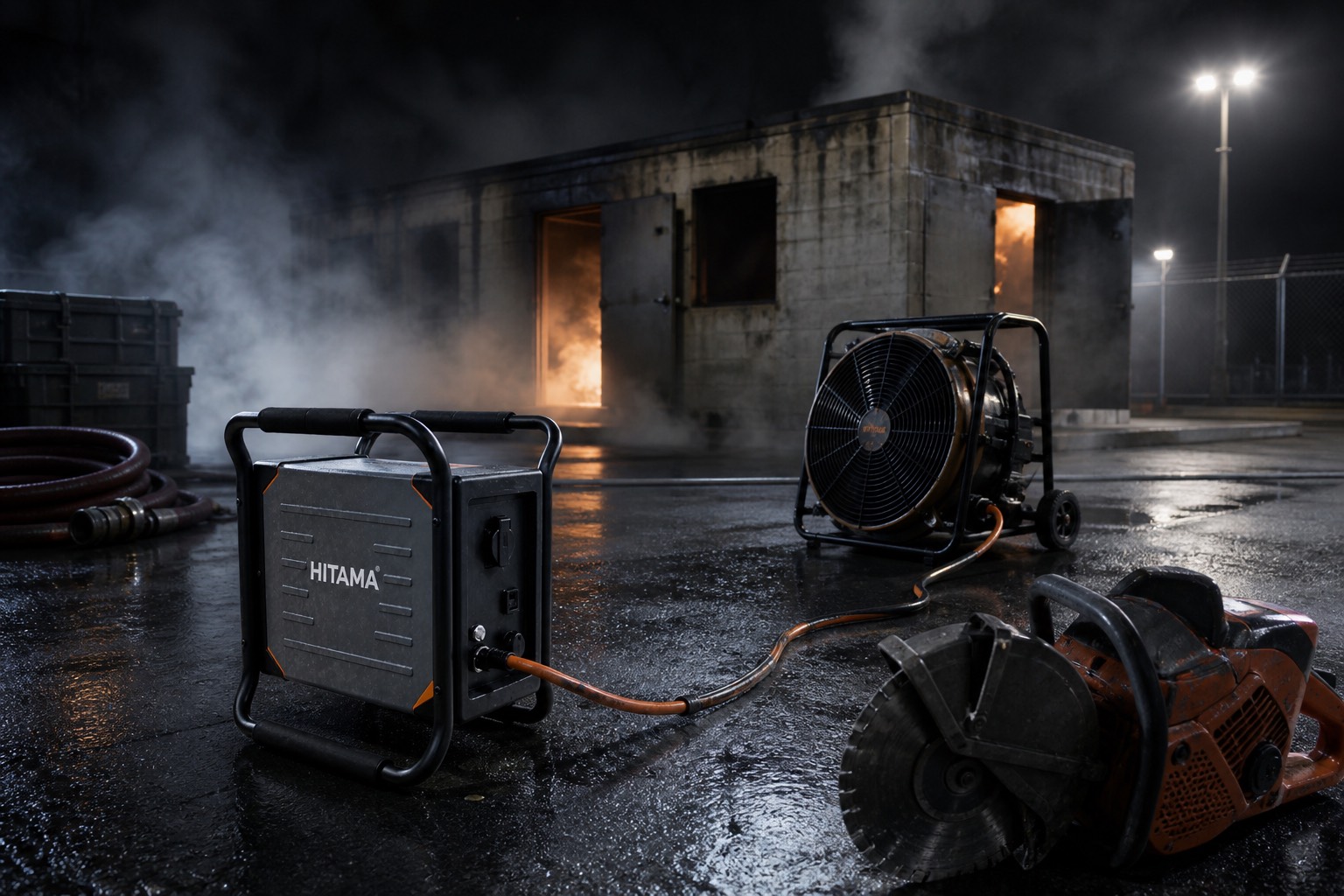
At an incident you are already managing noise, air and fuel. A generator adds all three to the list. A battery unit takes them off it.
What actually changes
Radio comes first. A unit without an engine means the pump operator can hear the incident commander. That is not a comfort feature.
It can work where a generator cannot be placed. Basements, stairwells, tunnel sections, enclosed rooms — the places where exhaust is not a nuisance but a hazard.
No refuelling run. A unit charged at the station is ready when the call comes: nothing to source at 3 a.m., no can to carry upstairs.
One person deploys it. 29 kg on the P25, no start procedure, no separate lifting gear.
It runs: ventilation fans, cutting and breaching tools, deployable floodlighting, and charging for hand tools and radios.
Sizing is arithmetic, not marketing
A P25 gives 2,500 W continuous and 2.7 kWh. Two units in parallel (P25-D) give 5,000 W and 5.4 kWh. Three units with the P25-T distribution box give 7,500 W and 8.1 kWh at 400 V. Read the tool's rated power and its starting surge, then pick the configuration. That is the whole method.
The limit worth stating
Capacity is finite. It is not a pump's duty cycle, and a unit is not an emergency supply for a building. The units recharge from a normal 230 V socket at 500–1,500 W, so plan the recharge the way you plan a fuel run — it is a task, not a given. IP54 means dust and water spray, not immersion.
Send us your appliance list and we will size the configuration with you.