
Two healthy units that refuse to run together
The unit that fails in parallel almost never fails on its own. It starts the saw, holds 2,500 W, takes a 5,000 W surge for ten seconds and passes every bench check. Linked to a second unit, the pair delivers less than the arithmetic promised.
Nothing is broken, which is what confuses the site engineer. No error code, no open fuse, and both machines still run a kettle. They are simply not the same machine at the level where the link is negotiated, and that level is not the cable.
The handshake happens before the first ampere
Units share a load only if their control electronics agree on how to share it. That agreement is firmware: the same build, the same parallel-capable configuration, the same output voltage and frequency settings. Two units from one batch can look identical and still disagree here after one was serviced.
A single field update is enough to break a pair. Each unit runs perfectly alone; linked, the handshake either never closes or closes and drops out under real load. This is why we ask for the build before we ask for the cable length.
The parallel box is a busbar, not a brain
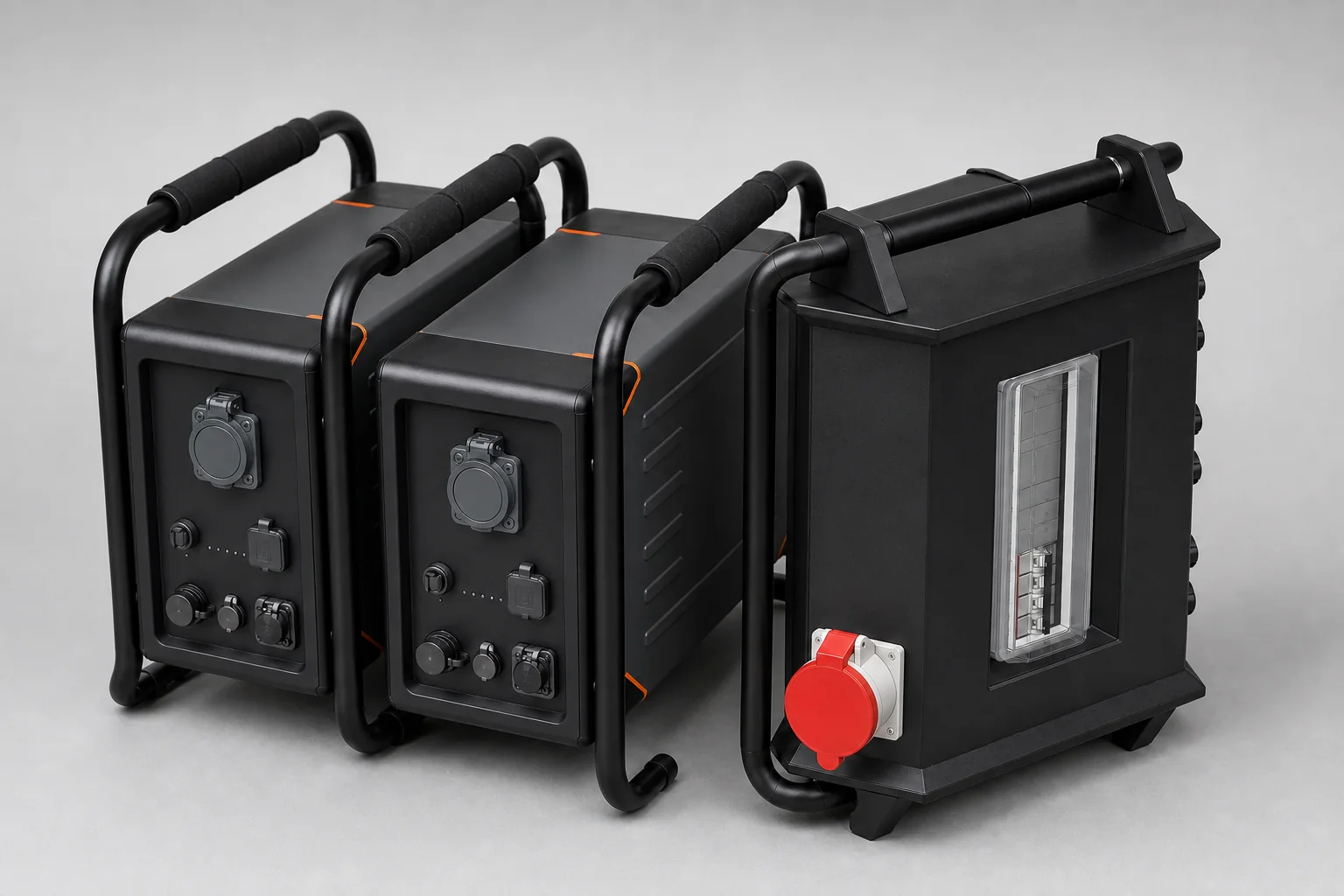
The box joins the outputs; it does not arbitrate between them. On the P25-D path it is the 230 V 20 A interface that lets two 2,500 W units present one supply. Whether the two units behind it speak the same protocol is something it cannot know.
A correctly rated box will still hand you a pair that refuses to close. The decision was made upstream of it, which is why the box is the last component in the chain and the first one suspected. When a pair closes and splits unevenly, the box is doing exactly what a busbar does.
Equal copper, or unequal current
Two leads of different length are two different resistors, and the shorter one wins. Copper at 1.5 mm² runs at roughly 12 mΩ per metre, and both conductors carry current, so each metre is about 24 mΩ of loop. Ten metres of difference is roughly 0.24 Ω.
At the 10.9 A a 2,500 W unit draws from 230 V, that is a couple of volts between two paths meant to be one. Current divides inversely to resistance, so the shorter lead carries more and reaches its limit earlier; the honest total lands below 5,000 W.
Equal length is the rule; short is the second rule. Equal, because the split depends on the difference and not on the absolute figure. Short, because every metre takes headroom from a peak that lasts ten seconds.
What this is not
This is not a claim that parallel operation is fragile. Two or three units are a documented configuration: two P25 reach 5,000 W continuous and 10,000 W peak, three P25-T reach 400 V three-phase at 10 A per phase. The arithmetic simply has preconditions.
It is not a firmware release policy, and we print no version numbers here. Build identifiers change with every service campaign, and a figure on a web page is wrong within a quarter. The pairing sheet in your own yard is the authority.
And it is not a substitute for the distribution rules or a grid connection. The unit supplies its own sockets; it is not a UPS and does not feed a building's fixed distribution. CE sits under the EMC Directive 2014/30/EU with report A2409245-C01-R01-V1, IP54 is an enclosure class rather than a seal, and UN 3480 class 9 is transport packaging.
Write the pair down before it leaves the yard
A parallel pair is a configuration, not two machines standing next to each other. A desk that pairs by availability rather than by build creates a fault reported as a defective unit, which then tests perfectly in the workshop.
The record costs one line per pair: two serial numbers, both builds, both lead lengths. When a pair comes back tripping under load, that line answers the first three questions before anyone opens a toolbox.
If you are setting up a pairing routine, send us the unit list, the builds in service and the loads the pair has to carry: https://www.hitama.net/en/contact