
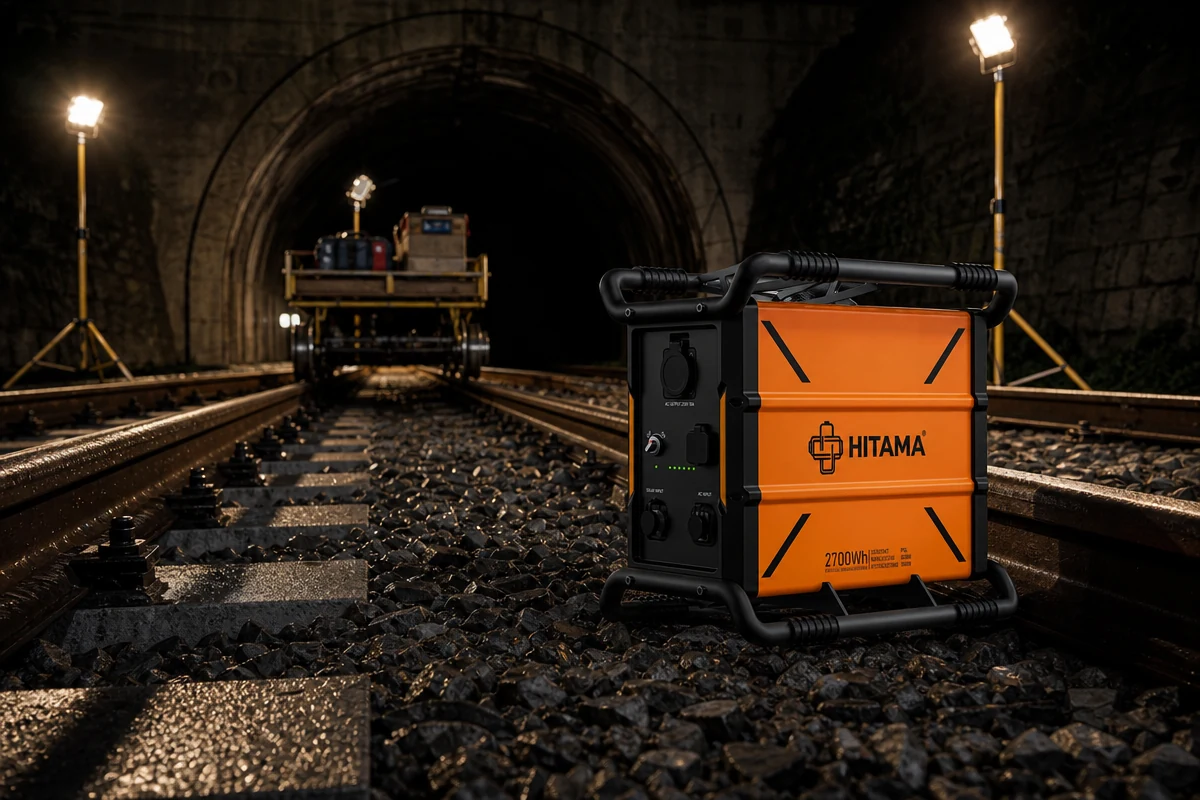
A tunnel does not hand you a state of charge; it hands you a walk. The unit stands where the section allows it, the work sits at the face, and coverage underground cannot be assumed. So the reserve that decides the night is a figure fixed before entry, not one read at two in the morning. On a 2.7 kWh unit with 2,500 W continuous, that figure is usually a fifth to a third of capacity. On a window under two hours carrying one flat load, it does not apply.
The gauge is at the portal, the work is at the face
The display is on the machine, and the machine is not where the crew is. A fuel tank shows a level you can see, and a can you can carry back to it; a battery shows a number at the panel. Underground, no reliable link out of the section can be assumed, so the only display is the one three hundred metres behind the crew.
The budget is small enough to be spent by surprise. At 1,000 W continuous, 2.7 kWh gives 2.7 hours; at 400 W, almost seven. Neither is a promise about the night, because the loads are not continuous.
A floor is a number, not an intention
"We keep an eye on it" is not a reserve. A floor is an energy quantity fixed before the window opens, and everyone in the section knows it. Thirty percent of 2.7 kWh is 0.81 kWh: about 48 minutes at 1,000 W, two hours at 400 W.
The ceiling and the floor are different questions. 2,500 W continuous decides which tools start together. The floor decides whether the crew walks out with the machine or carries it.
It has to cover the exit. Everything that goes in comes out the same way, tired, and 29 kg is one person's lift on flat concrete and a two-person job on a ramp or stair. The manual forbids stacking and lifting gear.
| Configuration | Continuous output | Capacity |
|---|---|---|
| P25 | 2,500 W | 2.7 kWh |
| P25-D, two units at 230 V | 5,000 W | 5.4 kWh |
| P25-T, three units with distribution at 400 V | 7,500 W | 8.1 kWh |
On rail, tunnel and infrastructure work the deliverable is the handback, and the questions asked before the work starts are where 0.81 kWh stops being abstract.
Three readings, not a live feed
Read at entry, at the midpoint, before the last tool. Three readings in a six-hour window show a trend and are too few to become a job of their own. Write down time, value and who took it: one person owns each reading, a second may call the stop when the floor is reached.
A reading costs a walk. Hence the fixed interval. If the distance from face to unit already shaped the configuration — as in the walk that decides the configuration — it is also why readings are scheduled rather than continuous.
Where the rule stops working
Capacity is finite, and a floor is not a second unit. A parallel pair — the P25-D kit at 5,000 W and 5.4 kWh — doubles the budget as two 29 kg units; three units with the distribution box reach 7,500 W at 400 V and 8.1 kWh. The rule scales with them.
It is not tunnel infrastructure, and IP54 is not immersion. Signalling, fixed lighting and anything that must stay live after the crew leaves are outside what a portable unit is for. The invert collects water; a unit standing in it is outside its rating, and no reserve figure repairs that.
Recharging has its own clock. Recovery runs at 500-1,500 W from an ordinary 230 V socket: from a 30 percent floor to full is 1.9 kWh, roughly 1.3 hours at 1,500 W and close to four at 500 W. That belongs to the next possession. Figures for the HITAMA P25 are on the product page.
Questions that come up on the walk
How much of a 2.7 kWh unit should be held back in a tunnel?
Between a fifth and a third — 0.5 to 0.9 kWh. That covers the walk out, the handback and one surprise, at 30 to 50 minutes of a 1,000 W load. What matters is that the figure stands before entry, not that it matches a number from another site.
Can the state of charge be read from outside the tunnel?
Only if the section has a working link, and that is not something to assume. Treat the panel as the only display. With 2.7 kWh in the machine, a reading you cannot take is not a reserve — it is an assumption somebody will have to defend at four in the morning.
Does a parallel pair remove the need for a floor?
No. It lifts the ceiling to 5,000 W and the capacity to 5.4 kWh, and the floor scales with it. A pair is also two 29 kg units to carry out if the plan goes wrong, which argues for a stricter floor rather than a looser one.
Send us the window length, the tool list and the distance from the portal to the face, and we will work out the floor with you.