
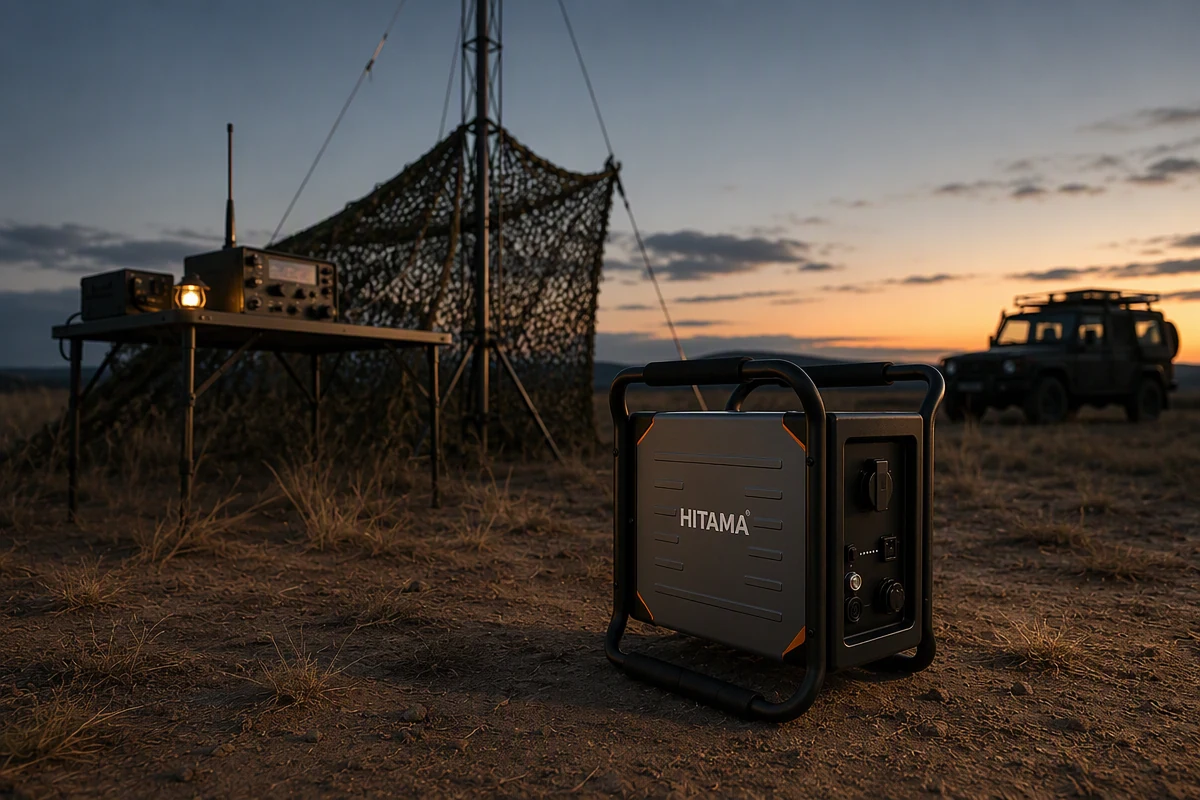
Everything at a field position gets covered — netting, a tarpaulin, a sandbag wall, the back of a vehicle — and the power unit is the one item that loses output when it is. It cools without a fan, so its housing is the whole heat path: 2,500 W of P25 in open air has surface working for it, and under a cover it does not. IP54 covers dust and spray, not a closed box.
A fanless unit is cooled by its own surface
No fan means no intake, and no intake means the case is the radiator. Nothing pulls dust or moisture through the electronics; in exchange, heat leaves through the outside of the housing, carried by air moving across it. Two consequences follow, both about the site: the surface stays exposed, and the air around it can move.
Shelter decides before ambient does. A unit in the open has free convection on its side; the same unit in a closed tent at the same air temperature sits in still air on all six faces, and still air insulates.
A position covers everything by habit
A field position is organised around concealment and weather, and the habit is applied to whatever arrives. Netting goes over the radio table, the fuel cans live under a poncho, the vehicle gets a cover at dusk. Each is correct practice, and none was written for a sealed unit at work.
Applied to a fanless unit, the same habit removes the only cooling path it has. A tarpaulin is the worst case: it lies close to the housing and holds still air against it. A closed crate is worse. Kit stacked on the top face is the quiet version — nobody counts a folded jacket as insulation.
Four checks before the unit goes down
Placement costs nothing and takes a minute longer than dropping the handles.
- Air on the faces. A gap on every side but the ground; the whole case sheds heat.
- Shade instead of cover. A vehicle's shadow blocks sun without touching the housing; netting laid on the case does not.
- Off the ground. A pallet keeps the base out of water and mud; IP54 covers spray, not a puddle.
- Socket side out. The panel stays reachable without lifting the case; the point of the unit is the 230 V outlet.
When the air is gone, the position loses margin
The datasheet figure is measured with the unit free-standing, and standing is the variable no datasheet contains. A unit that cannot shed heat has less room before its own protection intervenes — and protection prevents damage, it does not guarantee supply.
That weighs more at a position than on a site, where there is usually no second source standing by. A tool that stops on a construction site is an interruption; the same stop takes the radio watch off the air. Where a vehicle and a unit work together, the split is a separate decision — two power systems at one position — and a unit in a closed boot has no more air than one under a tarp.
What this argues for, and what it does not
None of this makes a case for leaving the unit in the open in all weathers. IP54 covers dust and spray, not immersion, so standing water, a flooded pit and a pressure washer stay separate problems. The housing is a heat exchanger, not armour.
What it argues for is a place chosen on purpose: air on the faces, out of the sun, off wet ground, panel reachable, case not used as a shelf. A position that solved radio, charging and light — the silent power side of the question — usually settles this too.
The figures the placement protects. The P25 series is built to run sealed and uncovered; these are the numbers a covered unit cannot deliver.
| HITAMA P25 | Figure |
|---|---|
| Continuous output | 2,500 W |
| Stored energy | 2.7 kWh |
| Weight | 29 kg |
| Ingress protection | IP54 — dust and water spray, not immersion |
| Cooling | Fanless; heat leaves through the housing |
Questions that come up at a position
Can the unit run inside a tent?
Yes, if the tent is ventilated and the case stays uncovered. A 2.7 kWh unit on a radio watch draws little, but the heat still has to leave the fabric. Put it near the door on the dry side.
How much space does it need?
Enough for air to move on every exposed face. A hand's width is a working rule, not a specification. The test: if you cannot feel air passing the case, it has less surface than it was rated with.
Does a cover help in rain?
Only if it keeps water off without touching the case. A raised sheet with clearance does both; a tarpaulin laid on the housing keeps rain out and heat in — the wrong trade for a 2,500 W unit that cools through its skin. IP54 covers spray already.
Send us the position: what stands where, what covers it, how much air it gets. We will answer with where the unit should stand — and honestly if it should not stand there at all. More of the series: [defence and field operations](/en/news/field-operations).