
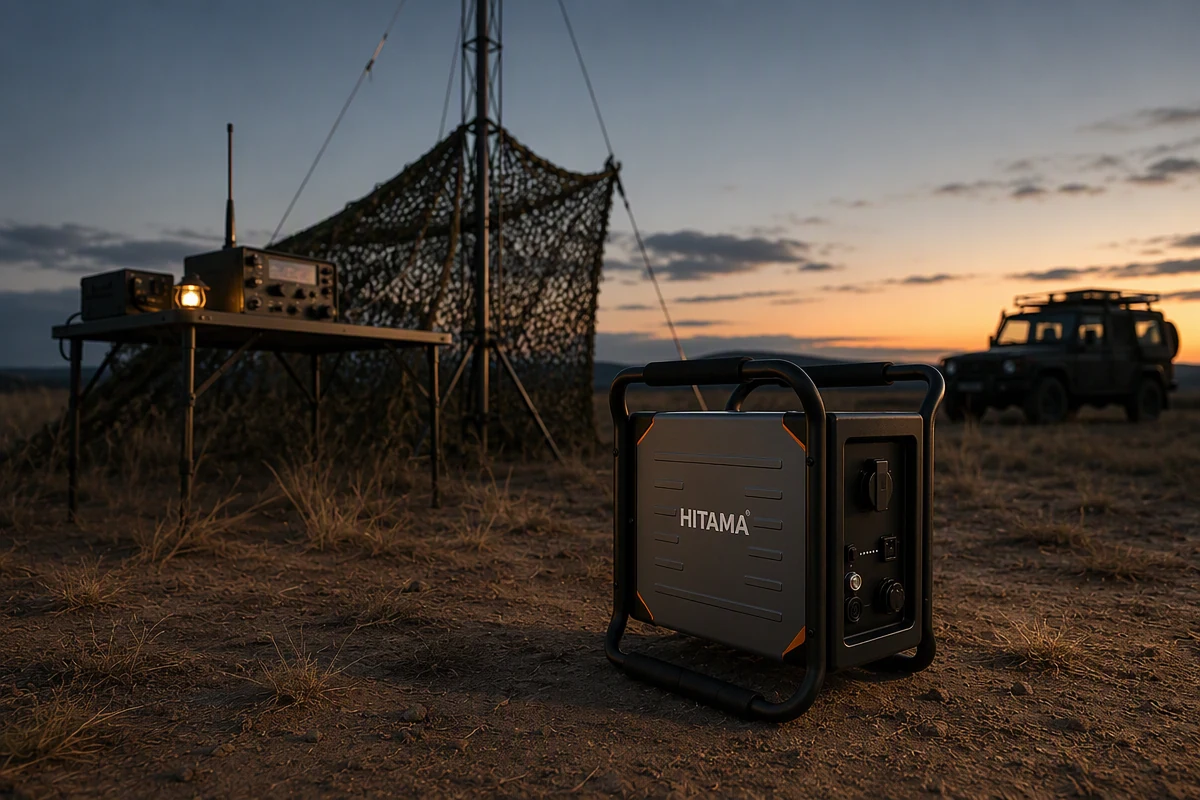
At a field position the continuous load belongs on the portable unit, and the vehicle keeps only what it needs to stay mobile. The reason is arithmetic before it is electrical: 2.7 kWh carries a radio watch and a charging table through the night, while the same draw from a parked vehicle ends in a jump start. The split fails when capacity is smaller than the shift it covers.
The battery that is on no kit list
Every vehicle carries a battery nobody counts. It is specified for one job, starting a cold engine, and sized with a margin unrelated to radios. With the engine off it is the only source on the vehicle, and it is not instrumented like a power unit: no watt-hour state of charge, no log.
A flat starter battery is a mobility failure, not a power failure. An hour without radio is an annoyance; a vehicle that will not start changes the plan. Every load moved onto the vehicle is a loan against mobility, invisible until it falls due.
Idling solves the electrical question and reopens the reason for the position
An idling engine is a power source paid for at the position itself. Once it runs to charge, the position has noise, exhaust and a fuel chain again — the three things a battery unit was chosen to remove.
Idling is also a poor charger. Alternator output at idle is a fraction of what the engine gives on the move. A full 2.7 kWh through a 230 V socket takes over five hours at 500 W, under two at 1,500 W.
1. Why not charge from the vehicle while it stands?
You can, if it has a 230 V socket and the engine runs; the constraint is the two hours, not the cable. Two hours at 1,500 W is two hours of engine at the position.
The split that holds
Continuous loads go to the unit; mobility stays with the vehicle. Radio watch, the charging table at stand-down, working light and any instrument that must not drop belong on the unit. Starting, and whatever the vehicle needs to move, stays with the vehicle. Nothing is shared and no cable runs between the two.
The unit is a power point, not a second alternator. It does not charge the vehicle and should not be wired into it.
| | P25 | P25-D (two units) | P25-T (three units + distribution box) |
|---|---|---|---|
| Continuous output | 2,500 W | 5,000 W at 230 V | 7,500 W at 400 V, three-phase |
| Capacity | 2.7 kWh | 5.4 kWh | 8.1 kWh |
| Weight | 29 kg | 29 kg per unit | 29 kg per unit |
| Recharge from a 230 V socket | 500–1,500 W | 500–1,500 W per unit | 500–1,500 W per unit |
One unit at 29 kg is one person's lift. Where a position needs more, the answer is a second unit beside the first. See the HITAMA P25 series and Defence & field operations.
What the split does not settle
Capacity is finite, and the split adds nothing. 2.7 kWh is 2,700 Wh; at an average of 250 W that is just under eleven hours. Measure across a night, not from nameplates — see field power readiness between deployments.
IP54 covers dust and spray, not immersion, and this is not equipment for a hazardous atmosphere. Fanless cooling needs air: heat leaves through the housing, so the unit needs space around it, not a crate and not a tarpaulin.
It is not a base power plant. This is power at the point of work, for hours, carried by one person. The vehicle still has to be there — the arrangement only stops it being used as a generator. For a position with no engine at all, see silent power for camps and communications.
Questions that come up in procurement
1. Can the unit be charged while driving?
Yes, where the vehicle has a 230 V socket and the engine runs. Recharge draws 500–1,500 W, so a two-hour move returns much of a 2.7 kWh unit without a stop. Check the inverter rating first: it, not the unit, usually sets the limit.
2. How long does one unit last at a position?
Divide 2,700 Wh by the measured average draw. At 100 W that is 27 hours; at 250 W, just under eleven. Both figures assume a measured load rather than a sum of nameplates, and that difference is what turns a planned night into four hours.
3. Does a second unit replace the vehicle's electrical system?
No. Two units give 5,000 W at 230 V and 5.4 kWh, which is a capacity decision rather than an electrical one: more hours, or a heavier charging table. The starter battery stays the vehicle's, and neither system is wired into the other.
4. What puts a position outside the rating?
Dust and spray are inside it; standing water is not. IP54 covers the enclosure, not a flooded floor or a hazardous atmosphere, and the fanless housing needs air around it. If the ground holds water at the position, the placement needs planning as much as the unit.
Send us the position's load list and where the vehicle sits in it, and we will draw the boundary with you.