
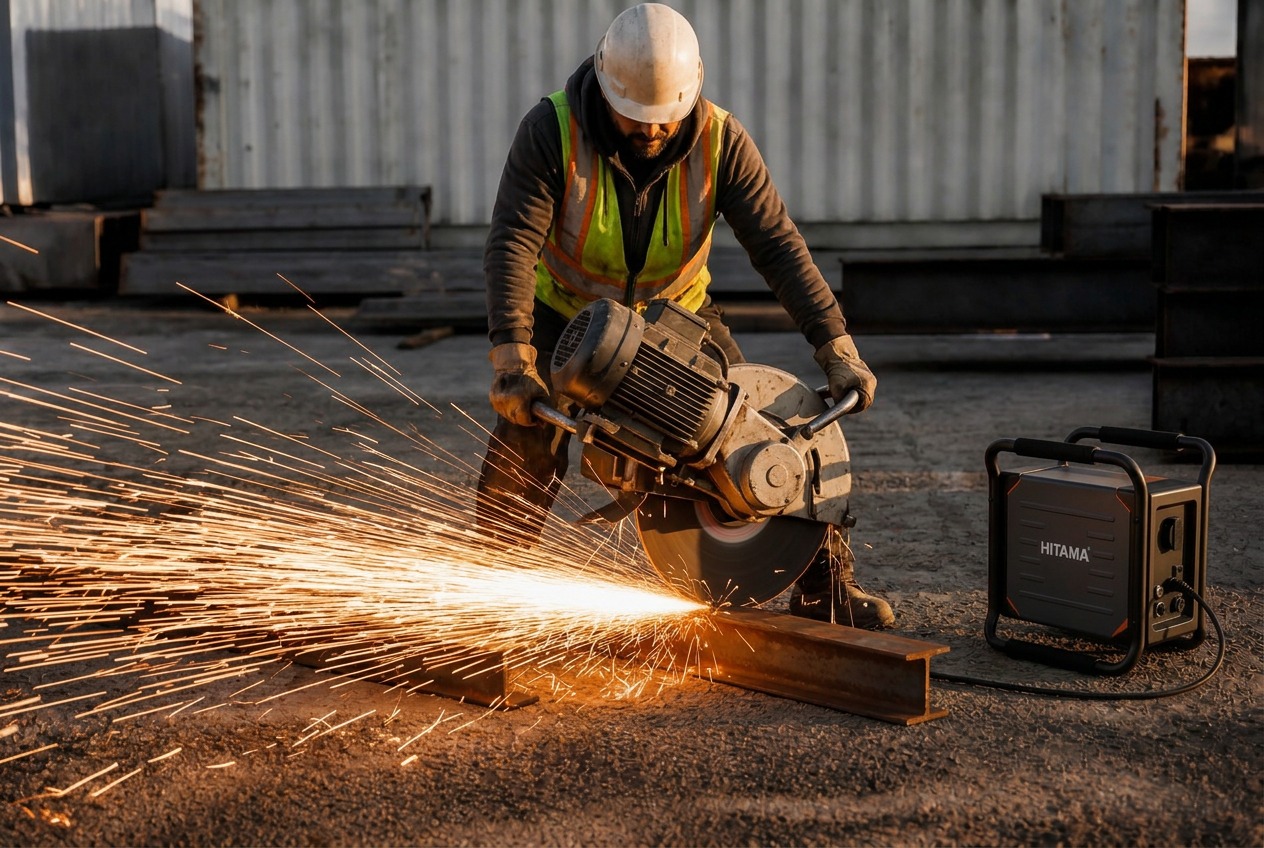
The most common sizing error
Most sites are sized on the sum of all connections. That systematically produces an oversized — and overpriced — solution.
The error has a cause: the sum of all connections is easy to determine. Actual simultaneity is not. So people take the sum and add safety margin. What they end up with is a unit running at 15 % utilisation most of the time.
The right basis is the load profile, not the connection list.
Four steps to a load profile
Step 1 — Separate continuous from peak consumers
List all tools in two columns:
- Continuous consumers: run for hours, steady, moderate load (lighting, chargers, heaters, cooling)
- Peak consumers: run briefly, draw a lot (angle grinder, core drill, cut-off saw, welding set, vibrator)
This separation is the whole trick. Continuous consumers determine your energy, peak consumers determine your power class.
Step 2 — Determine the inrush of the peak consumers
Inrush is typically four to eight times rated current, for a short duration. Two consequences:
- The peak rating of the unit must cover the inrush, not the rated load.
- If a motor is already running when the next consumer starts, the inrushes add up.
Check this before selecting the power class. Checking afterwards means buying larger afterwards.
Step 3 — Define simultaneity
Walk the tool list by work sequence, not by the connection plan: what really runs in parallel when one crew is working? An interior fit-out with two trades rarely exceeds two simultaneous peak consumers.
Step 4 — Compare energy against deployment duration
Power is one thing, energy the other:
```
Energy required (Wh) ≈ Σ(continuous load in W × hours) + Σ(peak load in W × minutes / 60)
```
Compare the result with the usable energy of the unit, not with gross capacity. Depending on depth of discharge there is a significant difference between the two — which is why the supplier should state usable energy rather than only the capacity figure.
A worked example
An interior fit-out section with:
| Tool | Load | Operation per day |
|---|---|---|
| Lighting (LED) | 200 W | 8 h |
| Battery tool chargers | 300 W | 4 h |
| Angle grinder (peak) | 2,400 W inrush, 1,100 W rated | 1.5 h spread |
| Cut-off saw (peak) | 2,200 W inrush, 900 W rated | 1 h spread |
Energy: 200 W × 8 h + 300 W × 4 h + 1,100 W × 1.5 h + 900 W × 1 h = 1,600 + 1,200 + 1,650 + 900 = 5,350 Wh
Power: the constraint is not the sum (around 2,000 W rated) but the inrush — the two cutting tools rarely run at exactly the same moment, but when they do, roughly 4,600 W of inrush add up. Two simultaneous peak consumers are the normal case for a section with two trades.
Result: you need a configuration covering around 5.3 kWh of usable energy and about 4.6 kW of peak. Neither figure comes from the connection list — only from the sequence.
Plan for expansion instead of one-off oversizing
The work stage is the wrong planning unit for the whole project. The P25 series is therefore built for parallel operation: 2,500 W single, 5,000 W with P25-D, or 7,500 W as 400 V three-phase with P25-T — at 230 V / 16 A and 29 kg per unit.
In practice: you start with one unit for the first stage and add units when simultaneity rises or a 400 V consumer appears. Each unit stays hand-portable; the system grows with the project instead of with the connection list.
For three-phase consumers (circular saw, larger welding sets) the 400 V output of the P25-T configuration is the relevant point — such loads cannot be produced by adding up single Schuko outlets.
Which figures to require in writing
1. Continuous rating, peak rating and peak duration (in seconds, not "briefly")
2. Usable energy at a stated depth of discharge
3. Start-up behaviour with inductive load
4. Output form and number of phases — single-phase 230 V or three-phase 400 V
5. Weight per unit, if the system is to be moved by hand
Point 5 is regularly underestimated: a system that cannot be carried to where it is needed needs a second transport route — and that raises the cost of the deployment independently of output.
---
Send us your tool list with simultaneity and inrush figures — we will work through the load profile with you and recommend a configuration. Prices on request.