
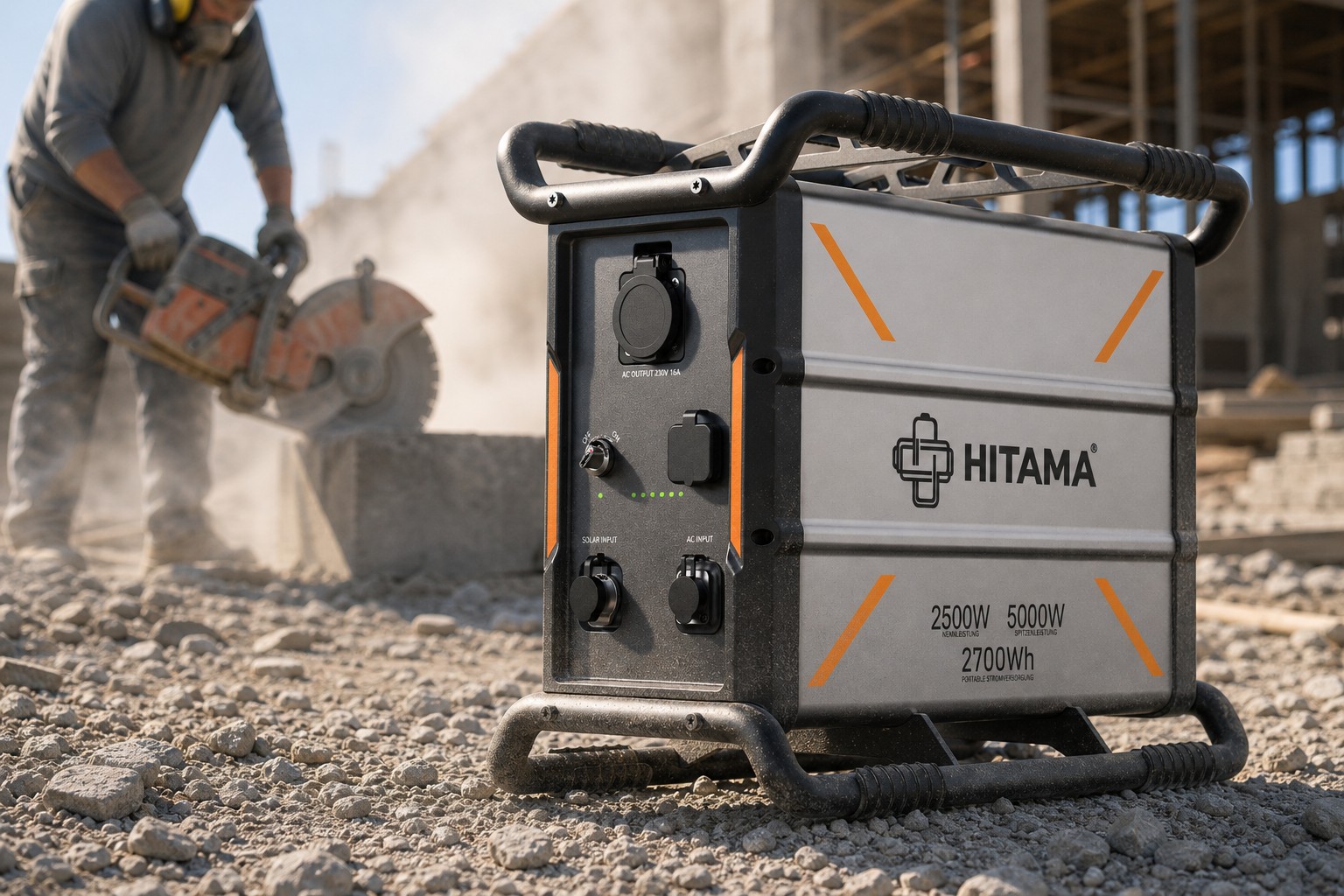
kWh vs kW is the difference between whether a tool runs at all and how long a shift survives, and buying on the wrong one fails in two different ways. A 2,500 W unit under a 1,500 W load empties its 2.7 kWh in roughly 1.8 hours, and a 3 kW tool sits above that unit's 2,500 W continuous rating no matter how full the pack is. The distinction only stops mattering when the load is small and steady enough that neither ceiling is ever reached.
1. Two ceilings, two different failures
One number decides whether the tool runs, the other decides when the shift ends. A power ceiling is breached in an instant and announced by a protection trip; an energy ceiling is reached slowly and announced by nothing at all. On a quarry bench the first looks like a breaker that refuses to start, and the second looks like floodlights dimming an hour before the gate opens.
1. Which number does a tool ask for?
Every tool states its demand in watts, and almost none of them state it in watt hours. A plate reading 1,800 W says what the tool needs while it is working; the hours are yours to supply. That is the whole of the kWh vs kW confusion in one line: the equipment side is a capability, and the shift side is a duration.
2. Why the two units cannot be converted into each other
A kilowatt hour is a kilowatt held for an hour, so the conversion needs a third quantity that is on no plate. Multiply 2,500 W by one hour and the result is 2.5 kWh; hold 500 W for the same hour and a 2.7 kWh pack is barely touched. Same pack, same hour, two different outcomes.
2. Reading a quarry load list in the right unit
A quarry load list is written in kilowatts and the question that decides the purchase is asked in kilowatt hours. The face carries a breaker, two grinders, a cut-off saw, floodlights, a small pump and a charger for the handhelds. Summing those plates gives a figure that is too high for the power ceiling and too low for the energy budget, because no two of those tools run at once for eight hours.
1. Where the arithmetic usually breaks
The common error is multiplying every plate by the whole shift. A breaker that runs eleven minutes in an hour contributes about one fifth of its rating to the energy total, but its full rating to the power ceiling. Both statements are true at the same time, which is why a single number can never answer both questions, and why reading a list in the right unit is the whole discipline the kWh vs kW gap asks for.
3. What 2.7 kWh buys at the face
Capacity is a duration once a load is attached, and a meaningless word until then. At 500 W a 2.7 kWh pack runs about five hours; at 1,500 W it runs about an hour and three quarters. One unit, one state of charge, two very different days.
| Figure | Value |
| --- | --- |
| Continuous output, P25 | 2,500 W |
| Capacity, P25 | 2.7 kWh |
| Weight | 29 kg |
| Ingress protection | IP54 |
| Recharge from a 230 V socket | 500-1,500 W |
The table answers the capability question and leaves the duration question to the load list. That is why HITAMA publishes both figures, and why a quotation carrying only one of them cannot be checked against a shift.
4. The kWh vs kW question when the job changes mid-shift
A face crew changes tools more often than it changes shift, and every change reopens the power question. Lights and a charger draw a few hundred watts and will run all night; adding a breaker moves the same unit onto its continuous ceiling within minutes. Sequencing is not a trick, it is the ordinary way a small pack covers a mixed day, and it is why the P25 is specified with both numbers side by side.
Where the panel has to carry two heavy tools at once, the arithmetic moves to a parallel pair. Two units give 5,000 W and 5.4 kWh at 230 V, which buys simultaneity rather than more endurance per kilogram. The mining and quarrying entries cover the shifts where that trade is worth making.
5. Where this stops
This arithmetic is honest only inside its own assumptions, and those assumptions break easily. Starting current sits outside it entirely: a motor's first half second asks for several times its running figure, so a list that sums to 2,200 W may still refuse to start. Heat and cold move both ceilings, conversion losses take their slice, and the pack keeps a reserve at the bottom that is never handed out. A plant running ten hours at 4 kW is 40 kWh of work, which is not a portable unit's job, and a face whose water has to move for two days belongs to the dewatering and drilling plan rather than to a battery.
The honest use is the shift, not the site. Everything above describes a crew that carries its own supply for a working day and charges overnight, which is why what keeps running after the wash plant stops is a different question from the one on this page.
6. Questions we get at the face
Does a higher kWh figure also raise the kW ceiling?
No. Capacity and output are separate ratings, and a large pack behind a small inverter still trips at the inverter's limit. A 2.7 kWh unit with 2,500 W continuous output carries the same ceiling whether it is full or at 40 percent, so the two numbers have to be chosen together and never one at a time.
How long does 2.7 kWh last at full continuous load?
About one hour and five minutes. At the 2,500 W continuous rating a 2.7 kWh pack delivers its whole capacity in a little over an hour, before reserve and conversion losses are counted. A real shift lasts longer only because the load is intermittent, not because the arithmetic changes.
Is kWh or kW the number to compare between brands?
Neither, taken alone. Compare the pair and the conditions they were measured under, because a 2,500 W rating at 25 °C is not the same promise at 45 °C. Two units can match on both figures and still differ on usable capacity, which is the number a shift is actually planned on.
Can one unit run a 3 kW tool?
Not as a continuous load. A 3 kW tool sits above a 2,500 W continuous rating, and the gap is not closed by waiting for a fuller pack. Where the tool runs briefly and intermittently, the start becomes the harder question, and that one is answered by the surge figure rather than by capacity.
Send us the load list for one shift and we will convert it into the two numbers that decide the unit.