
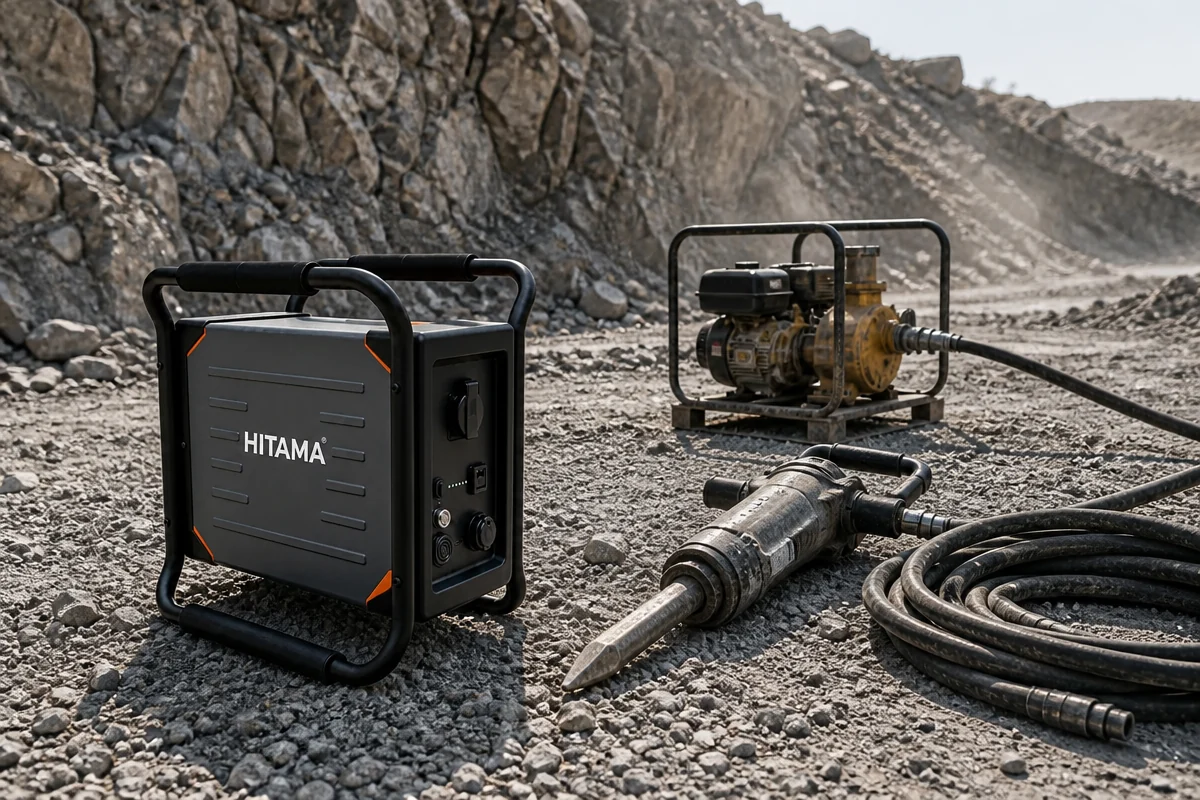
A wash plant that loses power stops feeding within a second; the damage lands afterwards, in the thickener and the settling pond. Three small loads decide whether the restart takes an hour or a shift: flocculant dosing, the level instruments and, where the drive is small, the rake. A carried 2.7 kWh unit holds them for hours. It cannot hold the return-water pump.
The feed stops first, the water circuit stops last
One event, two timelines. The drive drops out, the belt empties, the plant goes quiet in a way it never is mid-shift. That part is over in seconds. What continues is chemical: solids settle, the flocculant line stands still, and the return water the screens need at restart is no longer being pumped.
The restart is the expensive half. A thickener that has stood for six hours is not the vessel that was running: the bed is denser, the rake is buried, and the clarity of the return water decides whether the screens take feed. An unplanned stop rarely costs the stopped hours; it costs the hours spent bringing the circuit back.
1. Which loads are small enough to carry?
The metering pump, the level and density instruments, the pump-house lighting, a small rake drive, the electrician's hand tools. Anything that moves slurry in volume — return water, feed, the cyclone pump — is outside a carried unit's reach.
Three loads worth holding, and the ones to let go
Hold the dosing. A stopped flocculant line is not an emergency in minute one. It becomes one when thickener overflow carries fines into the settling pond, and clearing that takes a long-reach machine.
Hold the rake, if the drive allows. A rake standing under a settled bed is a start-up problem you inherit at the worst moment. A small drive is within reach of a carried unit; a large one is not, and then the answer is to keep the bed thin enough to wait.
Hold the instruments. Level, density and the signal to the control room. Power loss takes the signal with it, and an operator driving to site to look into a tank costs an hour of production.
Let the rest go. Conveyor, screens, return-water pump: loads to restart in order, not to bridge. That ordering belongs to the isolation procedure we described for a shutdown window — but a breakdown is not a shutdown window: nobody planned it, nobody isolated anything.
2. How long is the outage, in hours?
Duration sizes this, not throughput. An electrician's call-out, a fuse, a cable that a bucket found: the fault sets the number, so plan the pessimistic one.
Sizing from rating plates, not from memory
Every small motor has a plate, and the plate is the only number that survives an argument with a supplier. Note the rated input of each hold load, add the continuous ones, then look at the one that starts against a load: the start decides whether a small unit trips.
Two P25 units in parallel give 5,000 W and 5.4 kWh at 230 V; three with the distribution box give 7,500 W and 8.1 kWh at 400 V when a hold load is genuinely three-phase.
P25, single. 2,500 W · 230 V · 2.7 kWh carried · 29 kg. Hold list: dosing, instruments, light, hand tools.
P25-D, two units. 5,000 W · 230 V · 5.4 kWh carried. The same list plus a small rake or pump.
P25-T, three units and box. 7,500 W · 400 V three-phase · 8.1 kWh carried. For a three-phase drive on the hold list.
Recharge is part of the plan. A HITAMA P25 refills from an ordinary 230 V socket at 500–1,500 W — the same kind of socket the plant uses, and possibly the one that failed. The P25 series is 29 kg per unit for exactly this reason: it goes where the socket is not.
3. Where does the unit stand?
Above the floor, outside the bund, cable clear of the doorway. IP54 covers dust and spray; it does not cover standing water, and a sump room that floods is not a room for a battery overnight.
What this is not
It is not standby power for a wash plant: the pumps are tens of kilowatts, a carried unit is single-digit. It is the small part of the circuit that decides how the restart goes, held for the hours between the fault and the electrician.
No engine means no exhaust in a sump room and nothing to refuel — but it still has to be carried in and out, and passive cooling means the case has to breathe. The wider site picture is in our notes on mining and quarrying; the same arithmetic with another load list is in dewatering at the face.
Questions we get before a wet-plant outage
1. Can 2.7 kWh hold a thickener overnight?
It can hold the loads that keep a thickener from silting, if those loads are genuinely small, and only for the hours you get by dividing the capacity by your own plate readings. 2.7 kWh is a budget, not a rating.
2. Do we need three-phase for the water circuit?
Only if a hold load is three-phase. Dosing, instruments and lighting are single-phase 230 V; the 400 V case is a drive you have decided to hold, and that is P25-T at 7,500 W and 8.1 kWh.
3. How fast does the unit recharge between outages?
From an ordinary socket at 500–1,500 W, so the time depends on the socket rather than the unit. Where the socket is the fault, that is a logistics question: write the recharge point into the plan before you need it.
4. What should hang on the pump-house wall?
One page: the hold list with plate readings, the hours each load is needed, where the unit stands, and who carries it. Everything else can be worked out during the fault; that page cannot, because the panel is dead.
Send us your hold list — plate readings, hours, and the one load you are unsure about — and we will size the configuration with you.