
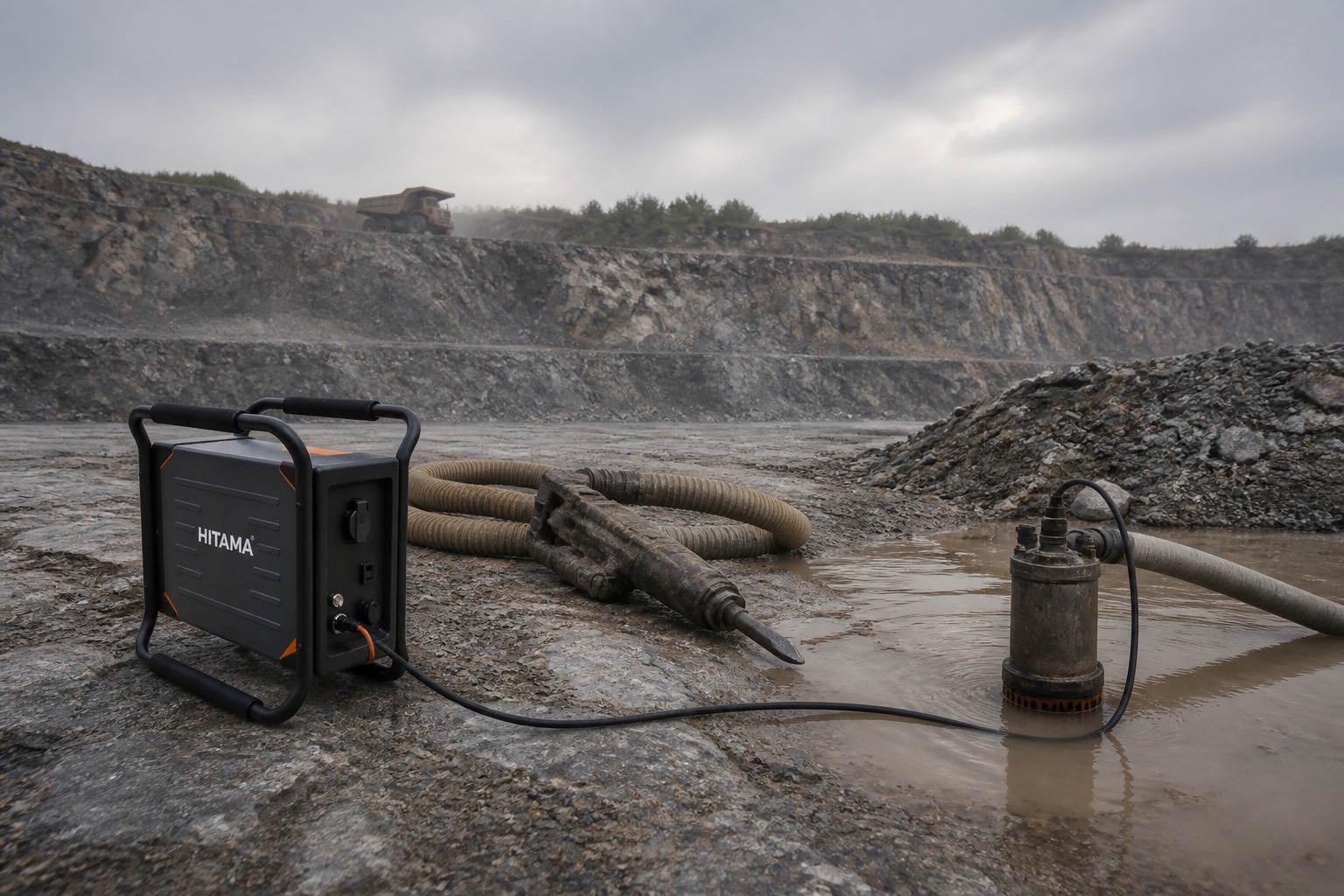
A quarry is a bad place for a combustion generator: dust, vibration, a slope nobody wants to carry a fuel can up, and a machine that must not be refuelled where the dust is explosive. The work, meanwhile, is portable by nature — the face moves, and the power has to move with it.
The loads that move
Dewatering pumps. The job that never stops. A submersible pump left running is a continuous load, and it usually sits down a hole where a cable run is impractical.
Rock drills and rotary hammers. High starting surge, short duty cycle — the classic case for peak output rather than continuous output.
Dust extraction. Required wherever the drill is, and it runs for as long as the drill does.
Bench and tunnel lighting. The load that makes a night shift possible.
Sizing on a modular platform
P25 is 2,500 W continuous, 5,000 W peak, 2.7 kWh. Where the tool is three-phase, three units with the P25-T distribution box give 7,500 W and 8.1 kWh at 400 V. The system is carried and assembled by hand: the operating manual forbids stacking and forbids lifting gear, so nothing here needs a crane.
The limits to respect
This is not a mine's primary power supply. It is power where the work is — a pump that would otherwise wait for a cable run, a drill that would otherwise idle a generator for a whole shift. IP54 means dust and spray, not immersion, and this is not equipment for an explosive atmosphere.
Send us the pump and drill nameplates and we will size the configuration.