
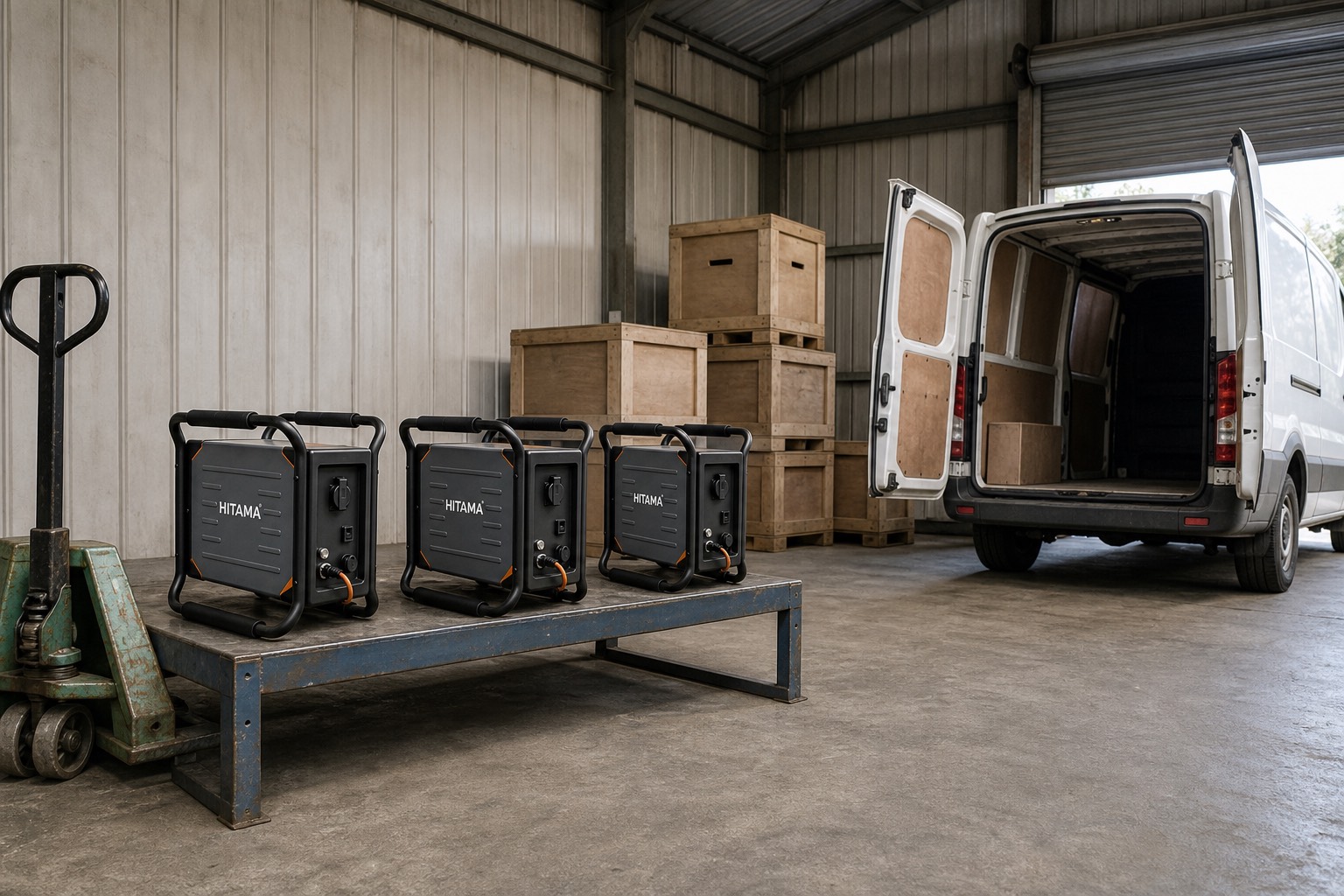
The first order is a test. The second one is the business.
The first time, what matters is that the unit arrives, runs and comes with the right paperwork. The second time, something else matters: that the same unit is available again, that a part can be reordered, that the second batch matches the first. Those questions decide your cost in year three — and none of them appear in a first quotation.
What is not on the site
On hitama.net you will not find a minimum order quantity, a lead time or a volume price list. That is not an omission; it is the only form in which those three numbers are honest.
They depend on the model, the quantity and the target market. Change the plug type, the language on the nameplate, the packaging or the destination country, and all three move with it. A number on a website would therefore be a number for exactly one configuration — and wrong for every other.
So the site says what is true: volume prices and dates are project questions, negotiated per order. Anyone who needs a binding figure gets it in a quotation, with the model, the quantity and the market inside. Not beforehand, not as a blanket rate.
Four details that must be settled before you ask
Without these four, every quotation is guesswork — ours included.
1. The supply format. A 400 V tool will not run on a 230 V unit, no matter how many of them stand side by side. Our 230 V units (P25, P25-D) and the 400 V unit (P25-T) are two answers to two different tool parks. Supply format first, power class second.
2. The quantity and the coupling. Two units next to each other are two units. Two units that can be coupled are a reserve. Two P25 units with the P25-D distribution unit give 5,000 W and 5.4 kWh; three give 7,500 W and 8.1 kWh. Whether your tool park needs that is decided on the inrush side, not on continuous output.
3. The target market and the paperwork. Plug, nameplate, language of the documents, and the conformity documents for the specific model — not for the series. This is the point where an order stalls later, when the inspector stands in the warehouse.
4. Who supplies the part later. A trading house bundles, a factory changes and re-manufactures. Both are legitimate; you should just know which answer you are getting. This question does not come up with the first order. It comes up with the first failure.
What one number cannot answer: the tool park
2.7 kilowatt-hours is not a runtime. It is the numerator of a division whose denominator only exists on your site.
An arithmetic example, all assumptions open: 2.7 kWh divided by a constant load of 0.9 kW gives three hours — if the load stays constant, the usable capacity is 100 percent and no conversion losses occur. No tool park looks like that. A cut-off saw draws in bursts, a compressor cycles, a rotary hammer has inrush currents. That is why we state no runtime for any use case: we have not measured it for your tool park, and a figure from a datasheet would not be a measurement.
Three pairs: one number and one sentence
- 29 kilograms at 2.7 kilowatt-hours. One person, one hand, one flight of stairs — no second pair of hands and no trolley.
- 5,000 watts for up to ten seconds (P25, peak). Inrush currents are a seconds problem, not a continuous problem. Comparing continuous output alone compares the wrong number.
- Three stations, ten checkpoints before dispatch. That is not a quality promise, it is a sequence: inspection happens before shipping, not after the complaint.
The daily calculation — with the fields left empty
Anyone comparing battery against diesel ends up at one formula:
Cost per working day = (purchase price − resale value) ÷ days in service + maintenance per day + (kilowatt-hours charged × price per kWh)
Five inputs: purchase price, resale value, days in service per year, maintenance effort, electricity price. We fill in none of them — not because we do not know them, but because they come from your rental fleet and not from our catalogue. The diesel side has four different ones: diesel price, consumption per hour, service interval, idle periods.
A comparison only becomes a calculation when both columns were filled by the same person using the same shift length. Anything else is a brochure.
What that means for the first order
Start small — but not blind. Four details, one datasheet, one date: that makes a first order a test that proves something. The second order then proves whether the supply chain behind it holds.
The registered figures for the P-series are under Products and P-series; how an order is structured for resale is under Dealers; who builds and inspects the units is under About us.
*All performance figures per datasheet. Runtimes are arithmetic examples, not measurements. Prices, minimum order quantities and dates are project questions, negotiated per order.*