
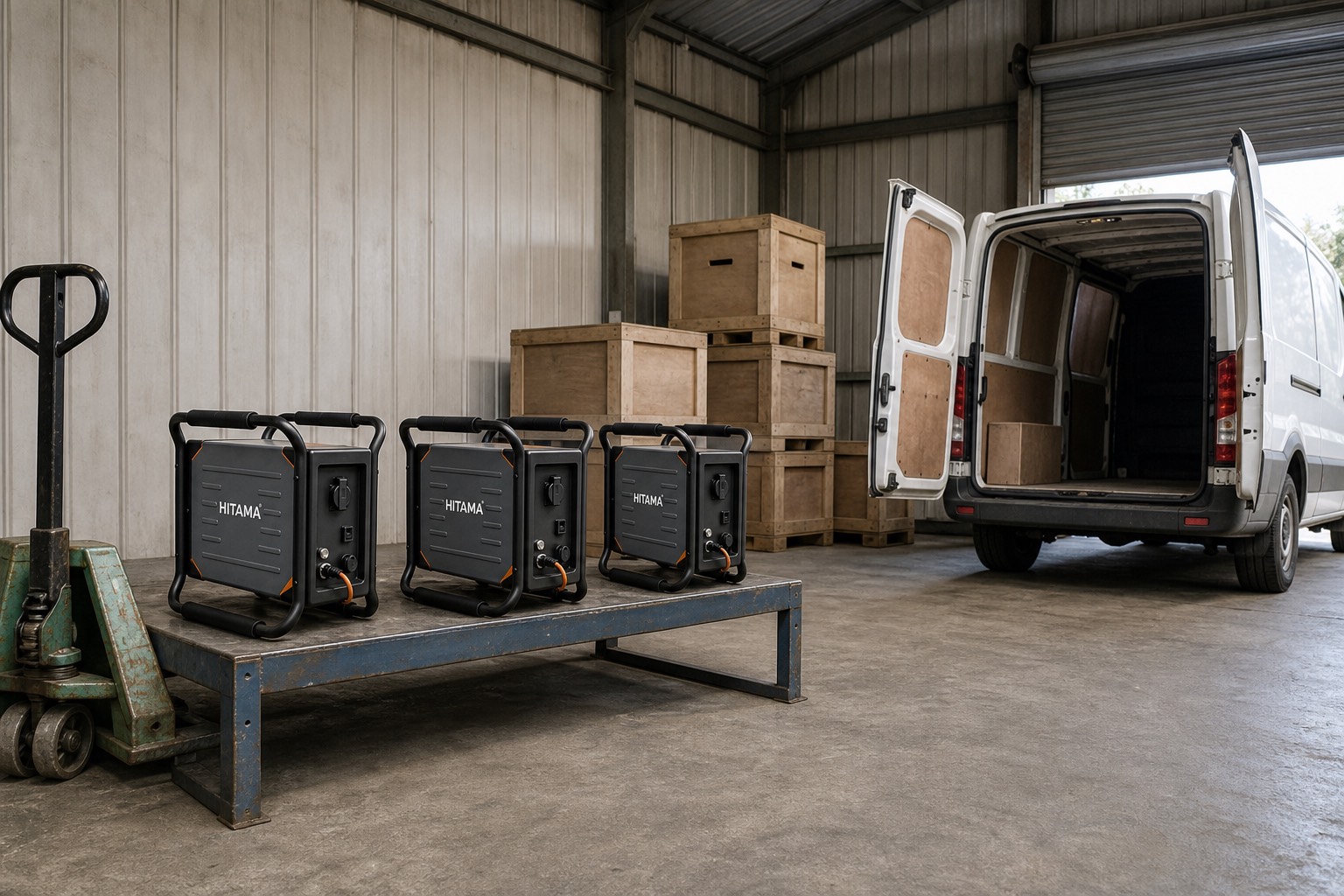
The yard sets the fleet size, not the site
A unit on hire is a unit nobody can charge. Rental power is decided twice: at the site, where the tool list matters, and at the depot, where units come back empty. The second decision quietly caps how many machines a yard keeps moving.
Wattage is a site number. Amperage is a yard number. A P25 gives 2,500 W continuous and 5,000 W peak for ten seconds out of 2.7 kWh, at 29 kg, on 230 V 16 A. Almost none of that appears at the charging inlet, where the unit draws 500 to 1,500 W. At full input that is about 6.5 A on a 230 V circuit, so one 16 A circuit is one unit's worth of charging, not six.
Two and a half hours per unit, eight hours per night
The P25 fills in around 2.5 hours and reaches 80 percent in about two. That is the machine that spent the day on site. A C24 charges in roughly 1.5 hours; the P36 is specified at 1.5 hours to full as an engineering sample.
A night is a queue with a closing time. From the last return at 18:00 to the first dispatch at 06:00 there are eight hours. Divide by 2.5 and one circuit serves three units only if the swap happens on the minute. Two is the number a dispatcher can plan with.
Six units on one circuit is fifteen hours of charging. This does not improve with a larger machine: the missing seventh hour does not exist inside the night. At that point the yard is not short of batteries. It is short of sockets.
A bigger battery makes the bay worse
Capacity and charging time move together. The P25-D carries 5.4 kWh and the P25-T 8.1 kWh, both at the same published input ceiling of 1,500 W. Twice the energy on one circuit is twice the queue.
Peak output does not reach the inlet. The 10,000 W peak of a P25-D is a site figure, quoted against a tool start. At the bay the limits are 1,500 W and the breaker.
Parallel operation is not a charging strategy. Two or three units in parallel is how output is raised on site. At the depot every unit still has its own inlet, its own cable and its own slot in the night; feeding several units from one socket is not a configuration we document.
What the bay can actually be changed to
A third circuit is cheaper than a seventh unit. Going from two circuits to three moves the night from six units to nine, for the price of a cable run and a breaker. It is the only item here that adds hours to a night which does not get longer.
Throttling buys hours, not throughput. Running a unit at 500 W stretches a P25 fill towards eight hours. For one machine that has all night that is a good trade. For six machines it only moves the queue.
A midday window works, if the returns allow it. Units back before noon can take a partial charge so the night only has to finish them. That depends on the hire cycle, not on the hardware.
What this is not
It is not a charging standard. The 500 to 1,500 W range is the input we publish. How a yard distributes it is an installation question for a qualified electrician, and IP54 on the enclosure does not travel to the socket, the cable or the leaking roof above it.
It is not a UPS. There is a gap between the mains failing and a unit being connected, and a charger in the yard bridges nothing.
It is not a claim that one socket serves six units. The opposite: six units on one socket is precisely the failure this describes.
What to measure before you order
Three numbers decide the bay. How many independent circuits exist and what they are protected at; how many hours the window really contains once staff and vans are counted; and what share of returns come back empty rather than half full.
Send those three, plus the tool list. Write to us at https://www.hitama.net/en/contact and we will work out how many machines the bay can carry — and say plainly when the answer is fewer than you hoped.