
The workshop is the exception
At a quarry, most repair hours are not spent in the workshop. A haul truck on the ramp, a loader at the stockpile, a rig that stopped mid-hole: none of them can be brought in, so the job starts where the machine stands. A service truck carries tools, parts and a fitter. It does not carry a connection to the site's distribution, which ends with the plant.
That turns part of the work order into a power question. Not all of it — but the jobs that need a motor to turn: cutting out a seized pin, setting torque on a hydraulic coupling, drilling a bracket, lighting the underside of a machine after dark.
Two kinds of job on one list
The list splits by electrical demand, not by difficulty. A wheel change and a hose swap need hand tools and judgement. A seized pin needs a grinder and possibly a drill. A torque pump starts an electric motor every time it is switched on. A diagnostic session ends with a row of tool batteries to charge.
What sizes the field kit is the shape of the load. Field repair is short and intermittent: a torque pull lasts seconds, a cut lasts minutes, and almost nothing here runs for hours the way a dewatering pump does. Output that starts a motor matters more than the continuous figure, and the waveform matters because the same unit also feeds electronics.
What the field kit carries
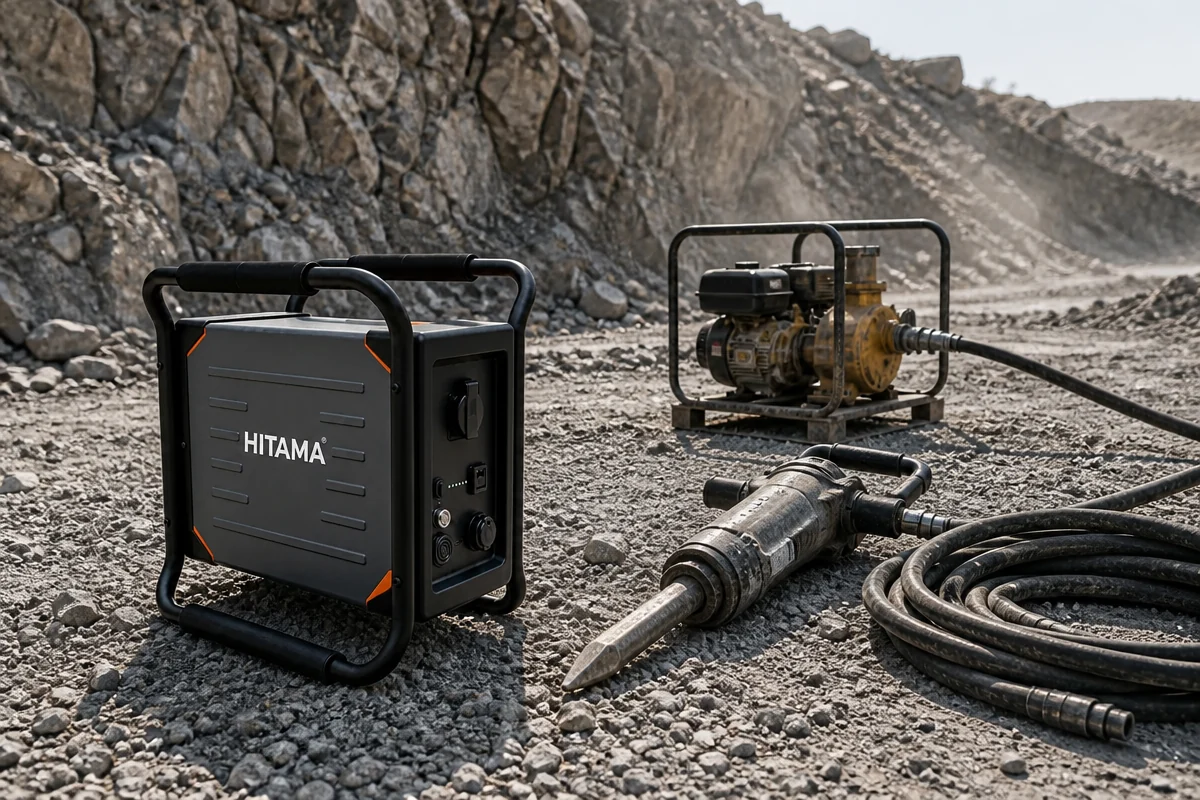
Stored energy first, output second. One P25 carries 2.7 kWh of stored energy and holds 2,500 W of continuous output; it weighs 29 kg, is carried by hand, and needs no start procedure and no fuel. Two units in a 230 V pair (P25-D) reach 5,000 W and 5.4 kWh. Three units with the three-phase distribution box (P25-T) reach 7,500 W and 8.1 kWh at 400 V.
No engine means no intake, no filter and nothing to top up. Fanless self-cooling leaves dust no path into the electronics, which on a quarry bench is the failure that arrives quietly. There is also no exhaust to route and no fuel can to carry up a ramp — relevant wherever the site forbids refuelling near rock dust.
What this is not
It is not the site's supply. A unit on the service truck is not the plant's standby power and does not replace the fixed distribution.
The energy is finite. A repair that grows into a two-shift job outruns one unit; that is an argument for a second unit, or for bringing the machine in after all. Charging draws 500–1,500 W at an ordinary 230 V outlet, so the workshop end of the site keeps a role in the plan.
IP54 is dust and spray. It is not permission to wash the unit down or leave it standing in water, and this is not equipment for explosive atmospheres.
The site's own rules still decide the plan. Hot work permits, isolations and exclusion zones apply to the job whatever powers the tools.
Send us your field repair list with the run time of each tool and where the service truck parks — we will work the configuration out with you.