
On 22 October the German Solar Industry Association published its analysis of the federal market register. The headline: 8.2 gigawatt-hours of new battery storage in the first nine months of 2026, up 91 percent year on year, spread across more than half a million newly commissioned units.
For anyone whose job is getting power onto a site, the more interesting question is a different one: where in this release is the jobsite?
Four line items that add up to 8.2
The release breaks the additions down by segment:
- Utility-scale storage: around 3.8 gigawatt-hours, more than quadrupled year on year (roughly +350 percent). This segment accounted for about half of newly installed capacity.
- Home storage: 3.2 gigawatt-hours, up 20 percent.
- Commercial storage: around 0.7 gigawatt-hours, up 67 percent.
- Very small storage: around 0.5 gigawatt-hours, up 33 percent.
3.8 plus 3.2 plus 0.7 plus 0.5 comes to 8.2. The four items add up cleanly to the total the association reports. That is not a given, and it is the first thing worth checking in a release like this.
What the register counts — and what it does not
The federal market register records installations by type and size class: utility-scale, home, commercial and very small. It does not record whether a unit stands bolted to a cellar floor or rides to site on a trailer.
That leaves a limit we would rather name than paper over: this release cannot tell you how much storage capacity actually works on jobsites. There is no such figure in the source. So we do not supply one either.
Anyone who reads a percentage for "the jobsite share" at this point did not get it from this statistics. We did not calculate it in.
Three signals that can be read
First: the growth sits at the grid, not at the site fence. Half the additions — 3.8 gigawatt-hours — are utility-scale units at substations and grid levels. That capacity matters enormously at the system level and not at all to a site manager at seven in the morning.
Second: commercial storage is the only line item close to everyday operations. 0.7 gigawatt-hours, up 67 percent — against 8.2 gigawatt-hours in total, that is roughly 8.5 percent (our arithmetic, not the association's). This item covers storage at commercial premises, not on construction sites. A commercial building is not an excavation trench.
Third: the policy agenda is about grids, not about site power. The 15 reform proposals published the same day target flexible grid connection agreements, tenders for storage at substations and a reform of redispatch. These are important topics. None of them touches the question of how a drilling rig gets through the day without a grid connection.
Why the jobsite runs a different calculation
A grid-connected storage system answers the question: is there enough capacity when the grid needs it? A unit on site answers a different question: is there enough energy to run these tools, in this place, for this shift?
The second question cannot be answered with an addition figure in gigawatt-hours, because it does not know the load. 2.7 kilowatt-hours is not a statement about a working day. It is the numerator of a division whose denominator only exists on site.
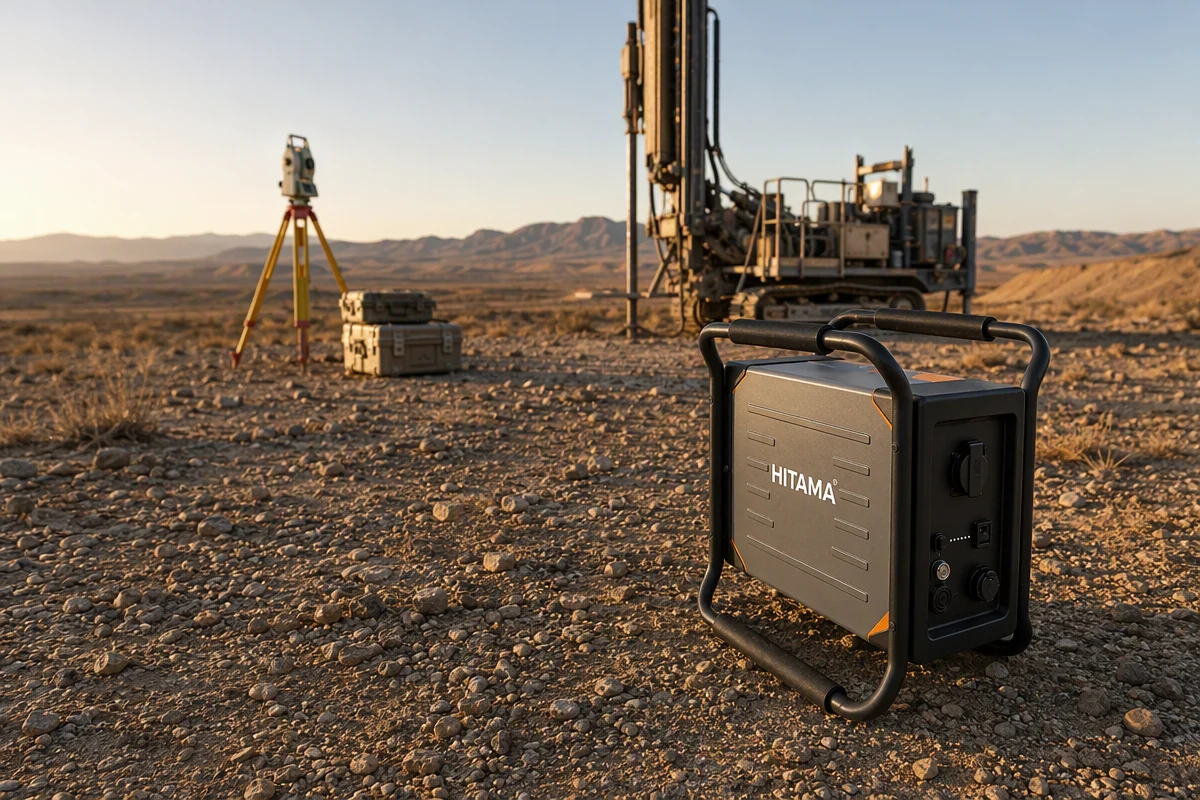
Our two 230-volt units, as registered on hitama.net:
- P25: 2,500 watts continuous, 5,000 watts peak (up to 10 seconds), 2.7 kilowatt-hours, 29 kilograms.
- P25-D: 5,000 watts continuous, 10,000 watts peak, 5.4 kilowatt-hours, around 60 kilograms.
Two of them can be coupled. What we do not say: how long a unit will last on your site. That number comes out of your tool list, not out of our datasheet. And what we also do not say: how much money you save against another solution. That calculation needs your diesel prices, your service intervals and your utilisation — and we will not invent them.
What rental companies and site power planners can take from this
The storage market is growing fast, and that is good news for the industry. But the growth figures describe a market in which your rental unit does not appear. Concluding from them that the jobsite market grew along with it means inferring a demand the statistics never surveyed.
In practice: whether a battery goes to site and the diesel generator stays home is still decided at the trench, not in the market report. It hangs on three things no gigawatt-hour figure contains: the tool list, the shift length, and who recharges the unit in the evening.
Sources and caveats
The figures come from the BSW-Solar analysis of the Bundesnetzagentur market register, published 22 October 2026, data as of 12 October 2026. The association notes that late registrations may still raise the addition figures — so 8.2 gigawatt-hours is a floor, not a ceiling.
The statement that an additional 80 gigawatt-hours of storage capacity could have relieved consumers and the federal budget of almost four billion euros comes from a calculation by the Fraunhofer Institute for Energy Economics and Energy System Technology, cited by the association. It is not our calculation, and it refers to the previous year, not to 2026.
The ratio of 0.7 to 8.2 gigawatt-hours — roughly 8.5 percent — is our own arithmetic; the association does not state it. Product data matches the status published on hitama.net. We state no runtimes and no savings for any use case until we have measured them ourselves.
Original release: BSW-Solar, 22 October 2026
To compare the units, the registered figures are on the product overview; the logic of working without a grid connection is under battery generators.