
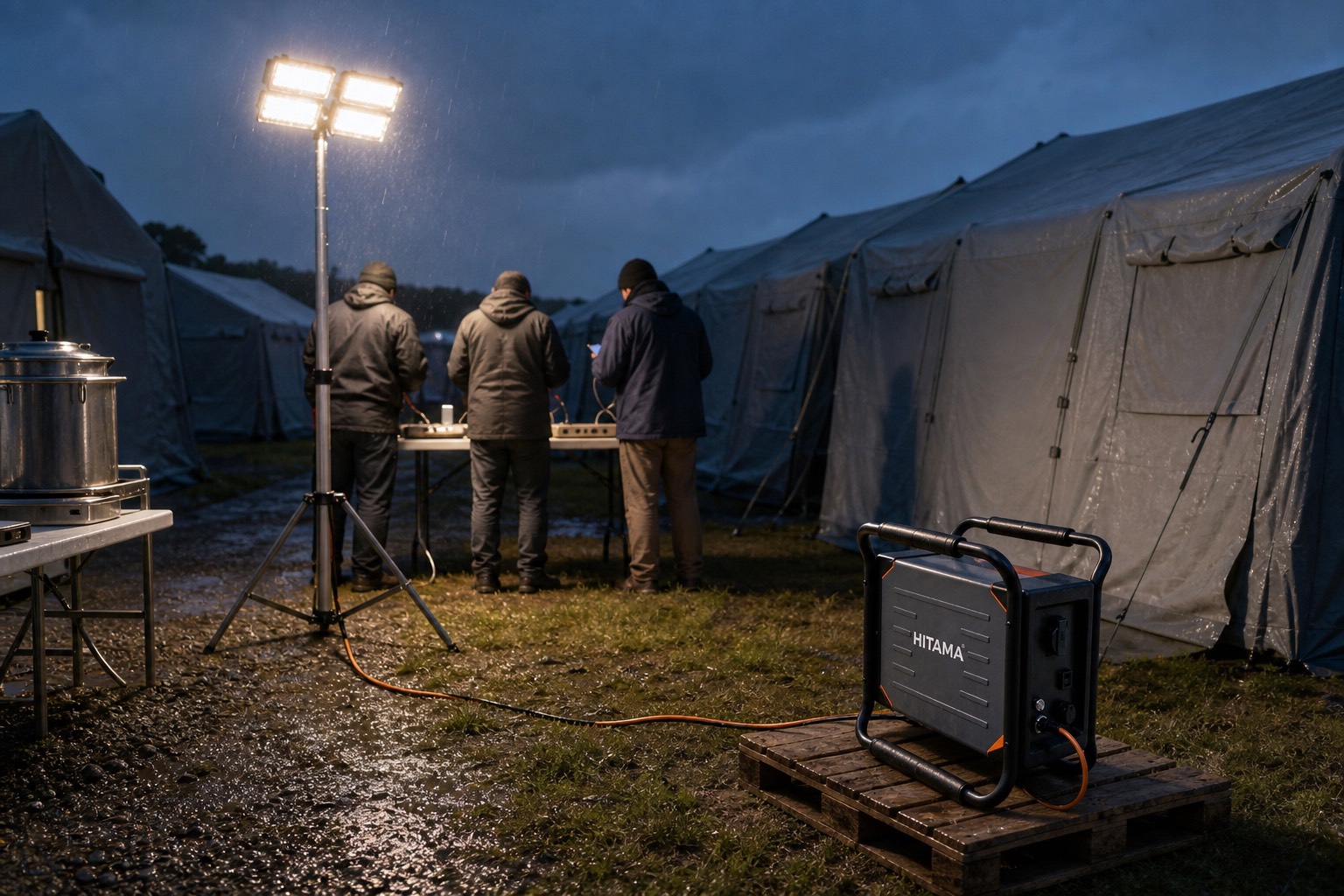
In a relief operation the grid is often the casualty, not the infrastructure. What is left is a list of jobs that all need electricity.
The four loads, in the order they matter
Command and communications. Radios, laptops, a printer. A few hundred watts — the smallest load on site and the one that must never drop.
Lighting. Camp lighting and the floodlights around a distribution point are what turn a field into somewhere people can be safe after dark.
Field kitchen. The heaviest load and the one that runs to a schedule. Kitchen equipment starts with a surge, so this is the load that decides the configuration.
Device charging. Small per person, large in total, and the load people judge you on.
How to size it
One P25 is 2,500 W and 2.7 kWh. Two units (P25-D) reach 5,000 W and 5.4 kWh; three (P25-T) reach 7,500 W and 8.1 kWh at 400 V. Add the continuous loads, keep the sum under the rated output, check the largest motor's starting surge — then compare your run hours against the capacity. Where the kitchen and the camp run on different schedules, split the fleet: the platform is modular so that one unit can serve a shift elsewhere instead of idling.
What it is not
It is not the emergency supply for a hospital. It is a unit that keeps an operation running and recharges from whatever socket is reachable, at 500–1,500 W. IP54 covers dust and water spray, not immersion — worth knowing before the site floods rather than after.
Tell us the site's shift pattern and we will produce a run-hour estimate for your load list.